Solar panels commonly produce less power on the hottest, clearest day of the year than they do on a cool, bright day in spring. That result seems backwards — more sun should mean more electricity — but it is a normal and well-documented behavior of photovoltaic cells, and it is one of the first things to rule out when a homeowner notices summer output falling short of expectations. Below are the questions homeowners ask most often when summer production disappoints, answered in the order they usually come up.
Q: Why would panels produce less in July than in April?
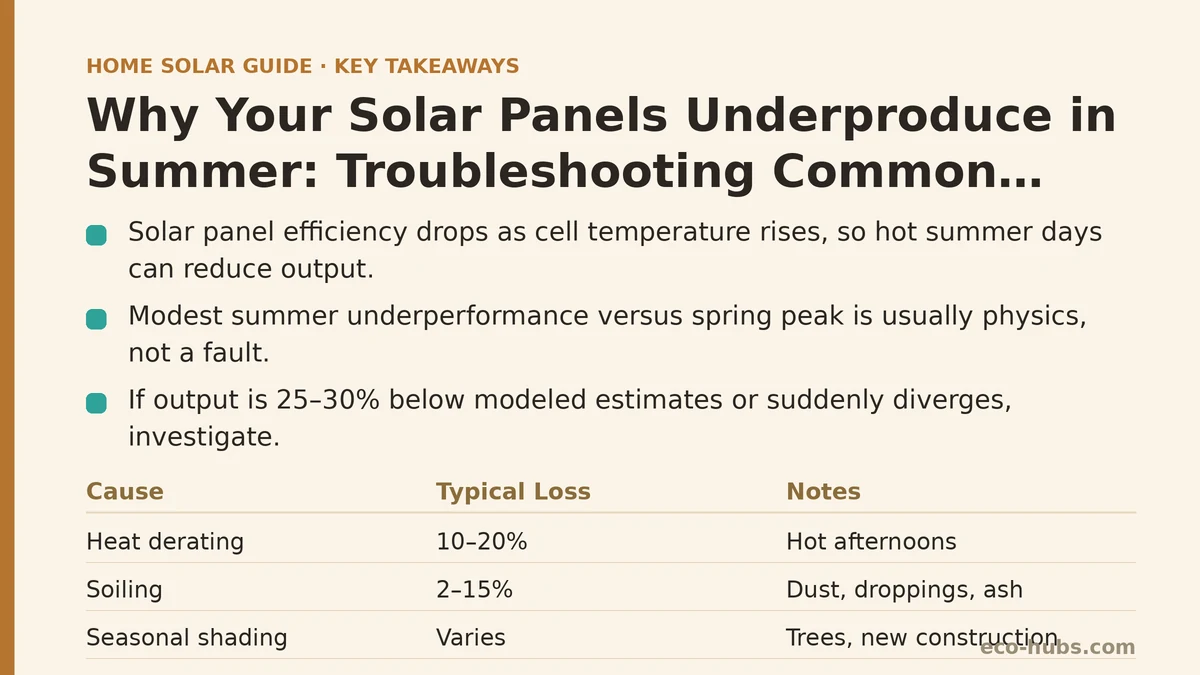
Because panel efficiency drops as cell temperature rises. Manufacturers rate panels at Standard Test Conditions: 25°C (77°F) cell temperature, 1,000 W/m² irradiance, and a specific air mass. Real rooftops rarely sit at 25°C. On a 90°F day with direct sun, panel surfaces can reach 140–160°F, and cell temperatures can climb even higher.
Most crystalline silicon panels carry a temperature coefficient of roughly −0.30% to −0.45% per degree Celsius above 25°C. At a cell temperature of 65°C (about 40°C above the rating point), a panel with a −0.35%/°C coefficient loses roughly 14% of its rated output. That loss can offset much of the gain from longer summer days and a higher sun angle. A cool, breezy May afternoon at 70°F can outperform a still, 95°F July afternoon even though July has more daylight hours.
What this means in practice: modest summer underperformance relative to a spring peak is usually physics, not a fault. It becomes a troubleshooting matter when output falls far below the modeled estimate for your location and system size.
Q: How do I know whether my output is low or just normal for the season?
You need a reference point. Three are worth having:
- Your installer’s production estimate. Most proposals include a monthly or annual kWh projection, often from modeling tools like PVWatts, Aurora, or Helioscope. Ask for the monthly breakdown, not just the annual total.
- Your monitoring app’s own baseline. Most inverter or monitoring platforms display expected vs. actual production and flag underperformance automatically, though the thresholds vary by vendor.
- A public modeling tool. NREL’s PVWatts calculator is free and lets you enter your address, system size, tilt, azimuth, and soiling assumptions to generate an independent monthly estimate.
If your system is producing within roughly 10–15% of the modeled figure for that month, you are likely in normal territory. If you are 25–30% below, or if one month suddenly diverges from prior years with no weather explanation, it is worth investigating.
Q: What are the most common causes of low summer output, in rough order of likelihood?
1. Heat derating. Covered above. Typical loss of 10–20% versus rated output on hot afternoons.
2. Soiling. Dust, pollen, bird droppings, agricultural spray drift, and wildfire ash all block light. Light, uniform dust films might cost 2–5%; heavy soiling or concentrated droppings on a few cells can cost far more because a panel’s output is limited by its weakest cell string. In dry, dusty regions, soiling losses of 5–15% between cleanings are common.
3. Shading that changes with the season. A deciduous tree that was bare in March may fully shade an array by June. New construction, a neighbor’s new tree, or a satellite dish installed after your system can also introduce shading that did not exist at commissioning.
4. Inverter clipping or faults. If your inverter is undersized relative to the array (common by design), it will “clip” peak production on the sunniest days. That is expected and usually baked into the financial model, not a defect. A fault, derating, or overheating inverter, however, is a real problem.
5. String or module-level faults. A failed bypass diode, a loose MC4 connector, a cracked cell, or a failed optimizer can knock out part or all of a string. Symptoms usually include a step-change in output rather than a gradual decline.
6. Monitoring or communication errors. Sometimes production is fine but the data pipeline is not. Check the inverter’s local display or its own app before assuming a hardware fault.
7. A tripped breaker or open DC disconnect. Less common but trivially easy to check.
Q: How do I tell soiling apart from shading or a fault?
The pattern of the loss is the tell.
| Symptom | Likely cause |
|---|---|
| Gradual decline over weeks, uniform across all panels | Soiling |
| Sharp drop on one string or one panel only | Shading, fault, or failed optimizer |
| Drops on every day at the same time of day | Shading (structural or seasonal) |
| Output flatlines at a suspiciously round number | Inverter clipping (often normal) |
| Output falls to near zero mid-day | Breaker, disconnect, or inverter fault |
| Output lower than peers on the same roof | Panel-level issue (soiling, crack, diode) |
If you have module-level monitoring (optimizers or microinverters), the answer is usually obvious: one panel will stand out. If you have string-level monitoring only, comparing strings against each other, and against the same time last year, narrows it down.
Q: Should I clean my panels myself?
Often not, and this is where homeowners get into trouble. Panels are typically cleaned by rain in most climates. Aggressive cleaning can do more harm than the dirt it removes.
Before climbing on the roof, consider:
- Safety. Falls from residential roofs are a leading cause of home injury. If your roof is steep, two stories or higher, or the panels are hard to reach safely, hire a professional.
- Warranty terms. Some panel manufacturers require cleaning with specific methods and prohibit abrasive tools or high-pressure washers. Check your documentation.
- Water quality. Hard water leaves mineral spots that can be worse than the original dust.
- Timing. Clean in early morning or late evening when panels are cool. Spraying cold water on hot glass can cause thermal shock.
If you do clean them yourself: use a soft brush or microfiber pad, plain water or a mild soap, and no pressure washer. Do not walk on the panels. Do not use abrasive pads. If you would not clean a car windshield that way, do not clean a panel that way.
If you have heavy or recurring soiling (agricultural area, wildfire season, heavy pollen), a professional cleaning once or twice a year may pay for itself. Typical residential cleaning costs range from roughly $150 to $500 depending on system size, roof pitch, and region.
Q: My inverter is making noise and the output is down. What is happening?
Modern string inverters often have cooling fans, and in summer they work harder. Some noise is normal. Warning signs include:
- A continuous loud hum or rattle that was not there before
- The inverter shutting down during the hottest part of the day and restarting in the evening
- Error codes in the monitoring app (common ones reference “grid fault,” “DC isolation,” or “over temperature”)
- A burning smell or visible discoloration
Inverter overheating in summer is a known issue, especially when units are mounted in direct sun or in an unventilated garage. Check the manufacturer’s clearance requirements — most specify several inches of space on all sides and shade during peak hours. If the inverter is faulting repeatedly, contact the installer or manufacturer; do not open the unit yourself.
Q: What if one panel or one string is clearly the problem?
Panel-level problems are usually diagnosed by your monitoring platform if you have module-level electronics. If you have string-level monitoring only, the practical next step is to contact your installer with:
- A screenshot or export showing the underperforming segment
- The dates and times the issue appeared
- Any recent changes on the property (new tree, construction, added load, an EV charger installed)
Common culprits at the panel level include failed bypass diodes, cracked cells (often from hail or handling), loose connectors, and — less commonly — a failed optimizer or microinverter. Most of these are warranty items, but only your installer or the manufacturer can confirm coverage. Do not attempt to remove or rewire panels yourself; DC circuits remain live in daylight and can be lethal.
Q: Could my system be undersized or misdesigned rather than broken?
Yes, and this is worth ruling out early. A system that was sized for a smaller household load, or designed around a lower-than-actual shading profile, will consistently underperform against a homeowner’s expectations even if every component works correctly. Similarly, an array mounted at a suboptimal tilt or azimuth produces less than an ideal-orientation system by design.
If your system has always produced below the original projection, and the shortfall is broad rather than localized, design or modeling assumptions are the more likely explanation than a hardware fault. Ask your installer to walk through the original modeling inputs — shading, tilt, azimuth, soiling loss assumption, and inverter clipping — and whether any of them have changed.
Q: Is there anything I can do today to check?
A short diagnostic pass, in order:
- Open your monitoring app. Note today’s and this month’s production. Compare to the same period last year and to the installer’s monthly estimate.
- Compare panels or strings. If one is clearly lower, note it.
- Look at the inverter’s local display. Check for error codes or a shutdown state.
- Check the breaker panel and DC disconnect. Confirm nothing has tripped.
- Walk the array from the ground. Look for new shading (trees, structures), visible soiling, bird nests, or obvious physical damage.
- Note the weather and temperature over the past week. A heat wave alone can explain a two-week dip.
- Write down what you find. Dates, times, screenshots, and observations make any installer conversation far more productive.
What to Do Next
If your system is producing within roughly 10–15% of its modeled output for the month, summer underperformance is most likely heat derating plus normal soiling, and no action is needed beyond routine observation. If you are 25% or more below, or if one part of the array has clearly diverged from the rest, escalate in this order:
- Contact your installer first. They hold the workmanship warranty and typically have the fastest path to a diagnosis. Provide the screenshots and notes from the diagnostic pass above.
- Contact the equipment manufacturer if the installer is unresponsive or no longer in business. Panel, inverter, and optimizer warranties are usually backed by the manufacturer, not the installer, and can outlast the installer’s company.
- Consult a licensed electrician or solar technician for anything that requires inspecting wiring, connectors, or the inverter’s internals. Do not open enclosures yourself.
Keep in mind that the greatest summer output losses are often the least dramatic: heat, dust, and a slightly different sun angle than the model assumed. The dramatic ones — faults, failed components, new shading — are rarer and easier to spot once you know what pattern to look for.
Related guides: Common Solar Panel Problems: A Myth vs. Reality Troubleshooting Guide, Solar Panel Shading Issues and Solutions: A Troubleshooting Guide, and Solar Panel Performance in Extreme Heat: What Homeowners Should Know.
🔗 Recommended Reading
- Solar Incentive Paperwork: Common Filing Mistakes That Delay Your Rebate
- Home Battery Sizing Mistakes That Lead to Blackout Regret
- Common Solar Installer Mistakes Homeowners Should Catch Before Signing
- Common Home Battery Storage Wiring and Placement Mistakes to Avoid
- Solar Payback Period vs Cash-on-Cash Return: Which Metric Should Homeowners Use