Shading and soiling get lumped together constantly, but they’re not the same problem and they don’t call for the same fix. Soiling — dust, pollen, bird droppings — reduces output evenly across a panel’s surface and washes off. Shading is an obstruction blocking direct sunlight from part or all of a panel, and depending on how your system is wired, a small shadow can cause a production loss far larger than the shadow itself would suggest. Knowing which one you’re dealing with is the first diagnostic step, and it changes everything about what you do next.
This guide walks through the most common shading-related symptoms homeowners report, what’s usually causing each one, and what actually addresses it rather than just masking it.
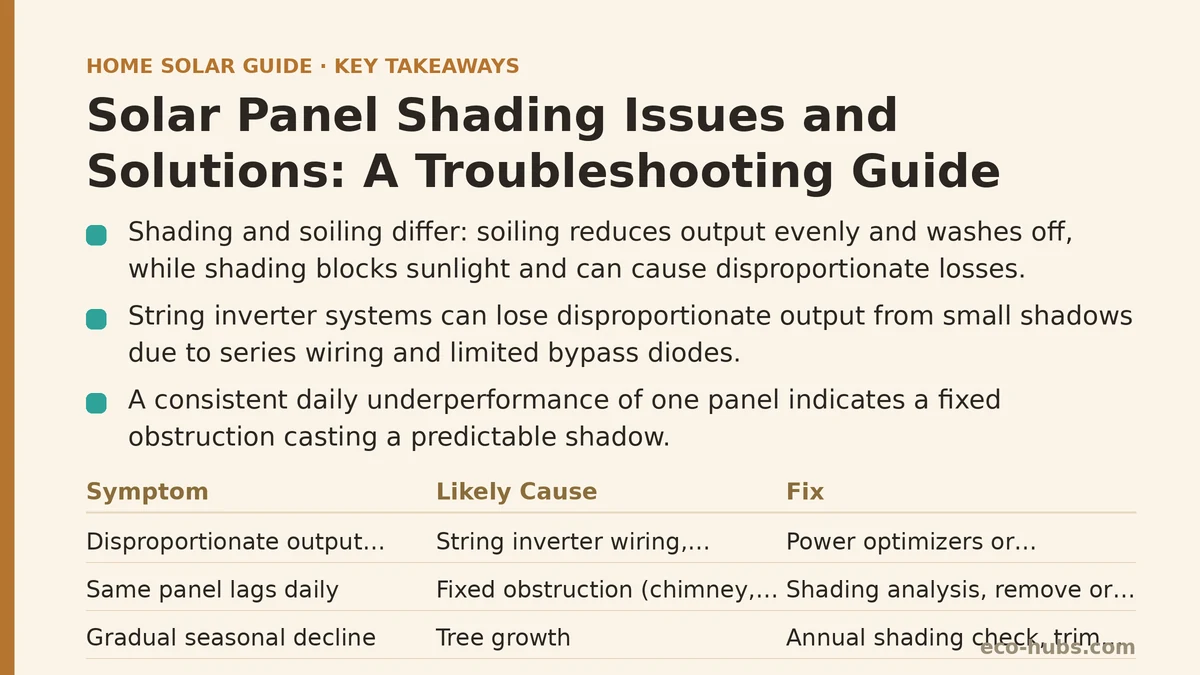
Symptom: Output Drops Far More Than the Shaded Area Would Explain
What you’ll notice: A tree branch or vent pipe covers what looks like a small corner of one panel, but your monitoring dashboard shows a production drop that seems disproportionate to that small obstruction.
Likely cause: Traditional string inverter systems wire panels together in series, and many panels are built with a limited number of bypass diodes covering large sections of cells. When shade hits even a small portion of one panel, it can disable an entire section of cells rather than just the shaded ones — and depending on the string configuration, that effect can ripple into other panels sharing the same string.
Fix: If your system uses a string inverter and shading is a recurring issue, ask an installer about retrofitting power optimizers on the affected panels, or converting to microinverters, which allow each panel to operate independently. This won’t eliminate the underlying shade, but it stops one shaded panel from dragging down the output of panels that have full sun.
Symptom: The Same Panel Underperforms at a Consistent Time Each Day
What you’ll notice: Module-level monitoring (if you have it) shows one specific panel consistently lagging during the same window every day, while the rest of the array performs normally.
Likely cause: A fixed obstruction — a chimney, a satellite dish, a roof vent, a neighboring structure — is casting a predictable shadow that moves across that spot at the same time daily as the sun’s position shifts through the day.
Fix: Start with a shading analysis using tools installers rely on (Solar Pathfinder assessments or satellite-based shading models) to confirm the exact obstruction and its impact window. If the obstruction is removable — an overgrown branch, a rarely used antenna — removing it is the simplest fix. If it’s a permanent fixture, panel relocation or reduced reliance on that specific panel’s output may be more realistic than trying to engineer around it with electronics alone.
Symptom: Production Declines Gradually Over Several Seasons
What you’ll notice: Your system performed close to its original estimate for the first year or two, but output has been trending downward year over year without any change to the equipment itself.
Likely cause: Tree growth is the most common culprit here. Trees that posed no shading risk at installation can grow into the array’s sun path within a few years, especially on lots with mature landscaping near the roofline.
Fix: Build a periodic shading check into your maintenance routine — an annual visual assessment during peak sun hours, ideally paired with your monitoring app’s historical production data, will catch this early. Trimming or removing problem trees before shading becomes severe is far cheaper than losing several years of production waiting to notice the trend.
Symptom: Monitoring Shows Uneven Performance Across the Array
What you’ll notice: Some panels consistently produce noticeably less than others, and the pattern doesn’t seem to correlate with any single obvious obstruction.
Likely cause: Partial shading affecting only a subset of panels, sometimes from multiple minor sources — a low fence, a nearby utility pole, morning shade from an adjacent building — none of which are individually severe enough to notice without panel-level data.
Fix: This is exactly the kind of issue that’s invisible without module-level monitoring, so if your system only reports total array output, upgrading your monitoring setup is worth the cost on its own. Once you can see which specific panels lag, you can target the actual source rather than guessing at the array level.
Symptom: Winter Production Is Disproportionately Weak Compared to Summer
What you’ll notice: Summer output tracks close to your original estimate, but winter months underperform by more than the expected seasonal dip in sun hours.
Likely cause: The sun’s lower winter angle changes which obstructions actually cast shade on your array. A structure that clears your panels easily in summer can throw a long shadow across them in winter, an effect that’s easy to miss if your original shading assessment was only performed during a single season.
Fix: Ask whether your original installation shading report accounted for full-year sun angles, not just the conditions present at the time of the site visit. If it didn’t, request a follow-up assessment covering winter sun paths specifically. In some cases, this reveals that a portion of the array was undersized for realistic winter output from the outset, which is useful to know when setting expectations rather than assuming equipment failure.
Symptom: A New Structure Nearby Has Reduced Your Output
What you’ll notice: A neighbor built a second story, added a large shed, or planted fast-growing trees near the property line, and your production dropped noticeably afterward.
Likely cause: New construction or landscaping on adjacent property changing the shading conditions your system was originally designed around — a factor entirely outside your control and unrelated to any fault in the original installation.
Fix: Document the production change with dated monitoring data before and after the new structure appeared. Depending on your jurisdiction, there may be solar access laws or easement provisions relevant to this situation, though these vary considerably by location and are worth checking with local authorities rather than assuming a blanket right to unobstructed sunlight. In many cases, the more practical path is adjusting expectations or exploring optimizer retrofits for the specifically affected panels.
When It’s Worth Calling in a Professional Shading Assessment
- Production has dropped noticeably and you can’t identify an obvious single cause from ground level.
- Your monitoring only reports whole-array totals, leaving you unable to isolate which panels are affected.
- You’re considering a costly fix (tree removal, panel relocation, optimizer retrofit) and want data confirming it will address the actual problem before spending on it.
- Shading appeared to change after a nearby construction project or years of tree growth, and you want a clear before-and-after comparison.
A proper shading analysis is inexpensive relative to the cost of guessing wrong, and it turns a vague sense that “output seems lower” into a specific, addressable diagnosis.
Have you noticed a shading pattern in your own system’s monitoring data that doesn’t quite match what’s described above? Share what you’re seeing and we can help narrow down which of these causes is the more likely fit.
Related guides: Solar Panel Cleaning: How Often Does It Actually Matter, Solar Panel Monitoring Systems: What the Apps Actually Tell You, and Why Your Solar Panels Underproduce in Summer: Troubleshooting Common Output Problems.
🔗 Recommended Reading
- How to Size a Solar System for Your Home: A Beginner's Step-by-Step Walkthrough
- Solar Panel Monitoring Apps: A Setup Guide for Beginners
- How to Read Your Electricity Bill After Solar: A Line-by-Line Walkthrough
- Solar Incentive Paperwork: Common Filing Mistakes That Delay Your Rebate
- Home Battery Sizing Mistakes That Lead to Blackout Regret