Say you are trying to decide between two quotes for the same roof, and one of them lists “bifacial panels” as an upgrade for a few hundred dollars more per system. The salesperson tells you they generate extra power by catching sunlight reflected off your roof or the ground beneath them. That claim is true in a lab setting and true on certain installations — but it is not universally true, and whether it applies to your specific roof depends on factors most homeowners never think to ask about.
How Bifacial Panels Actually Differ From Standard Panels
A standard monofacial panel has a solar-absorbing front side and an opaque backsheet on the rear, meaning only light hitting the front surface gets converted into electricity. A bifacial panel replaces that opaque backsheet with a transparent or semi-transparent one, allowing the rear cells to capture light that bounces off the ground, a white roof membrane, snow, or nearby reflective surfaces. Manufacturers typically quote a “bifaciality factor” — the rear side’s output as a percentage of the front side’s output — which commonly falls somewhere between 65% and 90% depending on the specific panel model.
That rear-side gain is the entire value proposition. Everything else about the panel — cell chemistry, frame, junction box — is largely similar to a comparable monofacial model from the same manufacturer. So the real question isn’t “does bifacial technology work,” it’s “does my installation give the rear side anything worth capturing.”
Ranking the Factors That Determine Whether Bifacial Is Worth It
Below is a ranked list of the five factors that most directly affect whether the extra cost of bifacial panels pays off, ordered from most to least influential based on how much they typically move the final production numbers.
1. Mounting Height and Ground Clearance
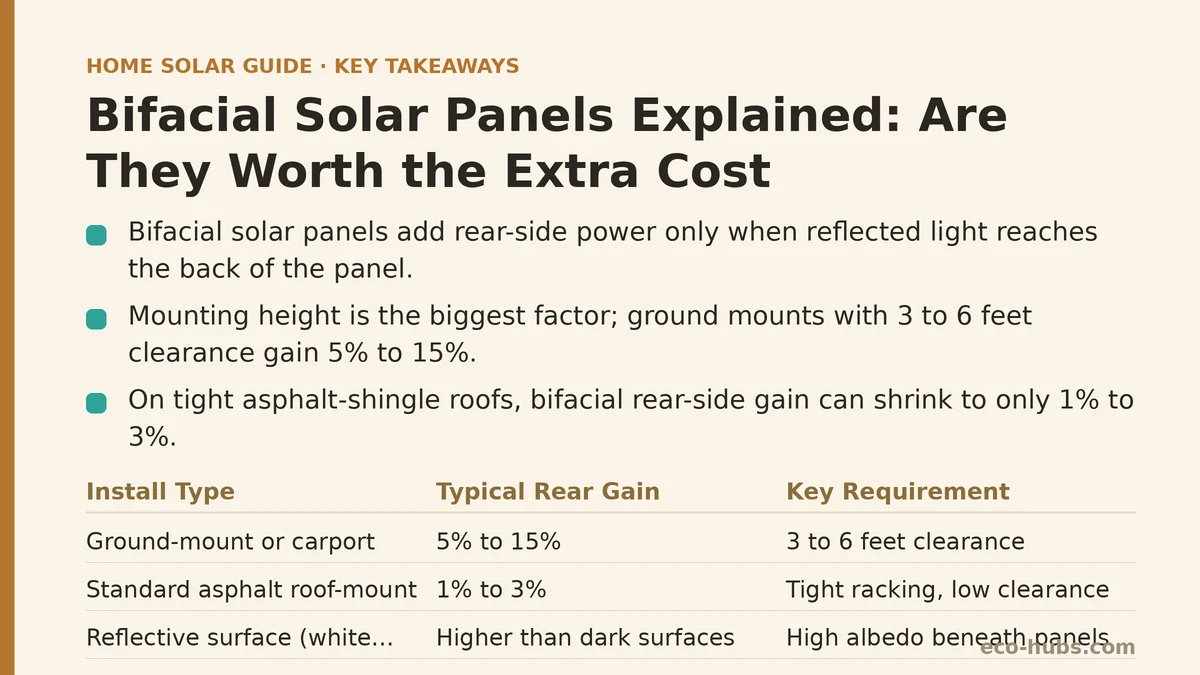
This is consistently the single biggest factor. Rear-side gain requires physical space and an unobstructed path for light to reach the back of the panel. A ground-mount or carport installation with 3 to 6 feet of clearance beneath the panels lets reflected light reach the rear cells with minimal obstruction, and this is where bifacial panels post their strongest measured gains — often in the 5% to 15% range over an equivalent monofacial system.
A standard residential roof-mount installation is a different story. Panels are frequently mounted just a few inches above the roof surface, which leaves almost no gap for light to bounce into. On a typical asphalt-shingle roof with tight racking, the rear-side contribution can shrink to something closer to 1% to 3% — measurable, but nowhere near the marketing figures quoted for ground-mount arrays.
2. Surface Reflectivity (Albedo) Beneath the Panels
Even with adequate clearance, the rear gain depends on what the panels are reflecting off. A white TPO roof membrane, light-colored gravel, or snow cover reflects a meaningful percentage of incoming light back upward, while dark asphalt shingles or bare soil absorb most of it and reflect very little. Installers sometimes address this on ground-mount systems by adding white gravel or reflective ground cover specifically to boost the bifacial gain, which adds a small additional cost but can measurably improve the return on the panels themselves.
For a typical dark-shingled residential roof, this factor works against you twice over: low clearance and low reflectivity combine to limit what the rear side can realistically capture, regardless of the panel’s rated bifaciality factor.
3. Row Spacing and Self-Shading in Multi-Row Arrays
On larger installations with multiple rows of panels, the spacing between rows affects how much light reaches the rear side of panels in shaded or partially shaded rows. Tightly packed rows shadow each other’s rear-facing surfaces, cutting into the bifacial gain during parts of the day. Most residential rooftop systems only have a single row or a small number of rows without this compounding shading issue, so this factor matters far more for larger ground-mount or commercial-style arrays than for the average home installation.
4. Panel Orientation and Tilt Angle
A steeper tilt angle generally increases the amount of ground-reflected light reaching the rear surface, since the panel plane is closer to vertical relative to the ground. Ground-mount systems, which often use adjustable or fixed steep tilts specifically chosen for production optimization, tend to benefit more from this than a roof-mount system constrained to match the roof’s existing pitch. If your roof has a shallow pitch, this is one more factor pulling the realistic bifacial gain toward the lower end of the range.
5. Panel Cost Premium Relative to Monofacial Equivalents
Ranked last not because it doesn’t matter, but because it is the most straightforward to evaluate once the first four factors are understood. Bifacial panels typically carry a premium of roughly 5% to 15% over a comparable monofacial panel from the same manufacturer and product tier. If the first four factors point toward a strong rear-side gain — ground mount, reflective surface, adequate spacing, steep tilt — that premium is recovered through measurably higher production. If those factors point the other way, as they do for most standard roof-mounts, the premium adds cost without a corresponding production increase large enough to offset it within a reasonable payback window, a comparison our payback period guide walks through in more detail for standard systems.
Where the Extra Cost Clearly Pays Off
| Installation Type | Ground Clearance | Surface Below | Realistic Rear-Side Gain | Bifacial Worth It? |
|---|---|---|---|---|
| Ground-mount, white gravel | 3–6 ft | High reflectivity | 8–15% | Yes, in most cases |
| Carport or elevated structure | 4–8 ft | Moderate to high | 6–12% | Yes, usually |
| Tilted rack on flat commercial-style roof | 1–2 ft | White membrane | 3–7% | Often, worth evaluating |
| Standard pitched residential roof-mount | 2–6 in | Dark shingles | 1–3% | Rarely, marginal |
| Roof-mount with reflective coating | 2–6 in | Light-colored | 2–4% | Sometimes, case by case |
A Practical Way to Decide for Your Specific Roof
Rather than accepting a general bifacial recommendation, ask your installer for a side-by-side production estimate for both a monofacial and a bifacial system quoted for your exact roof, mounting height, and orientation — not a generic manufacturer figure. Reputable installers can run this comparison using the same software they use for standard production estimates, and it will account for your roof’s actual pitch, surface color, and shading, which matters more to your final answer than any general bifaciality percentage printed on a spec sheet. If the modeled gain, once converted to dollars over the system’s lifetime, doesn’t clearly exceed the panel price premium, a standard monofacial system is likely the more defensible financial choice for your specific situation.
Are you comparing a bifacial quote against a standard monofacial one right now? Share your mounting setup — roof-mount versus ground-mount, and the approximate clearance — and we can help you think through whether the premium is likely to pay off for your specific installation.
Related guides: Community Solar Programs Explained: 5 Program Types Ranked by How Much They Actually Deliver, Is Solar Battery Storage Actually Worth the Additional Cost, and The Real Cost of Residential Solar Panels in 2026.
🔗 Recommended Reading
- Solar Panel Monitoring Apps: A Setup Guide for Beginners
- How to Read Your Electricity Bill After Solar: A Line-by-Line Walkthrough
- Solar Incentive Paperwork: Common Filing Mistakes That Delay Your Rebate
- Home Battery Sizing Mistakes That Lead to Blackout Regret
- Common Solar Installer Mistakes Homeowners Should Catch Before Signing