Say you are staring at three installer quotes for the same house: one proposes a 6 kW system, another 9 kW, and a third 12 kW with battery storage. The price spread is thousands of dollars, and nothing on the pages tells you which number matches your household. Sizing is the step that decides whether you save money or pay for panels that produce more than you can use — or come up short every winter. Here is how the calculation works, in the order a careful planner would do it.

What Does “Sizing” a Solar System Really Mean?
It means matching three numbers: how much electricity your home consumes, how much a given array can produce at your location, and how much of that production your house can use or export under your utility’s rules. Sizing well means those three numbers line up. Sizing badly means one of them is doing all the work while the others were never checked.
A system that is too small leaves you buying grid power you could have generated. A system that is too large can mean exporting power at a low credit rate, or in some utility territories, getting little or nothing for the surplus. Both errors are avoidable with the same basic arithmetic.
How Do I Figure Out How Much Electricity My Home Uses?
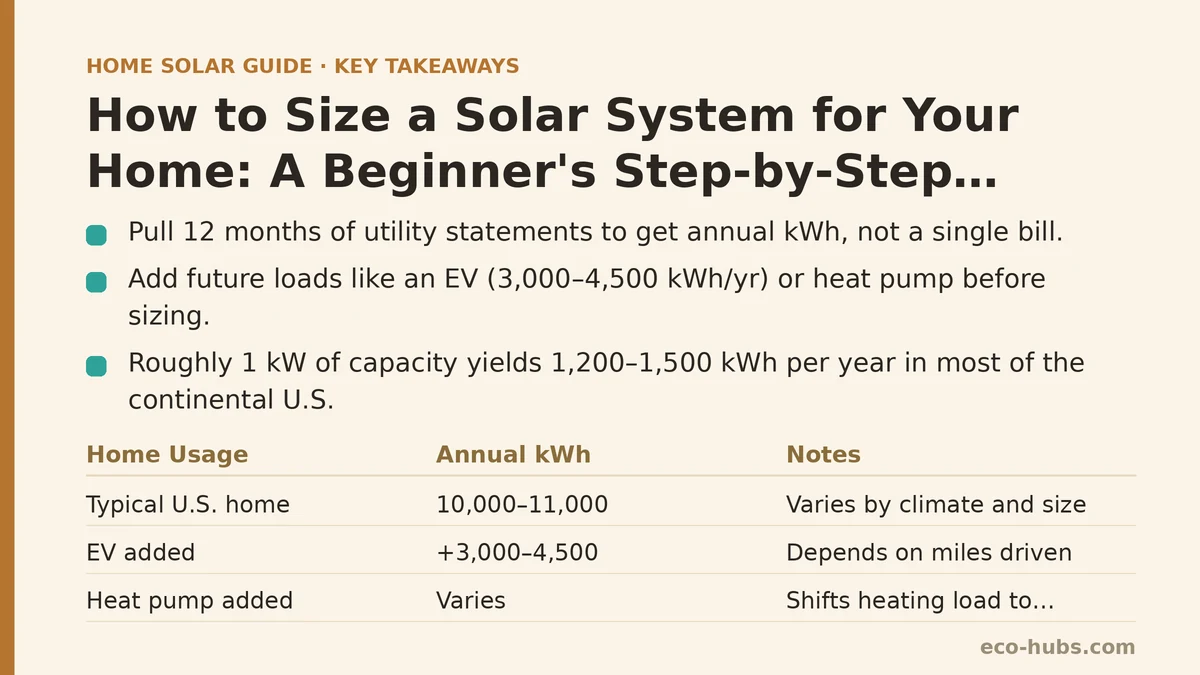
Start with 12 months of usage, not one bill. A single month hides seasonal swings — air conditioning in July, heating in January — and those swings matter more than the annual total for some sizing decisions.
- Pull the last 12 months of statements from your utility account (most utilities offer a downloadable usage history showing monthly kWh).
- Add the monthly figures to get annual consumption in kWh. A typical U.S. home falls somewhere around 10,000–11,000 kWh per year, though this varies widely by climate, home size, and whether you heat or cool with electricity.
- Note the highest and lowest months separately. If your summer usage is double your winter usage, a system sized purely to the annual average may still underperform for your peak season.
- Check whether your utility offers time-of-use rates. If it does, when you use power matters as much as how much — a system that produces heavily at midday pairs differently with an evening-heavy household.
If you are planning an electric vehicle, a heat pump, or a switch from gas appliances, add those future loads now. An EV commonly adds 3,000–4,500 kWh per year depending on miles driven, and a heat pump can shift a meaningful share of heating load onto electricity. Sizing for today’s usage alone is one of the most common regrets homeowners report after installation.
How Much Power Does a Solar Panel Produce Where I Live?
Production depends on location, roof orientation, tilt, and shading. A rough rule of thumb: every 1 kW of installed capacity generates roughly 1,200–1,500 kWh per year in most of the continental U.S., with the higher end in the Southwest and the lower end in the Northeast and Pacific Northwest. Panels themselves are typically rated 350–450 watts each, so a 10 kW system uses roughly 22–28 panels.
You can sanity-check installer estimates against public tools: the National Renewable Energy Laboratory’s PVWatts calculator takes your address, system size, tilt, and azimuth and returns an estimated annual production figure. If an installer’s production estimate is far above what PVWatts returns for the same inputs, ask what assumptions they used — an inflated production number directly inflates the savings and payback figures that follow.
What Roof and Electrical Constraints Limit My System Size?
The roof, not the arithmetic, often sets the ceiling. Before finalizing a size, confirm:
- Usable area. A typical residential panel occupies roughly 17–18 square feet. A south-facing roof plane of 400 square feet can hold roughly 20–24 panels in practice once setbacks and walkways are accounted for.
- Orientation and tilt. South-facing is ideal; east and west orientations typically reduce production by roughly 10–20%, and north-facing roofs are usually poor candidates.
- Shading. Even partial shade on a string inverter system can drag down whole strings. Ask for a shading analysis, and consider microinverters or DC optimizers if shading is unavoidable.
- Structural condition. A roof nearing the end of its life (15+ years old) is worth replacing before panels go up, since removal and reinstallation for a re-roof can cost thousands.
- Electrical service panel capacity. Older 100-amp panels may need an upgrade to support a larger array and interconnection, adding cost that should be factored into the size decision.
How Do Utility Rules Change the Right Size?
This is the question most beginners skip, and it is where an oversized system can quietly stop paying for itself.
Under traditional net metering, exported power is credited at or near the retail rate, so oversizing is relatively forgiving. Under newer structures — net billing, avoided-cost export rates, or time-of-use export compensation — surplus power may be credited at a fraction of what you pay to buy it. In those territories, sizing to your own consumption rather than to your roof’s maximum capacity usually produces better economics.
Ask your utility directly: what rate applies to exported power, and does it vary by time of day? Pair that with your usage profile before you commit to a size.
| Sizing Scenario | Signal You Fit It | Typical Approach |
|---|---|---|
| Usage-matched | Full-retail net metering, no near-term electrification | Size annual production close to annual usage |
| Peak-shaving | Time-of-use rates with high evening prices | Size to daytime load, consider battery for evening |
| Future-load sized | EV or heat pump planned within a few years | Add expected future kWh to annual target |
| Roof-limited | Shading or small usable area | Maximize usable roof, accept partial offset |
| Export-limited | Low export credit rates | Size to self-consumption; avoid large surplus |
What Is the Actual Step-by-Step Calculation?
Work through it in this order, and keep every number written down so you can compare installers on equal footing:
- Annual usage (kWh). Sum 12 months of utility data.
- Add future loads. EV, heat pump, new appliances — estimate and add.
- Target production. Aim for annual production close to that total, adjusted for how your utility credits exports.
- Divide by local yield. Target production ÷ annual kWh per kW at your location = system size in kW. Example: 11,000 kWh ÷ 1,400 kWh/kW ≈ 7.9 kW.
- Convert to panels. System kW ÷ panel wattage. Example: 7,900 W ÷ 400 W ≈ 20 panels.
- Check the roof. Can 20 panels fit with setbacks, shading, and orientation accounted for? If not, you are roof-limited and should plan around the achievable count.
- Confirm the electrical panel can support the array, or budget for an upgrade.
- Ask each installer to show their work for steps 1–4 so you can compare assumptions, not just totals.
What Are the Most Common Sizing Mistakes?
- Sizing to a single bill. One high summer bill or one low spring bill skews the whole calculation. Always use 12 months.
- Trusting an inflated production estimate. Cross-check with PVWatts and ask for the shading and orientation assumptions behind the number.
- Ignoring future electrification. Adding an EV or heat pump after installation often means wishing the array were larger.
- Oversizing under low export credits. Producing more than you can use sounds good until you see what the utility pays for the surplus.
- Undersizing to hit a rebate or budget threshold. Sometimes rational, but make the tradeoff explicit rather than accidental.
- Skipping the roof condition check. Panels over an aging roof can turn a planned savings into a costly re-roof project.
How Do I Recover If I Already Sized Wrong?
If a system is already installed and undersized, the usual fix is an add-on array or battery, subject to inverter capacity and utility approval. If it is oversized and export credits are poor, a battery to shift surplus production into evening use is the common remedy, though the economics depend on your rates. If the array was sized to a faulty production estimate, ask the installer to reconcile the estimate against a full year of actual monitored output — most systems include monitoring that makes this straightforward.
What Should I Do Next?
Today: download 12 months of usage data and write down your annual kWh, peak month, and any planned electric loads. This week: run your address through PVWatts and note the annual kWh per kW for your location. Before signing: ask every installer to walk you through their usage figure, production estimate, and export-credit assumptions, and compare them side by side. That one conversation filters out most sizing errors before they become expensive.
What is your annual kWh figure and your state or utility territory? Share those two details and the sizing logic can be narrowed down considerably. Related guides: How to Compare Solar Installer Quotes for an Apples-to-Apples Decision, Net Metering vs Battery Storage: Which Setup Saves More, and Questions to Ask a Solar Installer Before Signing Anything.
🔗 Recommended Reading
- Solar Panel Monitoring Apps: A Setup Guide for Beginners
- How to Read Your Electricity Bill After Solar: A Line-by-Line Walkthrough
- Solar Incentive Paperwork: Common Filing Mistakes That Delay Your Rebate
- Home Battery Sizing Mistakes That Lead to Blackout Regret
- Common Solar Installer Mistakes Homeowners Should Catch Before Signing