By the end of this post, you will be able to take three or four solar installer quotes that look superficially different — different system sizes, different equipment brands, different financing structures — and reduce them to a single, fair comparison that points to the best value for your specific situation. You’ll know which numbers to normalize first, which assumptions to verify, and which quote differences are worth paying for rather than dismissing.
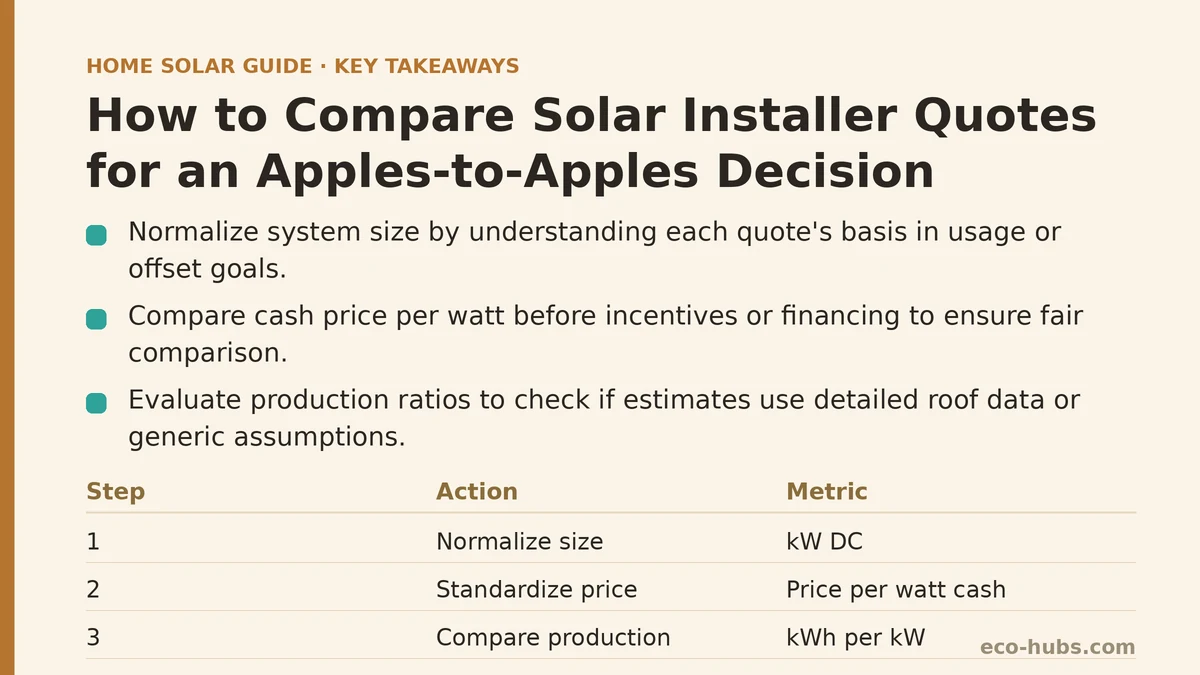
Step 1: Normalize the System Size First
Quotes rarely propose identical system sizes. One installer might bid a 6.8 kW system while another proposes 7.4 kW. Before comparing price per watt or total cost, you need to understand why those sizes differ. A larger system might reflect a different production estimate, a different assumption about your future electricity usage, or simply a salesperson pushing a bigger commission.
Write down each quote’s proposed system size in kilowatts DC. Then ask each installer to explain the basis for that number — specifically, whether it was derived from your past 12 months of electricity usage, a target percentage of offset (for example, 100% or 110% of your annual consumption), or something else entirely. If one installer sized your system at 7.4 kW to cover 110% of usage and another at 6.8 kW to cover 95%, the larger quote is not automatically more expensive — it is serving a different goal. Decide what your goal is before comparing further.
Step 2: Convert Everything to Price Per Watt
The most common unit for comparing solar costs is price per watt, calculated by dividing the total system cost (before incentives and before financing fees) by the system size in watts. A 6.8 kW system quoted at $23,800 gives $3.50 per watt. A 7.4 kW system quoted at $25,900 gives $3.50 per watt as well — identical pricing, even though the total dollar amounts differ by over $2,000.
The trap appears when one quote includes financing costs in the total and another does not. If you are financing, the total cost on the quote may include loan origination fees, dealer fees, or interest buydown costs that are folded into the equipment price. Always ask for the cash price of the system separately from the financed price. Compare cash prices per watt first, then evaluate financing separately. Otherwise you are comparing apples to oranges from the outset.
Step 3: Compare Production Estimates, Not Just System Size
Two identical 7.0 kW systems can produce meaningfully different annual kilowatt-hours depending on panel orientation, tilt angle, shading assumptions, and the software tool used for modeling. Installers typically use tools like Aurora or Helioscope, and the results can vary by 10–15% based on input assumptions alone.
For each quote, request the annual production estimate in kilowatt-hours. Then divide that annual production by the system size in kilowatts to get a production ratio — for example, 11,200 kWh per year divided by 7.0 kW gives 1,600 kWh per kW per year. If one installer’s ratio is 1,450 and another’s is 1,650 for the same roof, the difference is not equipment quality — it is modeling assumptions. Ask the higher producer to explain what shading or orientation data justifies the more optimistic number. Verify that they visited your roof or used a detailed satellite model rather than a generic regional average.
Step 4: Standardize the Equipment List
Quotes will mix equipment brands and tiers. One might pair a Tier 1 panel (like REC or Q CELLS) with a string inverter, while another pairs a budget panel with microinverters. These are not interchangeable, so compare each component category separately: panels, inverter, racking, and monitoring.
Write down the exact make and model for each component in every quote. Then check the manufacturer warranty for each. Panel warranties typically cover 25 years for product and performance, but degradation rates can differ — a panel with a 0.25% annual degradation rate will produce more electricity in year 25 than one at 0.50%. Inverter warranties range from 10 to 25 years. If one quote offers a 12-year inverter warranty and another offers 25 years, that difference has a measurable value, and you can price it roughly as the cost of replacing an inverter once in the gap years (typically $1,500–$3,000 including labor).
If two quotes are within $0.10–$0.20 per watt of each other after normalization, the equipment quality and warranty differences can easily tip the balance. Do not let a slightly lower price per watt automatically win if the equipment is a tier below.
Step 5: Separate the Installer’s Workmanship Warranty
The installer’s workmanship warranty is separate from any manufacturer warranty, and it is the one component that varies most widely between quotes. Some installers offer 10 years, others offer 25 years. Some warrant against workmanship defects only; others also cover roof penetration leaks for the full term.
For each quote, write down the exact workmanship warranty length and what it explicitly covers. Ask whether it transfers to a new homeowner if you sell within the warranty period. A transferable 25-year workmanship warranty from a company with a decade of local operating history is worth more than a non-transferable 10-year warranty from a newer firm, even if the equipment is identical. This is not a minor add-on — a roof leak caused by a poor mounting job can cost more than the entire system to remediate, so the warranty length directly affects your long-term financial exposure.
Step 6: Evaluate Financing Terms in Isolation
Financing is where quotes diverge most dramatically in total cost, and where homeowners frequently make the biggest comparison mistake. A quote that looks more expensive on price per watt might have a significantly lower interest rate, and a cheaper quote might carry a dealer fee that inflates the principal by 20–30%.
For each financed quote, ask for three numbers: the annual percentage rate, the dealer fee percentage (if any), and the total financed principal. Then calculate the total cost of the loan including interest over its full term, not just the monthly payment. A 6.99% APR loan over 25 years costs far more in total interest than a 4.99% APR loan, even if the latter has a higher monthly payment. Use a simple loan calculator to project each quote’s total cost over the loan term, then compare those totals against each other and against the cash price.
Also check for prepayment penalties or early payoff restrictions. As covered in our guide on the federal tax credit, many homeowners plan to use their tax credit to pay down the loan — if your loan restricts prepayment or charges a penalty, that planning changes.
Step 7: Build a Side-by-Side Comparison Table
Once you have gathered all the data, create a table with one column per installer and the following rows:
| Metric | Installer A | Installer B | Installer C |
|---|---|---|---|
| System size (kW DC) | |||
| Cash price ($) | |||
| Price per watt ($/W) | |||
| Annual production (kWh/yr) | |||
| Production ratio (kWh/kW/yr) | |||
| Panel model & warranty | |||
| Inverter model & warranty | |||
| Racking / mounting | |||
| Workmanship warranty (years, transferable?) | |||
| Dealer fee (if financed) | |||
| APR (if financed) | |||
| Total loan cost over term |
Fill in every cell before making any judgment. The act of writing each number down next to the others reveals inconsistencies that are easy to miss when reading quotes one at a time. If one row remains blank because an installer could not or would not provide that number, that is a signal about their transparency — and about how confident they are in their own quote.
Step 8: Weight the Differences That Matter for You
After normalizing, most competing quotes land within $0.30–$0.50 per watt of each other. That range is normal. The question is how to weight the remaining differences.
If you plan to live in the home for 10 years or less, a slightly lower price per watt with a shorter workmanship warranty might be the rational choice. If you plan to stay for 20+ years, the production ratio and warranty length deserve more weight than the initial price. If you value equipment longevity, inverter warranty length may justify paying $0.10–$0.15 per watt more. There is no universal correct answer — the right weighting depends on your horizon and your tolerance for future repair costs.
One practical approach: assign a rough dollar value to each non-price difference. A 10-year inverter warranty extension is worth roughly $1,500–$3,000 in avoided replacement cost. A transferable workmanship warranty adds some resale value to your home. Higher production per kW is worth the avoided electricity cost at your current utility rate, multiplied by the years you plan to stay. Add these adjustments to each quote’s price and compare the adjusted totals.
What This Method Will Not Do
This framework will not tell you which installer will show up on time, communicate well, or handle a permitting delay gracefully. Those factors matter enormously but cannot be quantified from a quote. Verify those through references, online reviews from verified customers, and direct conversations about their process. Use this comparison method for the numbers, and use your own judgment for the people.
The One Number That Deserves Your Full Attention
After all the normalization, the single number that separates strong from weak quotes most consistently is the production ratio combined with the system price — specifically, the cost per annual kilowatt-hour produced. Divide the cash price by the annual production estimate to get a figure like $2.10 per kWh-per-year, which captures both system efficiency and pricing in one metric. Compare that number across quotes before financing terms and warranty differences, and you will have separated the quality of the proposal from the noise of financing structures.
Which part of your quote comparison is currently the most unclear — the production estimates, the financing terms, or the warranty differences? Let me know which numbers you have on your quotes right now and I can help you work through the normalization for your specific set of installers.
Related guides: Common Solar Installer Mistakes Homeowners Should Catch Before Signing, Comparing Solar Quotes: What the Numbers Mean, and Questions to Ask a Solar Installer Before Signing Anything.
🔗 Recommended Reading
- Solar Incentive Paperwork: Common Filing Mistakes That Delay Your Rebate
- Home Battery Sizing Mistakes That Lead to Blackout Regret
- Common Solar Installer Mistakes Homeowners Should Catch Before Signing
- Common Home Battery Storage Wiring and Placement Mistakes to Avoid
- Solar Payback Period vs Cash-on-Cash Return: Which Metric Should Homeowners Use