Say you are signing a home battery quote and the sales sheet says “whole-home backup.” You picture a multi-day outage where the lights stay on, the fridge hums, and the Wi-Fi never drops. Then the first real blackout arrives, the battery empties by dinner, and the refrigerator is the only thing still running. That gap between the promise on the quote and the experience in the outage almost always traces back to sizing — and specifically to a handful of predictable mistakes that are easy to avoid if you understand them before you sign.
What Does “Sizing” a Home Battery Mean, Exactly?
Sizing is two separate calculations that get confused constantly:
- Capacity (kWh): how much total energy the battery stores, equivalent to the size of a fuel tank.
- Power (kW): how much electricity it can deliver at one instant, equivalent to the width of the pipe draining that tank.
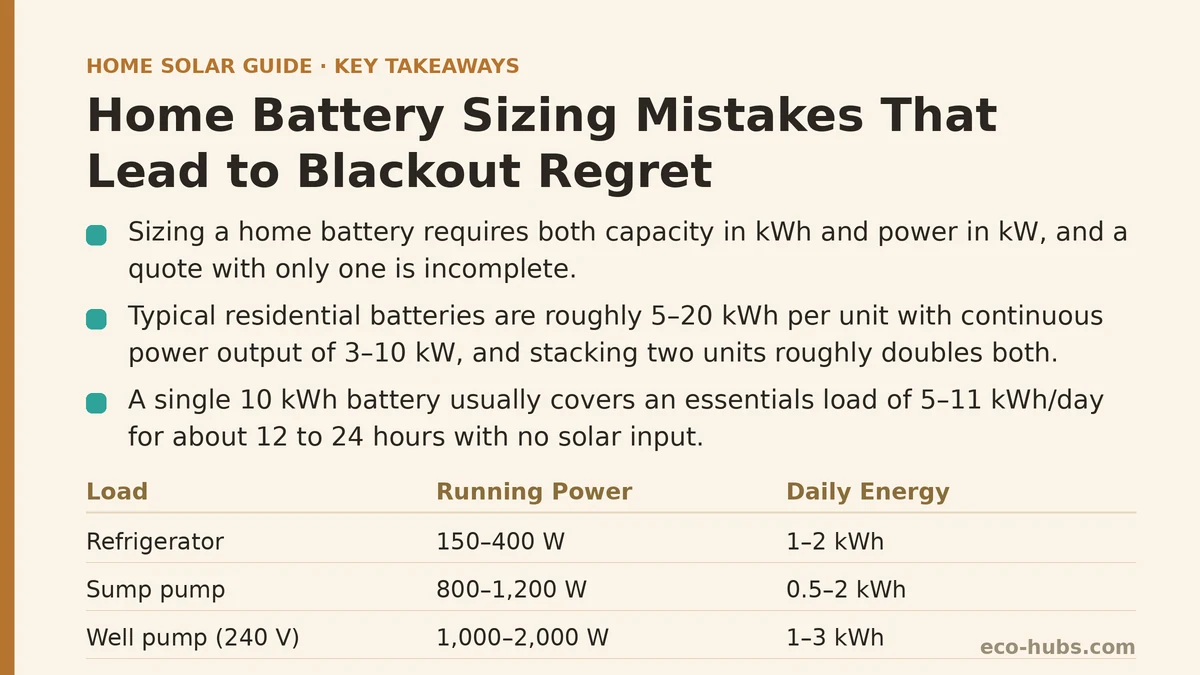
A battery can have plenty of kilowatt-hours but too few kilowatts to start a well pump or an air conditioner. The reverse is also true — a unit with strong power output can still drain in an hour if its stored energy is small. A quote that lists only one of these numbers is incomplete, and that alone is a reason to slow down.
Typical residential batteries range from roughly 5 kWh to 20 kWh per unit, with continuous power output usually between 3 kW and 10 kW. Stacking two units roughly doubles both figures, which is why many reputable installers quote pairs rather than singles for homes with meaningful backup goals.
Which Loads Do Homeowners Forget to Count?
The single most common sizing error is counting appliances on the basis of how they feel rather than what they draw. A refrigerator feels important; a sump pump feels optional — until a storm fills the basement. Here is a realistic starting point for common backup loads:
| Load | Typical Running Power | Estimated Daily Energy (with normal cycling) | Notes |
|---|---|---|---|
| Refrigerator | 150–400 W | 1–2 kWh | Compressor cycles, not continuous |
| Sump pump | 800–1,200 W | 0.5–2 kWh | Surge on startup can be 3–4× running watts |
| Well pump (240 V) | 1,000–2,000 W | 1–3 kWh | High startup surge, often needs 4–6 kW |
| Gas furnace blower | 300–800 W | 2–4 kWh | Winter outages are the hardest case |
| Wi-Fi/router + modem | 15–30 W | 0.4–0.7 kWh | Easy to include, rarely the problem |
| LED lighting (10 fixtures) | 100–150 W | 1–2 kWh | Highly variable with usage |
| Sump + fridge + furnace + lights | — | 5–11 kWh/day | This is a typical “essentials” backup load |
A single 10 kWh battery will usually cover this essentials list for roughly 12 to 24 hours with no solar input, depending on season and how disciplined the household is about not adding loads. Add an air conditioner (2–4 kW running, higher on startup) and the same battery may last three to five hours.
How Do Homeowners Undersize Without Realizing It?
Four patterns account for most blackout regret:
Counting appliances instead of kilowatt-hours. A homeowner lists “we need the fridge, internet, and a few lights” and concludes 5 kWh is plenty. That list may be correct, but adding a coffee maker (1,500 W), a microwave (1,000 W), and a hair dryer (1,500 W) during a morning outage can push real usage far past the plan.
Ignoring startup surge. Motors draw a brief spike on startup that can be three to four times their running wattage. A 1 kW well pump may need 3–4 kW of instantaneous power, and some batteries will simply shut down rather than supply it. The battery may have adequate kWh but insufficient kW.
Assuming the battery must back up the whole panel. Many systems are installed with a critical-loads subpanel that powers selected circuits only. If the sales conversation used the phrase “whole-home backup” but the wiring diagram shows a subpanel, that difference is worth confirming before signing.
Forgetting that solar may not recharge during the outage. A battery paired with solar can usually recharge daily. A battery alone cannot. During a multi-day winter storm with snow on the panels or heavy cloud, a solar-plus-battery system behaves much like a battery-only system — and its realistic runtime is measured in the same hours.
What About Winter, Heat, and Real-World Degradation?
Battery capacity does not stay at nameplate numbers.
- Temperature: lithium batteries commonly lose 10–30% of usable capacity in cold conditions, and many systems include thermal management that consumes some energy itself.
- Depth of discharge: most manufacturers reserve a buffer and only allow 80–90% of nominal capacity to be used, so a “10 kWh” battery often delivers closer to 8–9 kWh.
- Age: a typical warranty guarantees around 60–70% of original capacity by year 10. Toward the end of that window, planning load expectations should assume the lower figure, not the original one.
Stacking these factors, a 10 kWh nameplate battery in a cold-climate winter outage may realistically deliver 6–7 kWh of usable energy. That is one long evening for a furnace-driven household, not three days.
Should You Size for a Weekend or a Week?
A useful decision branch:
- If your grid outages are typically measured in hours (urban, well-maintained infrastructure), sizing for 8–12 hours of essentials is often enough. A single 10 kWh battery frequently suffices.
- If outages reach one to three days (suburban or rural with storm exposure), plan for 2–3 kWh of essential load per household member per day, plus heating or cooling, and expect to lean on solar recharge.
- If outages routinely exceed three days (remote areas, wildfire zones with public safety power shutoffs), battery alone is rarely economical. Pair with a generator or plan a load-shedding routine.
- If someone in the home depends on powered medical equipment, size with a 50% safety margin and confirm the loads behind the backup subpanel include the specific outlets that equipment uses.
What Should You Ask Before Signing?
Bring a short list to the installer conversation and get the answers in writing on the quote:
- What is the total usable capacity in kWh after manufacturer reserve?
- What is the continuous and peak power output in kW?
- Which specific circuits will be on the backup subpanel? Can I see the list?
- What is the estimated runtime for my specific load list in winter and in summer?
- How does the system behave if the outage lasts longer than expected and solar cannot recharge?
- What capacity does the warranty guarantee at year 10?
If the installer cannot answer the third and fourth questions specifically, that is a signal the sizing has not been done for this house.
What Can You Do Today?
Before you commit to a battery size:
- List your essential loads and tally the daily kWh using the table above as a starting point.
- Identify any motor loads — pumps, well, AC, furnace — and find their startup surge ratings on the nameplate.
- Decide how many outage days you are planning for, honestly, based on your grid’s track record.
- Ask for the backup subpanel circuit list in writing and compare it to your essential loads.
- Confirm usable capacity after winter derating and manufacturer reserve, then add a margin.
Sizing correctly the first time costs far less than retrofitting a second battery after one regretful blackout. If a quote feels vague on any of the points above, the right move is to ask again — not to sign and hope. Related guides: Is Solar Battery Storage Worth the Additional Cost, Net Metering vs Battery Storage: Which Setup Saves More, and Questions to Ask a Solar Installer Before Signing Anything.
🔗 Recommended Reading
- Common Solar Installer Mistakes Homeowners Should Catch Before Signing
- Common Home Battery Storage Wiring and Placement Mistakes to Avoid
- Solar Payback Period vs Cash-on-Cash Return: Which Metric Should Homeowners Use
- Net Metering Credit Rollover Rules: What Happens at Year End
- Mistakes Homeowners Make When Sizing a Home Battery Bank