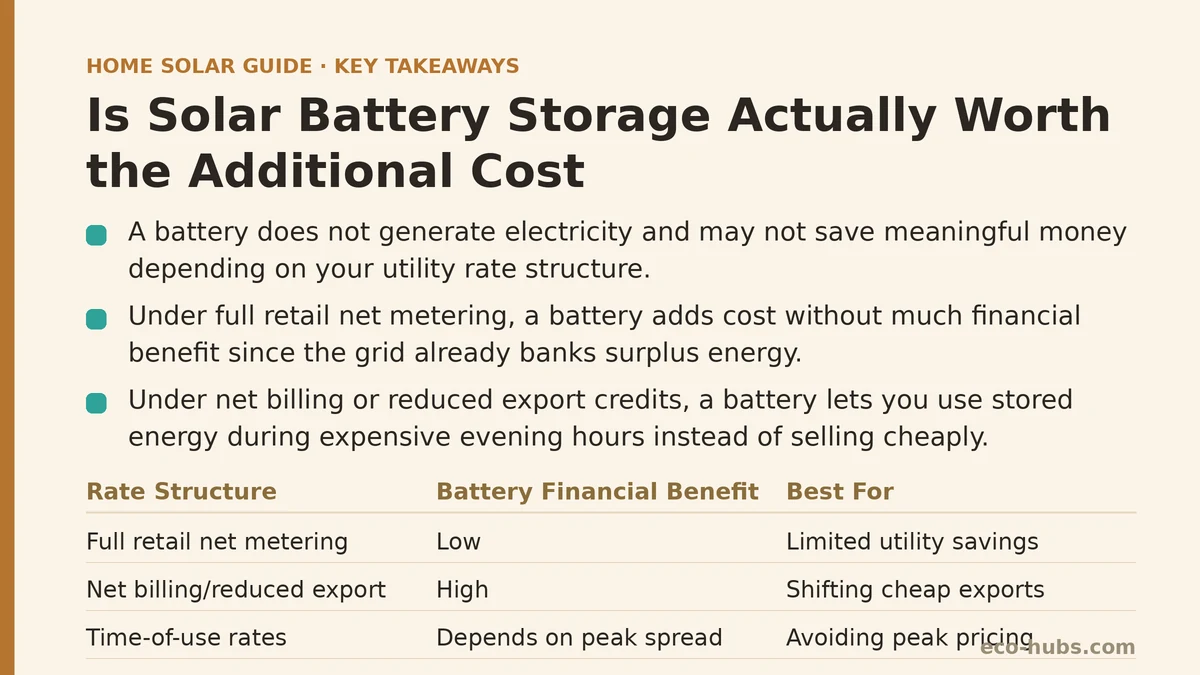
Many homeowners assume that adding a battery to a solar system is simply the next logical upgrade — the same panels, just with extra storage bolted on for good measure. That framing misses something important: a battery does not generate any electricity on its own, and depending on your utility’s rate structure, it may not save you meaningful money at all. Whether it’s worth the added expense depends less on the technology itself and more on how your specific utility bills you, how often your grid goes down, and what you’re actually trying to solve for. The following steps walk through how to work that out for your own situation rather than relying on a generic answer.
Step 1: Identify Whether Net Metering Already Solves Your Problem
Before pricing out a battery, check what kind of net metering agreement your utility offers. Under a full retail net metering arrangement, excess solar production sent back to the grid is credited at the same rate you’d pay to draw power later, which functions as a form of free storage. In that scenario, a battery adds cost without adding much financial benefit, since the grid is already doing the job of banking your surplus energy.
Where this changes is under net billing or reduced export-credit policies, increasingly common as utilities revise their solar programs. If your exported electricity is credited at a wholesale rate far below the retail rate you pay to import power, a battery lets you use your own stored energy during expensive evening hours instead of selling it cheaply and buying it back at a markup. This single distinction — full retail net metering versus reduced export credits — is often the biggest single factor in whether storage pencils out.
Step 2: Check Whether You’re on a Time-of-Use Rate Plan
Utilities on time-of-use billing charge different rates depending on when electricity is consumed, typically with a premium during early evening peak hours. Solar panels alone produce most of their output during midday, which doesn’t line up well with when rates are highest. A battery charged during the day and discharged during that peak window can shift your consumption away from the most expensive hours on your bill.
The size of this benefit depends on how large the gap is between peak and off-peak rates in your specific plan. A modest spread of a few cents per kilowatt-hour may not justify the added equipment cost, while a spread of 20 to 30 cents or more can shorten the payback period considerably. Pulling your utility’s actual rate schedule, rather than estimating, is a necessary step here — this is not a number worth guessing at.
Step 3: Assess Your Real Exposure to Grid Outages
Financial payback is only part of the equation for many households; backup power during outages is often the primary motivation. Pull your local utility’s outage frequency data if it’s published, or at minimum review your own history of outages over the past several years. Someone in a region with frequent storm-related outages has a very different risk profile than someone in an area where the grid rarely goes down.
It also matters what you intend to keep running during an outage. A battery sized to keep a refrigerator, some lighting, and a few outlets running is a much smaller and cheaper system than one intended to run an entire home, including air conditioning or well pumps, for an extended period. Defining this upfront prevents both underbuying a system that can’t cover your real needs and overbuying capacity you’ll rarely use.
Step 4: Run the Actual Cost Comparison
With rate structure and outage risk established, the next step is comparing the added battery cost against the savings it’s realistically expected to produce. Battery systems commonly add several thousand dollars to a solar installation depending on capacity and brand, and as discussed in our tax credit guide, batteries can qualify for the same federal tax credit as the solar system itself when installed alongside it, which meaningfully changes the net cost.
Divide the net battery cost, after any applicable credit, by your estimated annual savings from time-of-use arbitrage or avoided export at low buyback rates. This produces a rough payback period specific to storage alone, separate from the payback period of the solar panels themselves. A battery payback period stretching well beyond its expected lifespan — commonly 10 to 15 years depending on chemistry and warranty — is a signal that the financial case is weak even if the backup-power case remains strong.
Step 5: Factor In Battery Degradation and Warranty Terms
Batteries lose usable capacity over time, similar to how a phone battery holds less charge after a few years of daily cycling. Most manufacturers warranty a specific percentage of original capacity, often around 70 percent, over a set number of years or cycles, whichever comes first. Reviewing this warranty is worth doing with the same care described in our installer questions guide, since the effective lifespan of your investment is shaped as much by this fine print as by the sticker price.
Frequent daily cycling for time-of-use arbitrage will typically wear a battery down faster than occasional use limited to backup power during outages. If your primary goal is arbitrage, factor a shorter effective lifespan into your payback calculation than if the battery is mostly sitting idle, ready for an occasional outage.
Step 6: Decide Whether Partial Backup Meets Your Needs
Not every circuit in a home needs to stay powered during an outage. Many installers offer a partial backup configuration, wiring only a designated subset of circuits — refrigerator, some lighting, a few outlets — to the battery rather than the entire electrical panel. This reduces the battery capacity required, which lowers cost substantially compared with a whole-home backup setup.
For households mainly concerned with keeping essentials running through a multi-hour outage rather than an extended multi-day event, a partial backup system paired with a smaller, less expensive battery may deliver most of the practical benefit at a fraction of the cost of a system sized for full-home resilience.
Comparison at a Glance
| Factor | Battery Likely Worth It | Battery Likely Not Worth It |
|---|---|---|
| Net metering type | Net billing / low export credit | Full retail net metering |
| Rate structure | Significant time-of-use peak/off-peak gap | Flat rate, minimal time-of-use difference |
| Outage frequency | Frequent or extended outages | Rare, brief outages |
| Backup goals | Specific critical circuits identified | No clear backup priority |
| Payback period | Well within warranty/lifespan window | Extends beyond expected battery lifespan |
Step 7: Make the Decision Based on Your Own Priorities, Not a Blanket Rule
There isn’t a universal answer here, and that’s the point worth taking away from this walkthrough. A household on a full retail net metering plan with a reliable grid may find a battery adds cost without meaningful return. A household facing steep time-of-use rate gaps, frequent outages, or both may find the same battery pays for itself well within its warrantied lifespan. The difference comes down to the specific numbers pulled in Steps 1 through 5, not a general opinion about whether storage is a good idea in the abstract.
Where do you land on outage frequency and your utility’s rate structure — and is backup power or bill savings the bigger priority for you? Share those details and we can help work through whether a battery makes sense for your specific setup. Related guides: How Real Estate Appraisers Value Homes with Solar and Battery Storage, Net Metering vs Battery Storage: Which Setup Actually Saves More, and Solar and Battery Storage for Financial Advisors: What Clients Should Know.
🔗 Recommended Reading
- Solar Panel Monitoring Apps: A Setup Guide for Beginners
- How to Read Your Electricity Bill After Solar: A Line-by-Line Walkthrough
- Solar Incentive Paperwork: Common Filing Mistakes That Delay Your Rebate
- Home Battery Sizing Mistakes That Lead to Blackout Regret
- Common Solar Installer Mistakes Homeowners Should Catch Before Signing