Say you are trying to figure out what your options are for a set of panels that are twenty-two years into a twenty-five-year warranty, still producing power but noticeably less than they used to, and you’re wondering whether to wait out the remaining warranty period or replace them now and deal with the old ones somehow. That question — what actually happens to a solar panel once it stops being useful — turns out to have a more complicated answer than most homeowners expect, and the answer matters both for planning your own system’s later years and for understanding the environmental math behind solar power in the first place.
This guide works through the most common end-of-life scenarios in a symptom-cause-fix format: what you’re likely to notice, why it’s happening, and what your realistic options are.
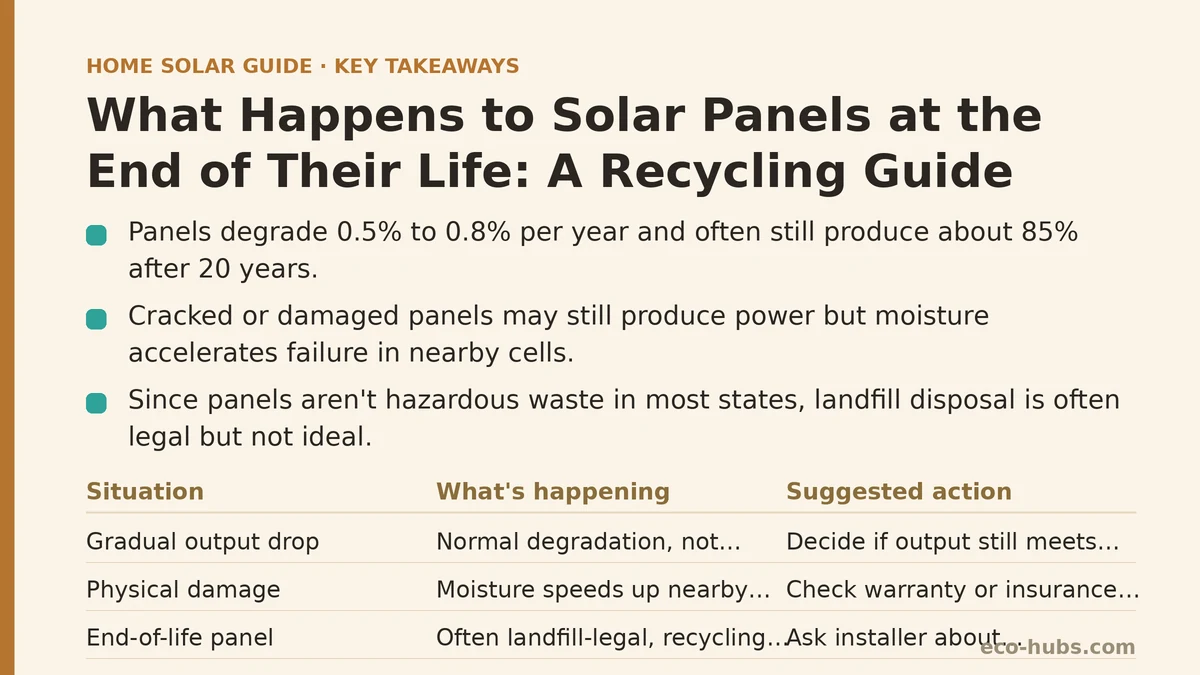
Symptom: Panel Output Has Dropped Noticeably, But the Panel Isn’t Broken
What’s going on: Every panel degrades over time, typically losing somewhere between 0.5% and 0.8% of its original output capacity per year. After twenty years, a panel manufactured with a 25-year performance warranty is often still producing 85% or so of its original rated output — reduced, but far from useless. This is gradual degradation, not failure, and it’s a normal part of a panel’s lifecycle rather than a defect.
The fix: A panel in this state doesn’t need to be recycled yet. It needs a decision about whether reduced output still meets your household’s needs or whether the marginal gain from replacement is worth the cost. Many homeowners keep degraded panels running well past the point where a fresh installation would outperform them, simply because the existing system is paid off and still contributing meaningfully to the electric bill. Recycling only becomes relevant once output drops so far, or damage occurs, that the panel is no longer worth keeping in service.
Symptom: A Panel Was Cracked or Physically Damaged (Hail, Falling Branch, Installation Accident)
What’s going on: Physical damage is a different problem from gradual degradation, and it usually shortens a panel’s useful life abruptly rather than gradually. A cracked cell can still produce some power, but moisture intrusion through the crack tends to accelerate failure of the surrounding cells over the following months.
The fix: Check whether the damage is covered under a manufacturer warranty or, if applicable, a homeowner’s insurance policy for storm damage — this is worth doing before assuming the panel is a total loss. If it isn’t covered and replacement is the only path forward, the damaged panel becomes an end-of-life unit immediately rather than after decades of service, which is exactly the kind of unit that solar recycling programs are built to handle. Contact your installer first, since many have existing relationships with take-back or recycling programs and can arrange removal as part of a replacement job rather than leaving you to find a disposal path on your own.
Symptom: You Assumed Old Panels Just Go to the Landfill
What’s going on: This assumption is common, and it isn’t entirely baseless — a meaningful share of decommissioned panels in the U.S. historically have ended up in landfills, partly because dedicated solar recycling infrastructure is still relatively young and unevenly distributed geographically. Panels aren’t classified as hazardous waste in most states, which means landfill disposal is often legal even where it isn’t the best environmental option.
The fix: Legal isn’t the same as necessary. Before assuming landfill disposal is your only option, check whether your state has specific e-waste or photovoltaic disposal regulations — a small number of states, including Washington, have passed laws requiring manufacturers to fund or provide takeback and recycling programs. Even without a state mandate, some panel manufacturers offer voluntary takeback programs, and it costs nothing to ask your original installer or the manufacturer directly whether one applies to your specific panels before defaulting to a landfill.
Symptom: You Can’t Find a Recycler Near You
**What’s going on: **Dedicated photovoltaic recycling facilities remain thin on the ground compared to general electronics recyclers, and a facility that specifically handles solar panels — separating glass, aluminum framing, silicon cells, and wiring into distinct material streams — may not exist within a convenient distance of your home.
The fix: Start with your installer or the panel manufacturer, since many have arrangements with regional recyclers that aren’t easily discoverable through a general search. If neither has a direct answer, general electronics or e-waste recyclers in your area sometimes accept panels even without specialized photovoltaic processing, though the material recovery in that case is usually less complete than a dedicated solar recycling line would achieve. Solar industry associations in some states also maintain directories of certified recyclers, which is worth checking before assuming no local option exists.
Symptom: You Were Told Recycling Costs Money and Are Wondering Whether It’s Worth It
What’s going on: Unlike scrap metal or aluminum cans, a solar panel’s recycling economics don’t currently favor the person disposing of it. Separating glass, silicon, silver, and framing materials is labor-intensive relative to the value of the recovered materials, so recycling a panel typically costs the owner a disposal fee rather than paying out — figures in the range of $20 to $30 per panel are commonly cited, though this varies by region and recycler.
The fix: Budgeting a modest disposal cost into a replacement project is more realistic than expecting recycling to be free or profitable. If cost is a genuine concern, ask your installer whether panel removal and recycling can be bundled into the price of a new installation — this is common practice and often works out cheaper per panel than arranging disposal separately after the fact. It’s also worth comparing that bundled cost against a landfill disposal fee, since the price gap is sometimes smaller than expected once removal labor is factored into either option.
Symptom: You Want to Know If the Panels Have Any Value Left Before Scrapping Them
What’s going on: A panel that no longer meets your household’s output needs may still be perfectly functional at a lower level of production, which means outright recycling isn’t always the only end-of-life path.
The fix: Look into secondary markets before defaulting to recycling. Panels removed for an upgrade are sometimes resold for off-grid cabins, agricultural buildings, or other lower-demand applications where reduced output is an acceptable tradeoff for a substantially lower price. Some installers and salvage buyers specifically seek out used panels for this purpose. This isn’t an option for panels with cracked cells or significant physical damage, but for panels retired simply because a household wants a higher-output replacement, resale can extend useful life by years before recycling becomes the only remaining option.
Symptom: You’re Worried About the Environmental Cost of Manufacturing New Panels to Replace Old Ones
What’s going on: It’s a fair concern — panel manufacturing does carry an environmental footprint, and replacing a system that still works, purely for a modest efficiency gain, doesn’t automatically make sense on a net environmental basis.
The fix: Run the comparison rather than assuming either direction. If your current panels are still producing at 80% or better of original output and meeting your needs, there’s rarely an environmental or financial case for early replacement. If output has dropped substantially, or damage has made the system unreliable, replacement paired with proper recycling of the old panels is generally the better outcome than keeping a badly underperforming system running indefinitely. The relevant question isn’t panel age alone — it’s current output against current need.
Quick Reference: Symptom, Cause, and Fix
| Symptom | Likely Cause | Recommended Fix |
|---|---|---|
| Gradual output decline | Normal annual degradation | Evaluate need vs. output; no action required yet |
| Cracked or physically damaged panel | Storm, impact, or installation error | Check warranty/insurance; treat as end-of-life if uncovered |
| Assumed landfill is the only option | Limited hazardous-waste classification | Check state law and manufacturer takeback programs first |
| No local recycler found | Thin recycling infrastructure | Ask installer/manufacturer; check e-waste recyclers as backup |
| Recycling costs money | Low material recovery value | Bundle removal/recycling into replacement project cost |
| Wondering about resale | Panel still functional, just lower output | Explore secondary markets before recycling |
| Considering early replacement | Concern over manufacturing footprint | Compare current output to actual need before deciding |
Where This Leaves You
None of these scenarios point to a single universal answer, because “end of life” for a solar panel isn’t one fixed moment — it’s a range of possible outcomes depending on whether the panel is degraded, damaged, or simply outdated relative to newer options. The one constant across all of them is that landfill disposal, while often legal, is rarely the only or the best choice once you’ve checked what your installer, manufacturer, and state actually offer.
Where does your situation fall on this list — gradual degradation, physical damage, or an upcoming replacement decision? Describe what you’re seeing with your system and we can help narrow down which of these paths applies to you. Related guides: Solar Panel Installation Process Step by Step: What Actually Happens, Solar Panels and Homeowners Insurance: What You Need to Know, and Solar Panels for New Construction Homes: What Builders Don’t Tell You.
🔗 Recommended Reading
- How to Read Your Electricity Bill After Solar: A Line-by-Line Walkthrough
- Solar Incentive Paperwork: Common Filing Mistakes That Delay Your Rebate
- Home Battery Sizing Mistakes That Lead to Blackout Regret
- Common Solar Installer Mistakes Homeowners Should Catch Before Signing
- Common Home Battery Storage Wiring and Placement Mistakes to Avoid