The common assumption is that adding a heat pump to a home with solar panels is like adding a second battery — a simple, always-beneficial pairing that doubles your savings. That assumption misses the critical detail: a heat pump changes your electricity load profile in ways that can either maximize or undermine your solar investment, depending on your rate structure, your climate, and how your system was originally sized. The pairing can be excellent, but it is not automatic.
What Does a Heat Pump Change About Your Electricity Use?
A heat pump does not just add a new appliance. It changes when you use electricity and how much you use in each season. A typical electric resistance furnace or baseboard heater draws power in short, intense bursts. A heat pump runs longer, at lower wattage, and — critically — its efficiency varies with outdoor temperature.
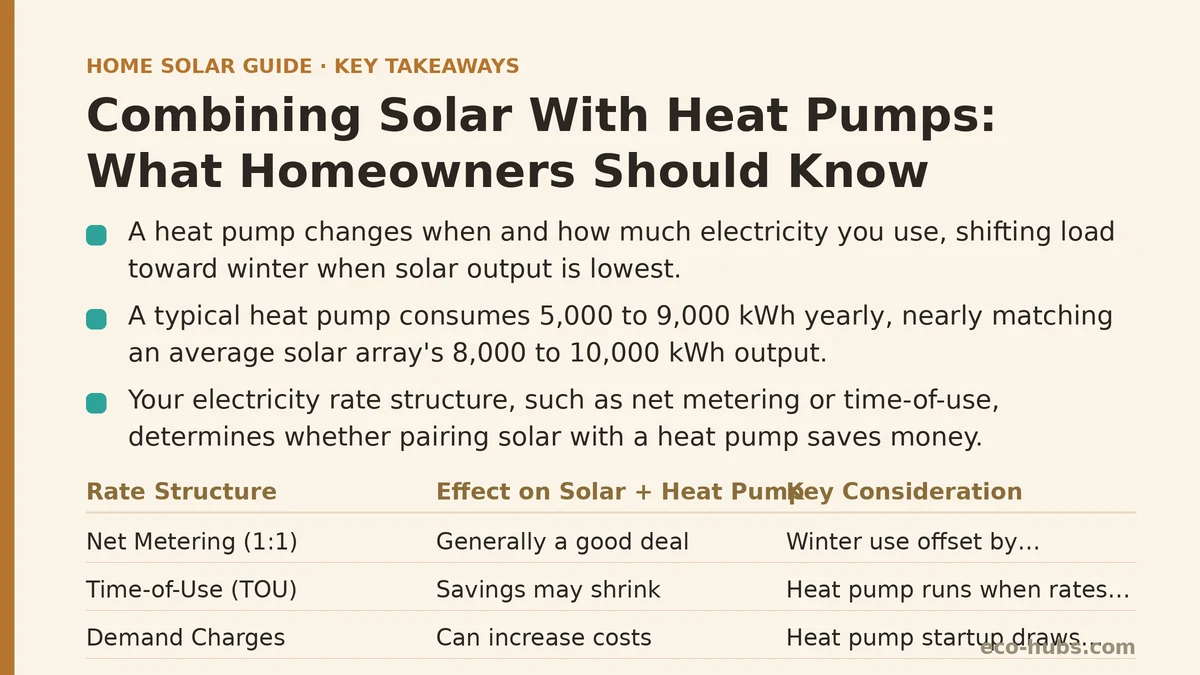
For a home with solar, the key shift is toward winter-heavy electricity use. In most climates, heating demand peaks in the coldest months, when your solar array produces the least. If your panels were sized to cover your summer cooling loads or baseline year-round use, adding a heat pump will likely push your winter consumption well beyond what your array generates.
Concrete numbers help here. A typical cold-climate heat pump in heating mode consumes anywhere from 2.5 to 5 kW while running, depending on outdoor temperature and unit size. In a home heating season running 2,000 to 3,000 hours, that translates to roughly 5,000 to 9,000 kWh of additional annual electricity. An average solar array in the U.S. produces about 8,000 to 10,000 kWh per year. The mismatch is clear: the heat pump alone may consume nearly as much as the entire existing solar production — or more.
Question 1: Was Your Solar Array Sized for Future Electrification?
Most homeowners who went solar in the last five years sized their array against their existing bill, not their future loads. If you added a heat pump afterward, your array may cover 50 to 70 percent of your new total usage, leaving the rest to the grid at retail rates.
The fix is not necessarily more panels. Before expanding, ask your installer to run a load analysis that includes the heat pump’s specific model performance curve, not just a generic estimate. Also verify your roof has the physical capacity and your inverter has the headroom — many inverters max out near their nameplate rating, so adding panels may require a second inverter or a larger one.
Question 2: What Is Your Electricity Rate Structure?
This question decides whether solar plus heat pump is a financial win or a wash.
Net metering (1:1): Under full retail net metering, your exported solar kilowatt-hours are credited at the same rate you pay for imports. Here, a heat pump is generally a good deal — you offset its winter use with summer surplus credits, and your overall bill drops compared to burning gas or oil.
Time-of-use (TOU) rates: TOU changes the math substantially. Many utilities charge higher rates in the late afternoon and early evening — exactly when heat pumps are least efficient and most likely to run. If your solar exports happen during low-rate periods and your heat pump imports during high-rate periods, your effective savings shrink even though you produce the same total kilowatt-hours.
Demand charges: A growing number of utilities bill residential customers for their peak 15- or 30-minute draw. A heat pump starting in cold weather can draw 3 to 5 kW at once. Pair that with your other appliances, and your peak demand may jump by 40 to 60 percent, raising your bill even if total usage stays flat.
If your utility has TOU or demand charges, ask directly: what are the on-peak hours, and what is the spread between peak and off-peak rates? In some markets, the spread exceeds 20 cents per kWh, which can add several hundred dollars per year to your heat pump’s operating cost.
Question 3: How Cold Does It Get Where You Live?
Heat pumps lose efficiency as outdoor temperatures drop. Modern cold-climate models maintain useful output down to about 5°F to -13°F, but their coefficient of performance (COP) — the ratio of heat delivered to electricity consumed — falls from around 3.5 at 47°F to roughly 1.8 to 2.2 at 5°F.
This matters for solar because at low temperatures, both the heat pump’s demand and the solar array’s production move in opposite directions. On a clear, sunny day in January at 15°F, your array might produce 20 to 30 percent of its summer peak, while your heat pump needs 50 to 80 percent more electricity than it would at 45°F. That gap is where the grid, and your bill, enters the picture.
For homes in climate zones 5 and colder (roughly, areas with more than 5,000 heating degree days), the practical implication is that solar alone rarely covers winter heat pump use. You will need either a larger array, a storage battery to shift midday solar production to evening heat pump use, or a plan to accept partial grid reliance during the coldest weeks.
Question 4: Should You Pair a Battery with the Heat Pump?
A battery changes the calculus in specific scenarios:
- TOU rate shifting: If your utility charges 2 to 3 times more during evening peaks, a battery lets you capture midday solar production and run the heat pump at night without buying grid power at the high rate.
- Demand charge avoidance: A battery can shave the heat pump’s startup spike, keeping your peak demand below a utility threshold. This can save more per month than the battery’s own cost in some rate structures.
- Backup power: A heat pump needs electricity to run. Without backup, a grid outage in January leaves you without heat. A battery plus a properly sized inverter can power a heat pump for several hours, though not indefinitely.
But a battery is not automatically worth it. If you have 1:1 net metering and no demand charges, a battery’s primary value is resilience, not economics. The payback period often exceeds 10 years, compared to 5 to 7 years for additional solar panels alone.
Question 5: What About the Tax Credits and Rebates?
Both technologies qualify for federal incentives, and they stack.
The residential clean energy credit (solar) offers 30 percent of system costs with no dollar cap. The energy efficiency home improvement credit (heat pumps) offers up to $2,000 for a qualifying unit, generally payable in the same tax year. Many states and utilities add their own rebates — some exceed $1,000 for a cold-climate heat pump, and some utilities offer performance-based incentives for pairing heat pumps with solar or batteries.
A practical point: these credits reduce your tax liability, not your out-of-pocket cost immediately. If your total tax bill for the year is less than the combined credits, you may not fully benefit in a single year — solar credits carry forward, but the heat pump credit is capped annually.
Check also whether your utility distinguishes between a heat pump installed as a direct replacement for an electric resistance system versus one replacing a gas furnace. The air-source heat pump tax credit eligibility depends on efficiency ratings (HSPF2 and SEER2), and your installer should provide the certification sheet before purchase.
Question 6: What Size Heat Pump and Solar Array Do You Need?
Right-sizing is where most pairing mistakes happen.
Heat pump sizing: The common error is oversizing. A unit too large short-cycles, which reduces efficiency and increases wear. A correctly sized unit should run nearly continuously at design temperature, reaching about 80 to 90 percent runtime on the coldest day. Your installer should perform a Manual J load calculation — not just estimate by square footage.
Solar sizing: Once the heat pump is sized, recompute your annual load. A rule of thumb: add 1.0 to 1.5 kW of solar capacity per 10,000 BTU/h of heat pump capacity for homes in moderate climates, and 1.5 to 2.0 kW per 10,000 BTU/h in cold climates. These figures account for both the seasonal mismatch and the efficiency drop in winter.
| Climate Zone | Heat Pump Size (BTU/h) | Recommended Solar Addition (kW) |
|---|---|---|
| Moderate (Zone 4) | 24,000 | 2.4 – 3.6 |
| Cold (Zone 5–6) | 24,000 | 3.6 – 4.8 |
| Severe Cold (Zone 7+) | 30,000 | 4.5 – 6.0 |
These are planning numbers, not guarantees. Your actual values depend on your home’s insulation, window area, and local solar resource.
Question 7: How Do You Handle the Winter Deficit?
Your system will not be zero-net in every month. A typical home with solar and a heat pump in a cold climate imports 60 to 80 percent of its winter heating electricity from the grid, even with a well-sized array. The question is whether your annual surplus from other months compensates.
Three practical strategies:
- Annual net metering (if available): Your summer surplus credits carry forward to cover winter imports. Some utilities cap this at a dollar amount or require true-up monthly, which kills the benefit.
- Battery shifting: Store midday solar and discharge in the evening. This works best where the gap between export and import rates is large.
- Partial heating: In the coldest weeks, use a backup gas furnace or wood stove for the top few degrees, letting the heat pump handle the base load. This can cut winter electricity demand by 30 to 50 percent.
What to Do Next
Before you sign anything, run this three-step check:
- Pull your last 12 months of electric bills. Divide your total annual kWh by 12 to get your monthly average. Then add the heat pump’s estimated annual kWh (ask for the specific model’s performance data, not a generic number).
- Look up your utility’s rate structure. Identify whether you are on net metering, TOU, or demand charges. Calculate your expected winter monthly import and its cost at your actual rates.
- Consult two installers — one for solar, one for heat pumps — with your numbers in hand. Ask both to model the pairing together, not separately. A solar installer who only looks at your existing usage will undersize; a heat pump installer who ignores your solar will oversize the electrical service.
The pairing works best when both systems are designed as one integrated whole. If your heat pump is already installed, the next step is a solar expansion analysis based on the heat pump’s real winter performance, not a guess.
What is your current setup — do you already have solar, a heat pump, or both? Share your system sizes and your utility’s rate structure, and I can help you estimate whether the pairing is working in your favor or where the gap is likely to be.
Related guides: Solar Panel Performance in Extreme Heat: What Homeowners Should Know, Solar Panels and Homeowners Insurance: What You Need to Know, and Solar and Battery Storage for Financial Advisors: What Clients Should Know.
🔗 Recommended Reading
- How to Read Your Electricity Bill After Solar: A Line-by-Line Walkthrough
- Solar Incentive Paperwork: Common Filing Mistakes That Delay Your Rebate
- Home Battery Sizing Mistakes That Lead to Blackout Regret
- Common Solar Installer Mistakes Homeowners Should Catch Before Signing
- Common Home Battery Storage Wiring and Placement Mistakes to Avoid