Say you are sitting across from a client who mentions they are thinking about putting solar on the roof and adding a battery, and they want to know whether it changes anything about their retirement projections, their tax picture, or their overall cash flow plan. You are not expected to design the system or quote the equipment, but you are expected to know which parts of this decision touch their finances and which parts are best handed off to a licensed installer. What follows is a ranked list of the things that most often come up in these conversations, ordered from the items that have the largest financial footprint down to the ones that matter mainly for logistics.
1. Total Installed Cost and the Realistic Range
This is where almost every conversation starts, and it is also where clients are most likely to have unrealistic numbers in their heads from advertising.
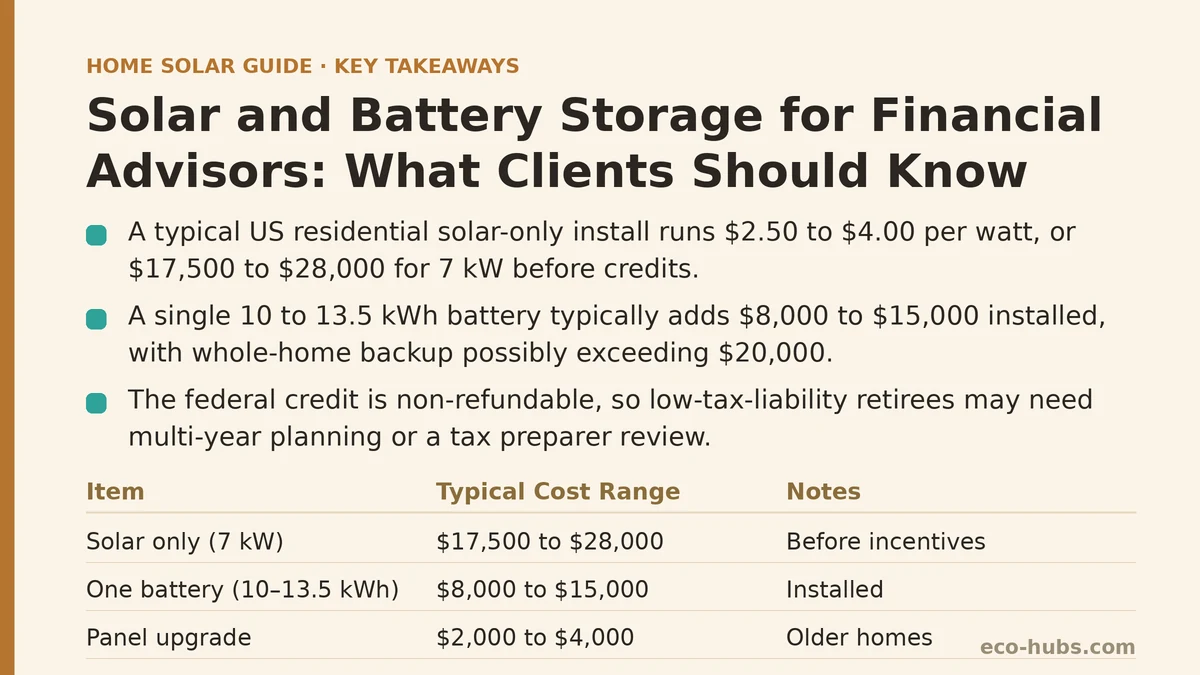
A typical residential solar-only installation in the United States has fallen into roughly the $2.50 to $4.00 per watt range before incentives in recent years, depending on region, roof complexity, and equipment tier. For a 7 kilowatt system, that works out to somewhere between about $17,500 and $28,000 before any tax credit. Adding battery storage pushes the number up substantially: a single 10 to 13.5 kilowatt-hour battery commonly adds $8,000 to $15,000 installed, and clients who want whole-home backup may need two batteries or a larger unit, which can push storage costs past $20,000 on their own.
What to flag for the client: Ask them to bring you the itemized quote, not just the bottom-line number. Equipment, labor, permitting, and any main panel upgrade are usually separate line items, and a panel upgrade alone can add $2,000 to $4,000 in older homes. If the client is comparing two quotes and one is dramatically lower, the difference is often in what is excluded rather than in how efficient the company is.
2. The Federal Tax Credit and Its Timing Problem
The residential clean energy credit has covered a percentage of qualified solar and battery costs for several years, with battery storage qualifying whether or not it is paired with solar. The percentage, the expiration timeline, and the rules around who can claim it are all subject to legislative change, so always confirm the current rules with the client’s tax preparer rather than relying on a figure you remember from a prior year.
The financial planning issue is less about the percentage and more about timing. The credit is non-refundable, meaning the client needs sufficient tax liability in the year the system is placed in service to use it. A retiree living primarily on Roth withdrawals or Social Security may have very little liability, in which case the credit can be carried forward in some circumstances but may take years to fully absorb. This is frequently the single largest surprise in the whole transaction.
If the client has low tax liability, then a useful branch is to model the credit over a multi-year horizon rather than assuming a one-year benefit, or to explore whether a partial-system installation spread across two tax years makes sense. Both approaches need a tax professional’s sign-off.
3. Battery Storage: What It Does and Does Not Do Financially
Batteries get marketed heavily, and the financial case is more nuanced than the marketing suggests.
A battery can store excess solar production for evening use, provide backup power during outages, and in some utility territories earn credits through demand response or virtual power plant programs. That last category is where the direct financial return lives, and it varies enormously by utility. In some service areas, participating in a VPP program can generate a few hundred to over a thousand dollars per year in combined incentives and bill reductions. In others, there is no such program at all, and the battery’s financial value is limited to avoided outage costs and time-of-use rate arbitrage.
Common mistake to flag: Clients sometimes assume the battery pays for itself through “selling power back to the grid.” In most residential programs, that is not how compensation works, and export rates are frequently lower than retail rates. Confirm the specific utility tariff before letting a client build a payback assumption around export revenue.
4. Financing Structure and How It Interacts With the Credit
Cash, solar loans, leases, and power purchase agreements each produce a different financial profile, and the differences matter for a client’s balance sheet.
A solar loan is typically structured as a secured or unsecured installment loan with a term of 10 to 25 years. Rates vary widely, and some loans are structured so the monthly payment steps up after 18 months, which catches clients off guard. Leases and PPAs involve no upfront cost but transfer the tax credit to the third-party owner, meaning the client does not claim it at all. For a client with meaningful tax liability, that is a real cost. For a client with none, it may be neutral or even favorable.
If the client is financing, then three questions to have them ask the lender: What is the actual APR including dealer fees? Is there a prepayment penalty? And does the loan require them to make a specific payment before they receive the tax credit funds? That last point trips up a surprising number of people, because the credit arrives months after installation while the first loan payments start immediately.
5. Impact on Home Value, Insurance, and Resale
This sits at the bottom of the list not because it is unimportant but because the evidence is softer and the effect is usually smaller than clients expect.
Studies on solar’s effect on resale value have produced a wide range of estimates, with premiums commonly reported somewhere between roughly 2% and 4% of home value in markets with strong solar adoption, but results vary enough that it should not be treated as a guaranteed recovery of cost. Roof-mounted systems complicate roof replacement, since panels must be removed and reinstalled, which typically adds $1,500 to $3,000 to a re-roofing job. Homeowner insurance premiums may increase modestly to reflect the added replacement value of the equipment. And if the system is leased rather than owned, the remaining contract has to be assumed by the buyer or bought out, which can complicate a sale.
Before/after comparison to keep in mind: A client who owns their system outright has an asset that may add some resale value and no ongoing obligation. A client who leased has no upfront cost and no asset, plus a contract that follows the house. Neither is automatically better, but the planning implications are different.
A Quick Comparison Table
| Item | Typical Range | Where It Hits the Client’s Plan |
|---|---|---|
| Solar-only installed cost | $17,500–$28,000 for a 7 kW system | Upfront cash or loan balance |
| Battery add-on | $8,000–$15,000 per unit | Upfront cash, usually not credited separately |
| Main panel upgrade | $2,000–$4,000 | Often excluded from initial quote |
| Federal credit | Percentage-based, subject to change | Tax year placement, non-refundable |
| VPP / demand response income | $0 to roughly $1,000+ per year | Varies entirely by utility territory |
| Re-roofing with panels | $1,500–$3,000 extra | Deferred maintenance planning |
What to Do Next
Before the client signs anything, encourage them to bring three documents back to you: the itemized installer quote, the specific utility tariff sheet showing how exported power is compensated, and a written summary of the financing terms if they are borrowing. With those three in hand, you can model the cash flow impact with far more confidence than any generic payback estimate would allow.
The single most useful action today is to ask the client one question: what is their expected federal tax liability in the year the system will be placed in service? That answer determines whether the credit is a real benefit, a multi-year carryforward, or effectively unavailable to them, and it shapes every other part of the analysis.
Are you working with a client who is currently weighing a solar or battery proposal? Describe the financing structure and the tax situation, and we can help you identify which assumptions in their payback estimate deserve the closest scrutiny.
Related guides: How Real Estate Appraisers Value Homes with Solar and Battery Storage, Is Solar Battery Storage Actually Worth the Additional Cost, and Solar and Battery Storage for Home Businesses: A Tax and Accounting Guide.
🔗 Recommended Reading
- Solar Incentive Paperwork: Common Filing Mistakes That Delay Your Rebate
- Home Battery Sizing Mistakes That Lead to Blackout Regret
- Common Solar Installer Mistakes Homeowners Should Catch Before Signing
- Common Home Battery Storage Wiring and Placement Mistakes to Avoid
- Solar Payback Period vs Cash-on-Cash Return: Which Metric Should Homeowners Use