An installer mistake, in the context of a residential solar contract, is any error or omission in the proposal, design, or agreement that shifts cost, risk, or underperformance onto the homeowner after signing. Most of these mistakes are not fraud. They are the ordinary result of a sales-driven process where the person quoting your system is compensated on signing volume, and where the details that protect you — production assumptions, escalation clauses, warranty carve-outs — are buried in documents most homeowners skim. Catching them requires knowing which specific claims to verify and which contract terms to read line by line.
Myth: The Production Estimate Is a Conservative Baseline
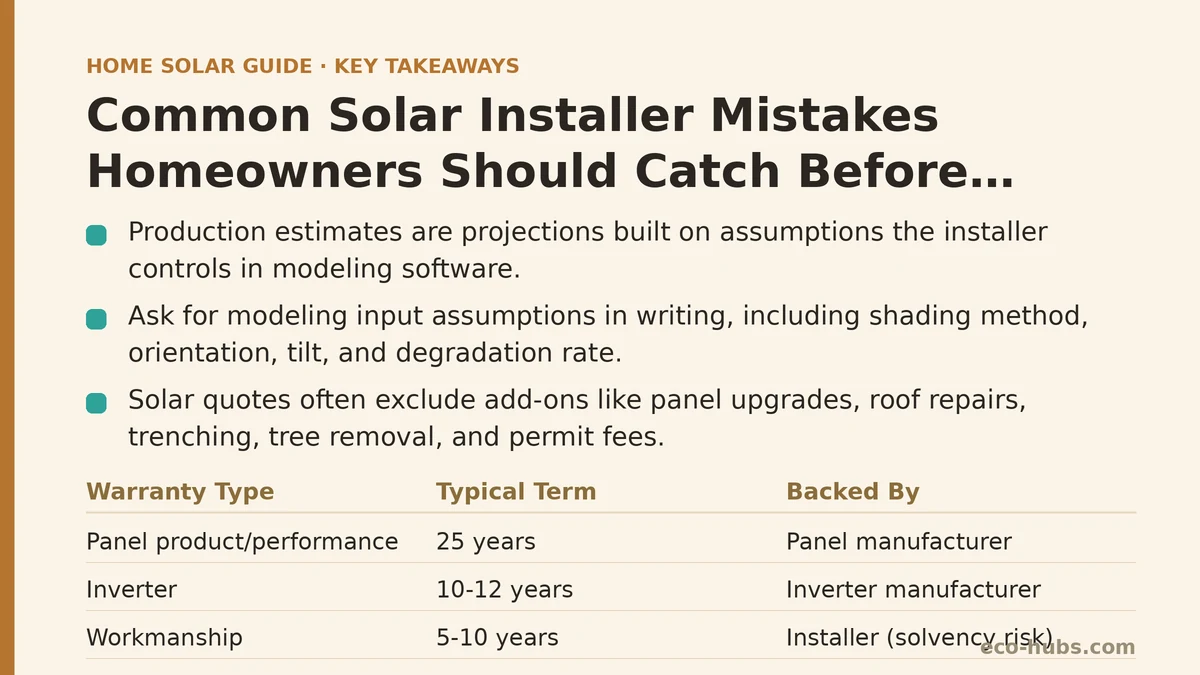
Reality: Production estimates are projections, not guarantees, and they are frequently built on optimistic assumptions about shading, panel orientation, and weather that the installer controls in the modeling software but does not control in the field.
A system sized at, say, 8 kW might be quoted at 11,000–12,500 kWh of annual production in a favorable climate. Small assumption changes — a 10% shading derate instead of 3%, a 15-degree orientation penalty instead of zero — can move that figure by 15–25% without any change to the hardware. The homeowner sees the same panel count and the same price; only the projected savings shrink.
How to catch it: Ask for the modeling input assumptions in writing, not just the output. Specifically request the shading analysis method (satellite, on-site measurement, or none), the assumed orientation and tilt, and the degradation rate applied to future years. If the installer cannot produce these, the estimate is a marketing number rather than an engineering one.
Myth: The Quoted Price Is the Price
Reality: Solar quotes commonly exclude several line items that appear later as add-ons: electrical panel upgrades, roof repairs needed before mounting, trenching for ground-mount conduit runs, tree removal for shading, and permit expediting fees. A $22,000 quote can become a $28,000 project once these are billed separately.
A main panel upgrade alone typically runs $1,500–$4,000 depending on jurisdiction and utility requirements. Roof work before installation can add several thousand more. None of this is unusual, but it should be itemized before signing rather than discovered mid-project.
How to catch it: Request a written scope that explicitly states what is included and what is excluded, and ask for the cost of each likely add-on in advance. A quote that says “panel upgrade if needed — TBD” is not a fixed price.
Myth: The Warranty Term Is What Matters
Reality: Warranty length is the least important part of a warranty. What matters is who backs it, what it excludes, and what happens if the installer goes out of business.
Most residential systems carry at least three separate warranties: the panel manufacturer’s product and performance warranty (often 25 years), the inverter warranty (commonly 10–12 years, sometimes extendable), and the installer’s workmanship warranty (typically 5–10 years). Workmanship coverage is the one most likely to disappear, because it depends on the installer remaining solvent. Roof penetrations, racking, and wiring — the components most likely to fail in the first decade — are usually covered only by that workmanship warranty.
How to catch it: Ask three specific questions. What does the workmanship warranty cover, and for how long? Is it transferable if you sell the home? And if the installer closes, does any manufacturer or third-party backstop exist? Get the answers in the contract, not in a sales conversation.
Myth: Financing Makes the System Affordable
Reality: Financing changes the timing of payments, not the total cost. A solar loan with a low headline rate can carry dealer fees of 15–30% rolled into the principal, meaning the amount financed is substantially higher than the cash price of the same system.
If a cash price is $20,000 and the financed amount is $26,000, the difference is a dealer fee paid to the lender, not to the installer for better equipment. Homeowners comparing a cash quote against a financed quote from the same installer are often looking at two different underlying prices.
How to catch it: Ask for the cash price and the financed amount side by side, and ask whether the loan carries a prepayment penalty. If the tax credit is factored into the loan structure — some lenders require a lump-sum payment after the credit arrives — understand that your monthly payment may step up in year two.
Myth: Net Metering Rules Are Stable
Reality: Utility compensation for exported power has been changing rapidly across the United States, and the rules in effect at signing may not be the rules in effect for the life of the system.
Several states have moved from full retail-rate net metering to reduced export rates or time-of-use structures, in some cases cutting the credit for exported power by 50% or more. A payback projection built on today’s rates can be materially wrong if the utility revises its tariff. Older systems are usually grandfathered, but only for a defined period, and new systems sign up under current rules.
How to catch it: Ask which net metering program the system will be enrolled in, what the current export rate is, and whether the utility has a pending rate case that would affect it. Your state public utility commission publishes these dockets, and they are usually searchable by utility name.
Myth: The Biggest Quote Is the Safest Choice
Reality: Installer size correlates weakly with quality and strongly with overhead. National and regional installers often subcontract the actual installation to local crews, which means the entity that quoted you may not be the entity that mounts panels on your roof and may not be the entity holding the workmanship warranty.
This matters for accountability. If the workmanship warranty is held by an installer that subcontracted the work and later went bankrupt, the warranty may be unenforceable even if the panels and inverter warranties survive.
How to catch it: Ask who will physically perform the installation, whether they are employees or subcontractors, and which legal entity signs the workmanship warranty. Get the entity name in the contract.
A Pre-Signing Checklist
| Item | What to Verify | Red Flag |
|---|---|---|
| Production estimate | Written shading, orientation, and degradation assumptions | Output figure only, no inputs |
| Scope of work | Itemized inclusions and exclusions, with add-on pricing | Blanket exclusions or “TBD” line items |
| Workmanship warranty | Coverage, term, transferability, backing entity | Term stated without coverage detail |
| Financing | Cash price vs. financed amount, prepayment penalty | Only financed price disclosed |
| Net metering | Program, export rate, grandfathering period | Rate assumed at current retail value |
| Installation crew | Employees vs. subcontractors, warranty holder | Vague or evasive answer |
| Timeline | Realistic permitting and interconnection duration | Two-month promise for a six-month process |
Decision Branches
If the production estimate cannot be explained: do not sign until you receive the modeling inputs. An installer unwilling to share assumptions is either unable to produce them or unwilling to defend them.
If the price is quoted as financed only: request the cash price in writing. Financing and cash pricing for the same system are the comparison that matters.
If the installer’s references are all under two years old: ask for a reference whose system has been installed long enough to have triggered warranty service, typically four years or more. Recent installations show sales process; older ones show what happens when problems arise. If the installer cannot or will not provide one, treat the workmanship warranty as aspirational.
What to Do Next
Before signing anything, complete four concrete steps this week:
- Obtain the cash price and the financed amount from every installer you are considering, in writing.
- Request the production model’s input assumptions — shading, orientation, tilt, degradation — for at least two competing quotes.
- Pull your utility’s current net metering tariff (or the equivalent export program) from your state public utility commission’s website to see how export rates are trending.
- Identify the specific legal entity that will hold the workmanship warranty and confirm it is the same entity that will perform the installation.
Two out of three solar proposals contain at least one term that shifts material risk to the homeowner in a way that a careful reader can catch in under an hour. The work is not complicated — it is just consistently skipped. If any of the four items above comes back missing, evasive, or contradictory, that is your signal to ask again before you sign, and to walk away if the answer does not arrive in writing.
Related guides: Questions to Ask a Solar Installer Before Signing Anything, Common Solar Installation Mistakes and How to Avoid Them, and Solar Panel Installation Mistakes Homeowners Regret.
🔗 Recommended Reading
- How to Size a Solar System for Your Home: A Beginner's Step-by-Step Walkthrough
- Solar Panel Monitoring Apps: A Setup Guide for Beginners
- How to Read Your Electricity Bill After Solar: A Line-by-Line Walkthrough
- Solar Incentive Paperwork: Common Filing Mistakes That Delay Your Rebate
- Home Battery Sizing Mistakes That Lead to Blackout Regret