Say you are looking at your utility bill in late February and you see a credit balance of 1,200 kilowatt-hours carried over from a strong summer of production. You assume that credit will simply sit there and offset next winter’s usage the same way it offset last winter’s. Then you get a letter stating that your annual true-up period ended, the balance was reset to zero, and the credits you were counting on are gone. That letter is the moment most homeowners first learn that net metering credits are not banked indefinitely — they follow rules set by your state, your utility, and the specific tariff you were enrolled under.
What follows is a ranked breakdown of the five credit rollover structures you are most likely to encounter, ordered from most favorable to least favorable for the homeowner, with the practical consequences of each.
1. Indefinite Rollover With No Expiration
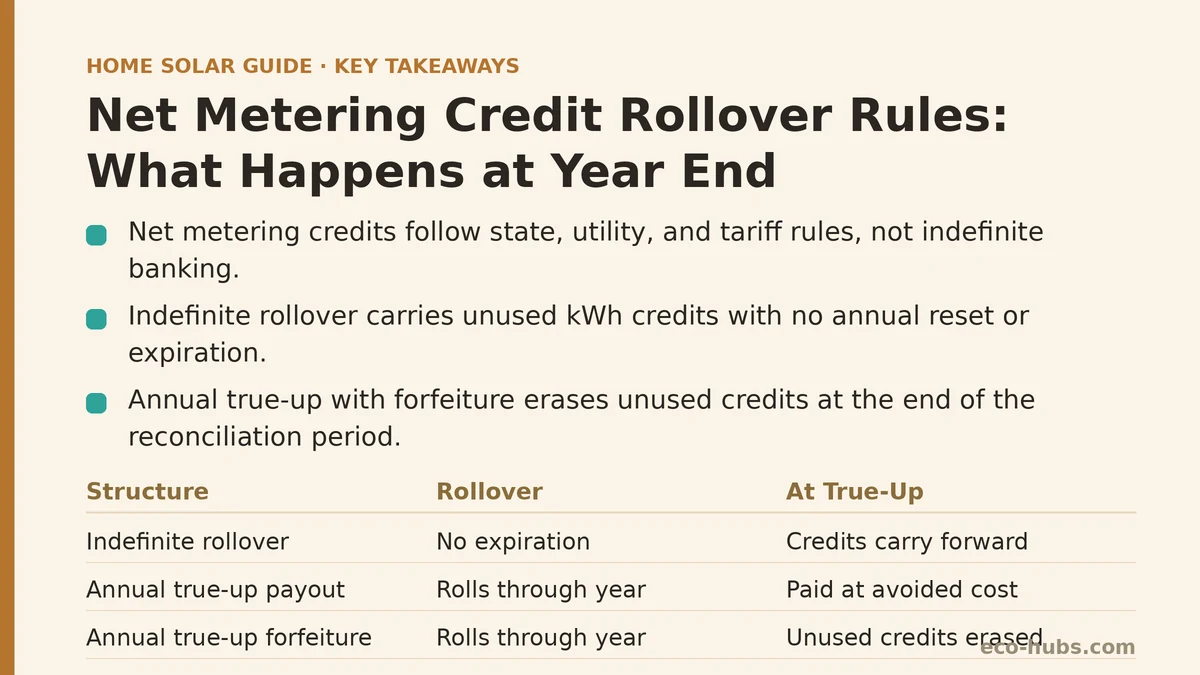
This is the most generous structure and the one most homeowners assume they have. Under indefinite rollover, unused kilowatt-hour credits carry forward from one billing period to the next with no annual reset and no expiration date, for as long as you remain a customer on that tariff.
In practice, this means a household that over-produces in June can draw down those credits in December, January, and February without any deadline pressure. It rewards oversized systems and it makes seasonal balancing straightforward, since summer surplus naturally covers winter deficit on a rolling basis.
What to watch for: Even “indefinite” programs often end the rollover at account closure or when you move. If you sell the house, some utilities zero out the credit balance rather than transferring it to the new owner. Confirm the transfer policy in writing before you list the property.
2. Annual True-Up With Credit Payout at a Lower Rate
Here the credits roll forward through the year, but once every 12 months — commonly at the end of a defined “reconciliation period” that may or may not align with the calendar year — any remaining balance is cashed out. The catch is the rate.
A kilowatt-hour you banked was worth the full retail rate when you generated it, often somewhere in the range of $0.12 to $0.30 per kWh depending on your region. At true-up, many utilities pay out the surplus at their avoided cost rate instead, which is frequently a fraction of retail — sometimes in the range of $0.03 to $0.06 per kWh. Some utilities apply a further “generation only” versus “full retail” distinction.
If your tariff works this way, then: the rational move is to size your system so that annual production roughly matches annual consumption, rather than deliberately overbuilding to chase a payout. Oversizing to sell power back at avoided cost rarely produces the return the headline numbers suggest.
3. Annual True-Up With Forfeiture
This is the structure that catches the most people off guard. Credits roll forward through the year, but at the end of the reconciliation period, any unused balance is simply erased. No payout, no carry into the next year. The utility keeps the value.
The reasoning utilities give is that the credit was issued against energy you did not consume, and the program is designed to offset consumption, not to function as a savings account. Whether that reasoning is fair is a policy debate, but the practical consequence is what matters here: a system that over-produces by 15 percent on an annual basis may see that entire surplus evaporate at true-up.
Recovery move if you are already in this situation: shift as much flexible load as possible into the shoulder months when you still have surplus credits — EV charging, heat pump water heating, and pre-cooling or pre-heating the house. You are converting credits back into consumed energy before the deadline instead of losing them.
4. Monthly Reset With No Rollover
Some utilities, particularly in areas with high solar penetration, have moved to a monthly rather than annual settlement. Under this model, each billing cycle stands alone. Surplus credits generated in July offset July consumption only; whatever is left is either paid at avoided cost or forfeited, and there is no accumulation across months.
This structure dramatically reduces the value of a solar system in a climate with strong seasonal swings, because winter consumption can no longer be covered by summer surplus. A system that penciled out well under an annual true-up framework can look considerably weaker under a monthly reset.
Decision branch: if your utility uses monthly settlement, run your payback model with month-by-month production data rather than annual totals. A tool that assumes annual netting will overstate your savings.
5. Time-of-Use Credit Valuation With Separate Rollover Buckets
The most complex structure assigns different credit values depending on when you export. A kilowatt-hour sent to the grid at 6 p.m. on a July weekday may be credited at a peak rate, while one exported at 11 a.m. on a Sunday in April may be credited at an off-peak rate. Some tariffs also maintain separate rollover balances for peak and off-peak credits, and each bucket resets on its own schedule.
This is where reading your specific tariff document becomes unavoidable. Two neighbors on the same utility can be on different rate schedules with different rollover behavior, and the difference in annual value can run into several hundred dollars.
What to verify: whether partial-hour exports are valued at the rate in effect at the top of the hour or pro-rated; whether peak credits can be applied to off-peak consumption at full value or at a conversion ratio; and whether each bucket expires independently.
Comparing the Five Structures
| Rank | Structure | Rollover Behavior | Typical Value to Homeowner |
|---|---|---|---|
| 1 | Indefinite rollover | Carries forward with no expiry | Highest — full seasonal balancing |
| 2 | Annual true-up with payout | Cashed out at avoided cost | Moderate — payout is usually well below retail |
| 3 | Annual true-up with forfeiture | Balance erased at year end | Variable — depends on oversizing |
| 4 | Monthly reset | No accumulation across months | Lower in seasonal climates |
| 5 | Time-of-use with separate buckets | Per-bucket reset on its own schedule | Depends heavily on load timing |
How to Read Your Own Statement Before the Deadline
Set aside 20 minutes at the start of your next billing cycle and pull the last 12 months of statements. Look for four specific things:
- The reconciliation date. Find the exact date the utility uses as the end of your credit year. It is often not December 31. Look for terms like “annual true-up,” “reconciliation period,” or “credit expiration date.”
- The rollover policy language. Search the tariff PDF for “carry forward,” “expire,” “forfeit,” and “avoided cost.” These four words determine everything.
- Your projected balance at true-up. If your current credit balance divided by the number of months remaining before true-up is greater than your average monthly winter consumption, you are likely to have surplus that will be either paid at a low rate or lost.
- The payout rate, if any. Compare the payout rate to your retail rate. This tells you how much a banked credit is worth if it rolls over versus if it is cashed out.
Common mistake: assuming your utility’s website summary reflects your actual tariff. The marketing page often describes the program’s best-case structure, while the tariff document that governs your account may be different. Request the full rate schedule for your specific rate class.
What to Do Next
If you are still in the planning stage, size your system for annual consumption rather than maximum production. Overbuilding to chase rollover credits works well under structure 1, modestly under structure 2, and poorly under structures 3 through 5. Confirm your utility’s rollover policy in writing before you sign an installation contract.
If you already have a system, check your true-up date now rather than in the month it occurs. Use the interval between now and that date to shift flexible loads into the period when you still hold surplus credits. If your tariff forfeits the balance, the credits are worth more consumed than banked.
For any decision that involves real money, confirm the current rules with your utility directly and with a licensed local installer who works in your specific jurisdiction — program rules change, and the tariff that governed installations two years ago may not be the one that applies to yours today.
Related guides: How to Read Your Electric Bill After Going Solar, Common Net Metering Application Mistakes That Delay Your Solar Connection, and How to Apply for Net Metering: A Step-by-Step Tutorial for First-Time Homeowners.
🔗 Recommended Reading
- How to Read Your Electricity Bill After Solar: A Line-by-Line Walkthrough
- Solar Incentive Paperwork: Common Filing Mistakes That Delay Your Rebate
- Home Battery Sizing Mistakes That Lead to Blackout Regret
- Common Solar Installer Mistakes Homeowners Should Catch Before Signing
- Common Home Battery Storage Wiring and Placement Mistakes to Avoid