An electric bill after solar installation is a different document entirely from the one you received before. The total due, the line items, and the meaning of a “reading” all shift. This guide defines the two primary billing structures you will encounter—net metering and net billing—then walks through a symptom-by-symptom troubleshooting table for the most common post-solar billing surprises.
The Core Definition: What Your Bill Is Now Telling You
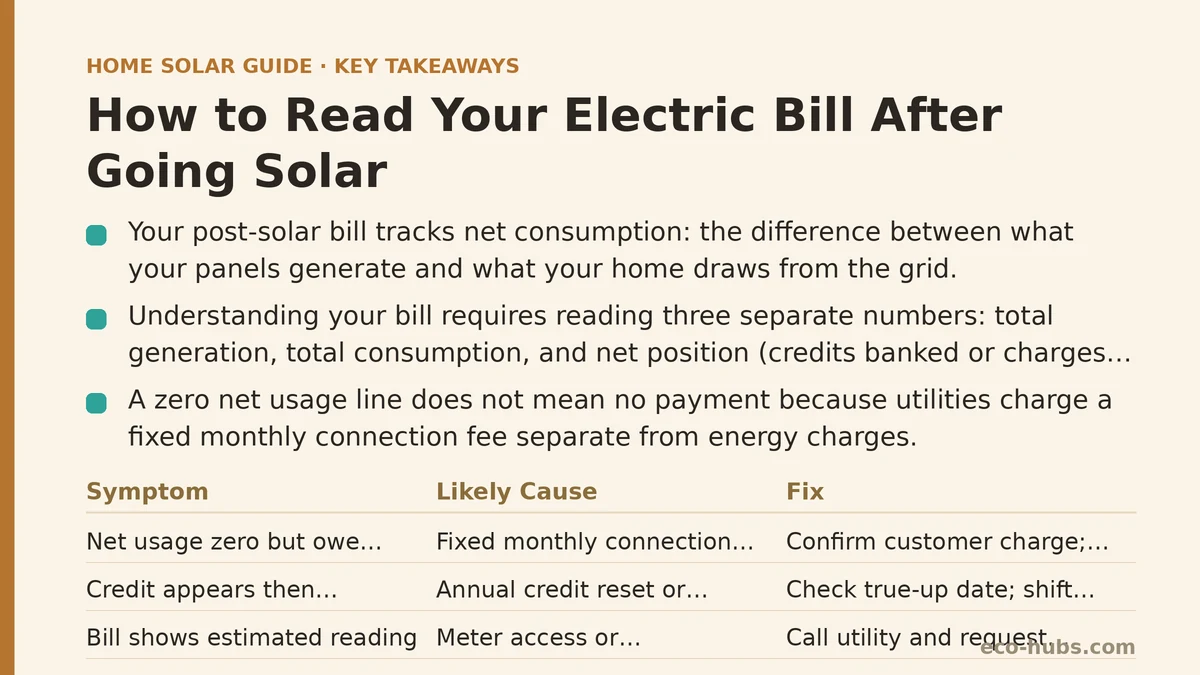
Before solar, your bill was simple: kilowatt-hours (kWh) consumed multiplied by your utility’s rate. After solar, your bill tracks net consumption — the difference between what your panels generate and what your home draws from the grid. When your system produces more than you use in a given moment, the excess flows out to the grid, and your utility records that as a credit. When your home draws more than your panels produce, you import from the grid, and you pay for that amount.
The bill you receive each month is a running ledger of these two flows. Understanding it requires reading three separate numbers: total generation, total consumption, and net position (either credits banked or charges owed).
Symptom Checklist: What Your Bill Is Telling You
Use this table to diagnose the most common post-solar billing anomalies. Each row follows the sequence: symptom → likely cause → fix.
| Symptom on Bill | Likely Cause | Fix |
|---|---|---|
| “Net usage” is zero, but you still owe money. | Your utility charges a monthly fixed connection fee ($5–$25 depending on jurisdiction) that is separate from energy charges. Net metering only offsets the energy portion. | Confirm the fixed fee on the line item labeled “customer charge” or “basic service charge.” This fee is unavoidable; factor it into your monthly solar cost projection. |
| A credit appears one month, then disappears the next. | Your utility may reset accumulated credits annually (often on a true-up date) or pay them out at a wholesale rate (2–4 cents/kWh) instead of the retail rate (10–30 cents/kWh). | Check your true-up date. If credits expire, shift energy-intensive tasks (EV charging, pool pumping) to months where you have surplus. |
| Bill shows “estimated reading” instead of “actual.” | The utility could not access your meter, or the meter’s communication module has an intermittent issue. | Call your utility and request an actual reading. Estimated readings on solar bills are frequently wrong because they extrapolate from pre-solar usage patterns. |
| A charge labeled “delivery” or “transmission” persists even with net-zero energy. | Many utilities split charges into supply (energy generation) and delivery (infrastructure maintenance). Solar offsets supply but sometimes only partially offsets delivery, depending on your state’s policy. | Check whether your delivery charge is volumetric (per kWh) or fixed. If volumetric, reducing net usage lowers this. If fixed, it behaves like the connection fee. |
| Your monthly usage line item shows a “reversal” or “negative consumption.” | This is a normal artifact of net metering. The bill is showing that your meter spun backward during peak solar hours. | No action needed. Confirm the negative number reconciles with the credit line on the following page. |
| A one-time charge appears labeled “interconnection fee.” | Your utility charges a fee for connecting your solar system to the grid. This ranges from $0 to $500 depending on your state. | This should appear once. If it recurs, call the utility billing department — a one-time fee posted as a recurring charge is a known billing system error. |
Anatomy of a Post-Solar Bill: Line by Line
A typical post-solar bill from a utility with net metering contains the following sections. The exact labels vary by utility, but the underlying logic is consistent.
1. Meter Reading Section
What you are looking at: Two numbers — the previous reading and the current reading — often followed by a “difference” figure in kWh.
How to interpret it: The difference represents your net position for the billing period. A negative number means you exported more than you imported. A positive number means you imported more than you exported. If your system has a production monitor (e.g., Enphase, SolarEdge), cross-reference this number against your monitor’s net export data. A mismatch of more than 5% warrants a call to the utility.
2. Energy Charges Section
What you are looking at: A table showing your net consumption (in kWh) multiplied by your rate (in cents/kWh).
How to interpret it: If you have a positive net consumption, this line will be a charge. If you are net-negative for the month, this line will show zero or a credit. Some utilities display this as a single net number; others itemize “imports” and “exports” separately.
Common mistake: Homeowners mistake the “delivery” charge line for a duplicate of the “supply” charge. In deregulated states, these are two separate charges — supply comes from your chosen electricity provider (or your utility’s default), and delivery goes to the utility for maintaining the wires. Solar credits typically apply to both lines in a net metering arrangement, but in some states they apply to supply only.
3. Credits Section
What you are looking at: The accumulated kWh credits or dollar credits from previous months.
How to interpret it: Net metering credits usually roll over month to month. Your utility tracks this balance. If you see the balance decrease without a corresponding charge, check whether a true-up has occurred (annual settlement). If no true-up is stated, contact the utility — this could be a billing error.
Concrete example: From a real Midwestern utility bill post-solar: 412 kWh imported, 386 kWh exported, net +26 kWh, charge of $3.12 for supply, $8.50 fixed charge, total due $11.62. The prior month’s credit of 158 kWh remained banked. This structure — a small charge plus a large banked credit — is the most common monthly pattern for a well-sized system.
4. Taxes and Surcharges
What you are looking at: Small line items that look like penalties but are fixed regulatory assessments.
How to interpret it: These include state gross receipts taxes, energy efficiency surcharges, and renewable portfolio standard charges. They typically total $2–$8 per month. They are applied to your gross consumption, not your net consumption, in most states. This means they do not shrink when your solar production increases.
What to Do If a Number Doesn’t Match
The single highest-value action after solar activation is a monthly reconciliation — comparing three sources of truth: your inverter production monitor, your utility’s bill, and your own reality (i.e., did your AC run more this month?).
The 5-Minute Reconciliation Process
- Pull your production monitor’s monthly total. This is your gross kWh generated.
- Look at your bill’s “delivered” and “received” line items. Your bill should show these separately in most net metering states.
- Check that delivered + received = your monitor’s gross generation. If the received line is lower than your monitor’s export, your system may have a sub-metering issue or the utility may be misreporting.
- If the mismatch is above 5%, call the utility’s solar billing department specifically. General customer service lacks the training to resolve solar-specific billing errors; ask for the distributed generation team.
Recovering From a Billing Error
If you catch an error (e.g., a full-rate charge on a month you had banked credits), act within the utility’s billing dispute window — typically 60–90 days from the bill date. Collect your production monitor data, your bill, and a screenshot of the net meter reading if available. Filing a written dispute with evidence increases your chance of a correction within one billing cycle; oral disputes often get deferred or lost.
The Two Billing Structures: Net Metering vs. Net Billing
The table above assumes a net metering structure. Some states and utilities have transitioned to net billing (sometimes called “net energy metering cap” or “successor tariff”). The difference matters for bill reading.
| Feature | Net Metering | Net Billing |
|---|---|---|
| Credit rate for exports | Retail rate (what you pay per kWh) | Wholesale or “avoided cost” rate (often 3–7 cents/kWh) |
| Bill structure | Net kWh multiplied by one rate | Separate charges for imports and separate credits for exports, at different rates |
| Typical appearance | Single “net” line item | Multiple line items, export credit calculated separately |
| Math check | Imports − Exports = Charge | (Imports × import rate) − (Exports × export rate) = Charge |
If you are on net billing, your bill will show two distinct line items for energy — do not confuse the export credit (smaller) with the import charge (larger). A common error in net billing states is homeowners calculating their bill as if net metering applies, then panicking when their monthly charge is higher than expected. The math differs, but the practice is the same: verify the credit rate on your bill against your utility’s published tariff schedule.
Seasonal Pattern: What to Expect Across a Year
Your bill will not look the same in July as in January, and this variation is not an error.
- Spring/Fall (moderate production, low consumption): Expect net credits nearly every month. Your billing summary will show a growing credit balance.
- Summer (high production, high AC consumption): You may see near-zero net charges during sunny months. If your AC runs hard, you might still have a small charge.
- Winter (low production, high heating consumption): This is when you draw down your banked credits. Expect charges that increase into the cold months.
- True-up month: Whichever month your utility settles annually, you will see a final reconciliation. Any remaining credit is either paid out at wholesale rate or forfeited, depending on your state.
A correctly sized system (offsetting 90–110% of annual usage) generates a rough annual zigzag pattern: credits build in shoulder months, deplete in winter, and settle near zero at true-up.
Practical Fixes for the Most Common Post-Solar Billing Confusion
Mistake: Assuming “Net Zero” Means You Pay Nothing
The fixed monthly connection fee ($5–$25) plus tax surcharges means a zero-energy bill still carries a minimum charge. Budget for this. If you budgeted for zero, the first bill is a surprise.
Fix: Locate the fixed fee on your bill. If your utility does not clearly label it, ask for a line-item breakdown. This fee does not respond to solar production.
Mistake: Ignoring the “Estimated Reading” Flag
A utility estimating your meter reading on a solar bill is a recipe for a chasing-error spiral. The utility’s algorithm generates estimates based on your pre-solar history, and then the next actual reading corrects it — resulting in a bill that is either too high or too low by hundreds of dollars.
Fix: Check every bill for the word “estimated.” If present, call and request an actual read. Do this every billing cycle until the issue resolves. Set a calendar reminder.
Mistake: Misreading the “Received” Line as Your Home Usage
Symptom: Your bill shows “Received: 480 kWh” and you assume your home used 480 kWh, but your production monitor says your system generated 650 kWh and your home consumption monitor says 520 kWh.
Cause: The 480 kWh figure is exports — the energy flowing out to the grid. It is not your consumption.
Fix: Reconcile using the formula: Consumption = (Imports from grid) + (Self-consumption from solar). Self-consumption is not on your bill; it is what you used directly from panels before any surplus flowed out. Your production monitor or a separate consumption monitor provides this number.
Your Immediate Next Step
Within the next 48 hours, pull the last three months of your post-solar bills and your production monitor data for those same months. Perform the 5-minute reconciliation described above. If any single month shows a mismatch above 5% of your gross generation, call your utility’s distributed generation department with your data in front of you.
Do not wait for the annual true-up to catch errors. Billing corrections applied retroactively are slower and harder to obtain. A monthly five-minute check is the difference between catching a rating error in April versus discovering a six-month overcharge in December.
Which part of your current bill is least clear — the net metering credit calculations, the fixed fees, or the seasonal variation expectations? Run through the reconciliation once, then describe what you found. We can help you determine whether what you see is standard billing structure or a problem worth escalating.
Related guides: Understanding Your Electric Bill After Going Solar, Net Metering Credit Rollover Rules: What Happens at Year End, and Common Net Metering Application Mistakes That Delay Your Solar Connection.
🔗 Recommended Reading
- Solar Panel Monitoring Apps: A Setup Guide for Beginners
- How to Read Your Electricity Bill After Solar: A Line-by-Line Walkthrough
- Solar Incentive Paperwork: Common Filing Mistakes That Delay Your Rebate
- Home Battery Sizing Mistakes That Lead to Blackout Regret
- Common Solar Installer Mistakes Homeowners Should Catch Before Signing