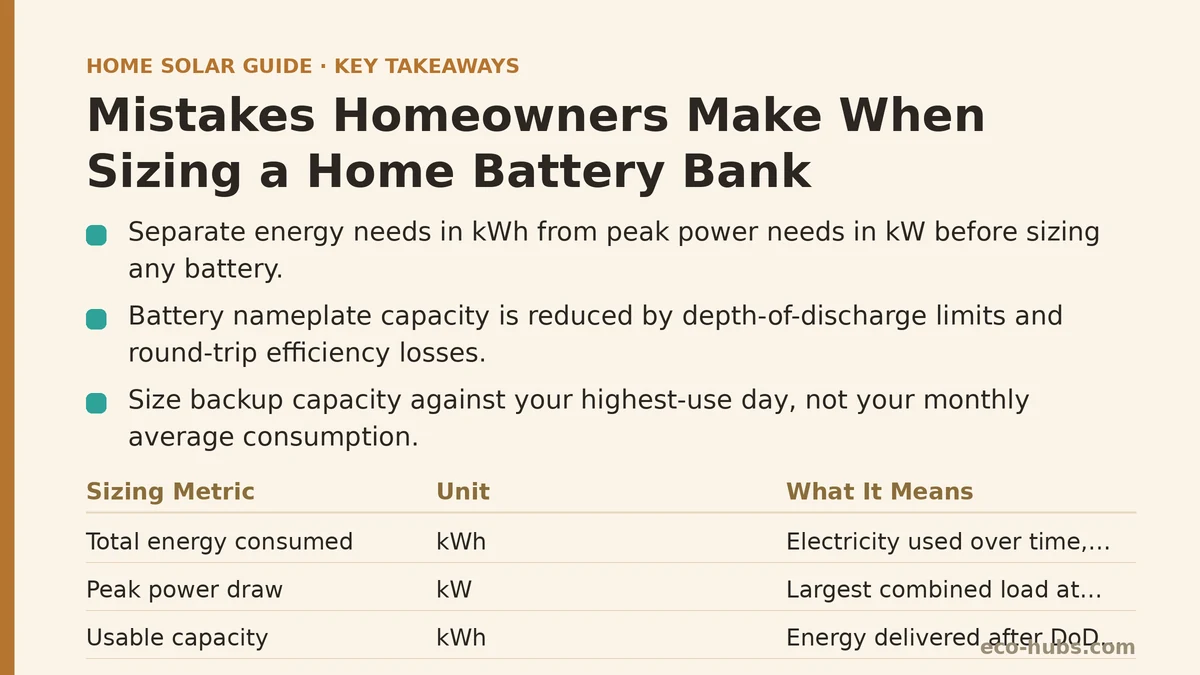
Sizing a home battery bank means matching three numbers that are frequently confused with one another: the total energy your home consumes over a given period (measured in kilowatt-hours), the peak power draw at any single instant (measured in kilowatts), and the usable capacity a battery can deliver after accounting for depth-of-discharge limits and efficiency losses. Get any one of these three wrong, and the system will either fall short during the exact moment you need it or cost thousands more than necessary.
The mistakes below are the ones that come up most often, presented in the order they tend to occur during a typical sizing project — so you can catch each one before it compounds into the next.
Step 1: Confusing Kilowatt-Hours With Kilowatts
This is the foundational error, and almost every other mistake traces back to it. A battery rated at 10 kWh does not mean you can run a 10 kW load for one hour indefinitely — it means the battery holds 10 kilowatt-hours of energy, and how fast you can pull that energy out is a separate limit called continuous power output (measured in kW).
A concrete illustration: a 5 kW well pump that runs for 30 minutes uses 2.5 kWh of energy. A battery with plenty of capacity (say 20 kWh) but only a 4 kW continuous output rating cannot start or run that pump alone, let alone alongside other loads. Capacity without matching power output is the single most common mismatch in homeowner-sized systems.
Before you size anything, separate your needs into two columns:
- Energy needs (kWh): how much total electricity you want to store and use per day
- Power needs (kW): the largest combination of appliances that might run at the same instant
If the second number is larger than the battery’s continuous output rating, capacity is irrelevant — the system will shut down or trip.
Step 2: Sizing for Average Usage Instead of Peak Usage
Monthly utility bills show average daily consumption, which is a misleading starting point. A home that averages 30 kWh per day might use 12 kWh on a mild spring day and 55 kWh on a hot August day with air conditioning running continuously.
Sizing a battery to the monthly average means it will be undersized on precisely the days when grid outages and peak-rate events are most likely — heat waves, winter storms, and high-demand evenings.
A workable approach:
- Pull 12 months of usage data from your utility (most provide hourly or 15-minute interval data on request).
- Identify the highest single day in that period.
- Size backup capacity against that peak day, not the average, if backup is the goal.
If the goal is only time-of-use rate arbitrage rather than outage backup, average daily usage is a more reasonable basis — but the two goals require different sizing logic and should not be blended carelessly.
Step 3: Ignoring Depth of Discharge and Round-Trip Efficiency
A battery’s nameplate capacity is not the amount of energy you can use. Two derating factors reduce it:
- Depth of discharge (DoD): Many lithium iron phosphate (LFP) batteries allow 80-100% DoD, but some chemistries and older lead-acid systems are limited to 50%. A 10 kWh lead-acid bank at 50% DoD delivers 5 kWh of usable energy.
- Round-trip efficiency: Energy lost in charging and discharging. LFP systems typically run 85-95% efficient; lead-acid systems commonly run 75-85%.
Combined, a 10 kWh LFP battery at 90% DoD and 90% efficiency delivers roughly 8.1 kWh of usable energy. A homeowner who sizes against nameplate capacity will be short by nearly 20% on every cycle.
Usable capacity formula:
Nameplate kWh × DoD % × round-trip efficiency % = usable kWh
Run this calculation for every battery you compare, because marketing materials frequently quote nameplate figures.
Step 4: Forgetting About Startup Surges
Motors and compressors draw a brief but very large current spike when they start — often 2 to 4 times their running wattage, sometimes more. An air conditioner that runs at 1.5 kW might pull 4-6 kW for a fraction of a second at startup.
Battery inverters handle this differently. Some have generous surge ratings (often double the continuous rating for a few seconds); others do not. A system sized comfortably for running loads can still trip offline when a well pump, furnace blower, or refrigerator compressor kicks on.
Checklist for surge-prone loads:
- Well pumps and sump pumps
- Central air conditioning and heat pumps
- Refrigerators and freezers
- Furnace blowers
- Washing machines
- Garage door openers and large power tools
Add the surge wattage of the largest single motor-driven load to your continuous load total, then confirm the inverter’s surge rating exceeds that sum.
Step 5: Overlooking the Solar Recharge Relationship
A battery bank is only as useful as its ability to refill. During a multi-day outage, a battery sized for two days of backup without considering how much solar production is available in winter will run dry on day two — often at the worst possible time.
In many northern latitudes, winter solar production can fall to 30-50% of summer output. A system that comfortably recharges a 20 kWh bank in July may barely manage half that in December.
If X then Y decision branches:
- If your primary risk is summer storm outages → size battery against summer peak day and confirm summer solar recharge
- If your primary risk is winter ice storms → size against winter peak day and assume solar contributes only 30-50% of summer output
- If you have no solar at all → the battery is grid-charged only, and sizing depends entirely on how long you expect the grid to be down and what loads you want to keep running
Step 6: Assuming One Battery Size Fits Every Goal
Homeowners frequently pick a battery size based on a single stated goal (“I want backup”) without distinguishing between backup types:
| Goal | Sizing basis | Typical capacity range |
|---|---|---|
| Critical loads only (fridge, lights, internet, phone charging) | 1-2 days of essentials | 5-10 kWh |
| Whole-home short backup (a few hours to one day) | Peak daily usage | 10-20 kWh |
| Extended whole-home backup (2-3 days) | Peak daily usage × days, minus solar contribution | 20-40+ kWh |
| Time-of-use arbitrage only | Daily shiftable load | 10-15 kWh |
| Off-grid full-time | Peak daily usage × autonomy days, with seasonal adjustment | 30-60+ kWh |
A system oversized for critical-loads backup wastes money; one undersized for off-grid becomes a daily frustration. Decide the goal before pricing anything.
Step 7: Skipping the Physical and Electrical Site Check
Battery banks take up space and require specific installation conditions. Common oversights:
- Clearance: Many manufacturers require several inches of clearance around units for airflow and code compliance.
- Temperature: LFP batteries lose capacity and charge acceptance in cold; garages that drop below freezing require heated enclosures or indoor placement.
- Wall strength: A 20 kWh wall-mounted bank can weigh 400-500 lbs; not every wall is rated for it.
- Ventilation and code: Fire separation, smoke detection, and in some jurisdictions specific room requirements apply. Local codes vary considerably.
- Electrical panel capacity: Adding a battery and inverter often requires a main panel upgrade, which can add $1,500-$4,000 to the project.
Confirm site constraints before finalizing equipment selection, not after delivery.
Step 8: Trusting a Single Quote Without a Second Opinion
Battery sizing involves assumptions — about your usage, your outage patterns, your solar production, and your goals. Different installers will make different assumptions, and the resulting proposals can vary by 50% or more in suggested capacity.
Getting two or three quotes is standard due diligence. Ask each installer to walk through the specific numbers behind their sizing recommendation: which usage data they used, what depth of discharge and efficiency they applied, what loads they included in the backup panel, and how they accounted for winter solar.
If an installer cannot explain the sizing math in plain terms, that is a signal worth taking seriously.
Step 9: Ignoring How Battery Capacity Ages
Every battery loses capacity over time. Most LFP batteries are warrantied to retain 60-80% of nameplate capacity after 10 years or a specified number of cycles (commonly 6,000-8,000 cycles).
A battery that meets your needs on day one at 20 kWh may only deliver 14-16 kWh at year ten. If your backup needs are tight, sizing with a modest buffer for degradation avoids a system that quietly becomes inadequate during its warranty period.
Check the warranty’s capacity retention curve — not just the headline cycle count — when comparing products.
Step 10: Not Accounting for Future Load Growth
Common household changes that add load:
- Purchasing an EV (adds 7-11 kW charging load, often overnight)
- Adding a heat pump to replace a gas furnace
- Adding a home office or growing family
- Installing a hot tub, pool pump, or workshop equipment
A battery sized today for today’s loads may be undersized in three years. Modular systems that allow capacity to be added later are usually worth the modest premium, especially if any of the changes above are plausible within the warranty period.
Recovery: If You Have Already Sized Incorrectly
If a battery has already been installed and the sizing is wrong, common recovery paths include:
- Adding capacity: Many systems support expansion with one or more additional battery modules. Check inverter compatibility and total system limits first.
- Reallocating loads: Moving non-essential loads off the backup panel often solves “not enough runtime” problems without new hardware.
- Changing operating mode: Some systems allow shifting from whole-home backup to critical-loads-only mode, extending runtime substantially.
- Load management devices: Smart relays that prevent high-surge loads from running simultaneously can prevent nuisance trips.
Reach out to the original installer first — many sizing issues can be resolved with configuration changes rather than new equipment.
What to Do Next
- Pull 12 months of interval usage data from your utility.
- List your critical loads and their running and surge wattages.
- Decide clearly whether your goal is backup, arbitrage, off-grid capability, or a combination.
- Calculate usable capacity (not nameplate) for every battery you consider.
- Confirm the inverter’s continuous and surge power ratings exceed your peak instantaneous load.
- Estimate winter solar recharge if solar is part of the system.
- Get at least two quotes and ask each installer to explain their sizing math.
Battery sizing rewards a slow, deliberate approach. The 2-4 hours spent gathering usage data and listing loads will save far more than that in avoided rework, undersized systems, and premature upgrades.
If you are in the middle of sizing a battery bank and stuck on a specific decision — how many days of autonomy to plan for, whether to prioritize surge power or total kWh, or how to compare two installer proposals — share the specifics and we can help work through the tradeoffs.
Related guides: Is Solar Battery Storage Actually Worth the Additional Cost, Common Mistakes Homeowners Make When Applying for Solar Tax Credits and Incentives, and Common Home Battery Storage Wiring and Placement Mistakes to Avoid.
🔗 Recommended Reading
- Solar Incentive Paperwork: Common Filing Mistakes That Delay Your Rebate
- Home Battery Sizing Mistakes That Lead to Blackout Regret
- Common Solar Installer Mistakes Homeowners Should Catch Before Signing
- Common Home Battery Storage Wiring and Placement Mistakes to Avoid
- Solar Payback Period vs Cash-on-Cash Return: Which Metric Should Homeowners Use