Commercial solar financing is the process of paying for a photovoltaic system on a business property through one of four main structures: an outright cash purchase, a bank or credit union loan, a lease, or a power purchase agreement (PPA). Each structure shifts who owns the system, who claims the federal tax credit, and how the cost lands on the business’s monthly cash flow — and those three factors, not the headline price per watt, determine which option fits a given business.
For a small business owner, the financing decision usually matters more than the equipment choice. A system priced at $2.50 per watt installed across a 50 kW array is roughly $125,000 before incentives, and how that $125,000 is paid — out of reserves, over seven years of loan payments, or as a monthly bill to a third-party owner — produces very different balance-sheet and tax outcomes. This guide walks through the decision in sequence, from sizing the number to reading the contract.
Step 1: Establish the Real Project Cost Basis Before Comparing Financing
Financing comparisons are meaningless if the underlying cost estimate is loose. Before requesting any financing quote, pin down four figures:
- Installed cost per watt. Commercial rooftop systems commonly land somewhere in the $2.00–$3.00 per watt range depending on region, roof type, and labor market, though quotes vary widely.
- System size in kW (DC). Based on twelve months of utility bills, not a rule-of-thumb square footage estimate.
- Annual production estimate in kWh. Request the modeling assumptions — shading, tilt, azimuth, and degradation rate — not just the final number.
- Roof condition and remaining life. Re-roofing under an array later is far more expensive than re-roofing before installation. If the roof has under 10–15 years of remaining life, address it first.
If a financing provider quotes terms against a system size you have not independently verified, you are negotiating over an unknown quantity.
Step 2: Understand the Federal Tax Treatment That Applies to Each Option
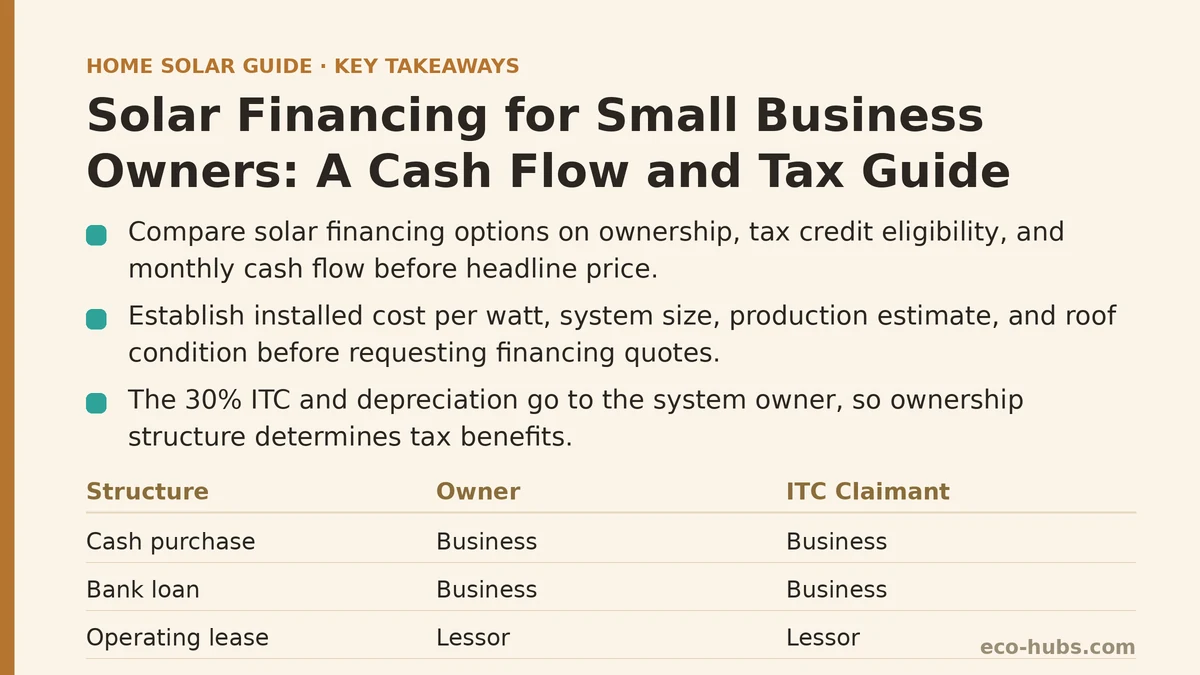
This is the step where most small business owners get tripped up. The federal investment tax credit (ITC) and depreciation rules apply differently depending on who owns the system. As of the current rules, the commercial ITC is 30% of eligible basis for systems that meet prevailing wage and apprenticeship requirements (a lower rate applies if those requirements are not met), and there is an additional 10% domestic content bonus and a 10% energy community bonus available in qualifying cases. Business owners should confirm current percentages and eligibility with a tax professional, since the rules have changed multiple times in recent years.
The table below summarizes how ownership and tax treatment typically differ across the four structures:
| Structure | Who owns the system | Who claims the 30% ITC | Depreciation benefit | Monthly cash flow pattern |
|---|---|---|---|---|
| Cash purchase | Business | Business | Business (MACRS, typically 5-year) | Large upfront outflow, then near-zero electric bill |
| Bank/credit union loan | Business | Business | Business | Loan payment replaces electric bill; net savings often positive |
| Operating lease | Lessor | Lessor (usually passed through as lower lease rate) | Lessor | Fixed monthly lease payment; no upfront cost |
| PPA | Third-party owner | Third-party owner | Third-party owner | Pay per kWh at contracted rate, often below utility rate |
The critical point: the 30% ITC and the depreciation deduction are available to the owner of the system. In a lease or PPA, the business does not own the system, so it does not claim those benefits directly. The economics of a lease or PPA only work if the lessor passes enough of the tax benefit back through lower payments or lower per-kWh rates — which is why the contract terms, not the marketing language, decide the comparison.
Step 3: Model Monthly Cash Flow Against the Current Electric Bill
The right comparison metric is monthly net cash flow, defined as: current electric bill minus solar-related payment, plus any bill offset the system produces. Run this across a full year, not a single month, because commercial demand charges and seasonal usage swings can distort a single-month view.
A typical pattern to check:
- Cash purchase: Month 1 cash flow is deeply negative (the entire system cost), then turns strongly positive for 25+ years as the electric bill falls. Payback periods of roughly 5–9 years are commonly reported for commercial systems that capture the full ITC and depreciation, though this depends heavily on utility rates and system cost.
- Loan: Monthly payment is the primary outflow. If the loan payment is less than the displaced electric bill, the business is cash-flow positive from month one. Ask the lender what rate and term produce that breakeven, and stress-test it at 2% higher rates.
- Lease: A fixed monthly payment regardless of production. Convenient for budgeting, but the business gives up the ITC and depreciation, and monthly savings tend to be thinner than a loan.
- PPA: Pay per kWh produced. Savings depend on the contracted rate versus the utility rate over the term (often 20–25 years). Escalators of 1–3% per year are common in PPA contracts and should be modeled explicitly.
If the business cannot use the tax credits in the year they are generated — for example, a startup with no federal tax liability — a lease or PPA may be the better cash-flow fit despite lower long-term total savings, because a tax credit the business cannot absorb has no immediate cash value.
Step 4: Check Whether the Business Can Use the Tax Benefits
The 30% ITC is a non-refundable credit: it reduces federal tax owed, but it does not generate a refund check beyond that liability. A business with modest or volatile taxable income should ask its accountant:
- Do we have enough federal tax liability this year to absorb a 30% credit on the full system cost? If not, the credit can typically be carried forward (rules on carryforward periods should be confirmed), but that delays the cash benefit.
- Can we use the depreciation deduction? Accelerated depreciation under MACRS (bonus depreciation may also apply depending on the year placed in service) generates a large deduction in early years, which is most valuable if the business is profitable.
- Does the business qualify for the prevailing wage and apprenticeship bonus? Failure to meet those requirements can reduce the credit rate materially, so confirm before signing an installer contract.
A business that cannot use the credits efficiently should weight lease and PPA options more heavily than a business with steady taxable income, even though the headline savings on an owned system look better on paper.
Step 5: Read the Financing Contract for These Specific Terms
Contract terms matter more than the sales summary. Review each of the following before signing:
- PPA escalator: What is the annual percentage increase, and is it fixed or tied to an index? A 2.9% escalator over 25 years roughly doubles the per-kWh rate compared to year one.
- Buyout provisions: If the business wants to purchase the system from the third-party owner mid-term, how is the buyout price calculated?
- Prepayment terms on loans: Is there a penalty for early payoff, particularly if the business plans to use the tax credit refund to reduce principal?
- Roof and relocation clauses: What happens if the business sells the building or needs to re-roof? Leases and PPAs sometimes include transfer or removal fees.
- Production guarantees: For PPAs, is there a minimum production guarantee, and what happens if the system underperforms?
- End-of-term options: At the end of a lease or PPA, does the business have the option to buy the system, renew, or have it removed — and at what cost?
Step 6: Compare Total Cost of Ownership, Not Just Monthly Payment
A common mistake is comparing financing options by monthly payment alone. A 25-year PPA with a 2.9% escalator can look cheaper in year one than a 7-year loan, but its cumulative cost over the contract term is typically much higher because the business never owns the system or captures the tax benefits. Run a 25-year cumulative cost comparison:
- Cash purchase: System cost minus ITC minus depreciation tax shield, plus any inverter replacement around year 12–15.
- Loan: Total of loan payments plus interest, minus ITC and depreciation (if the business owns and can use them), plus inverter replacement.
- Lease: Total of lease payments over the term, with no ITC or depreciation to offset.
- PPA: Total of per-kWh payments over the term, adjusted for the escalator.
The lowest year-one monthly payment is rarely the lowest total cost. The right choice depends on whether the business values lower total cost (favoring ownership) or lower upfront capital commitment (favoring lease or PPA).
Common Mistakes and How to Recover
- Signing a PPA before confirming the business can use the ITC. Recovery is difficult after signing; review tax capacity before committing.
- Assuming the ITC is a refund check. It is a non-refundable credit. Adjust cash-flow planning accordingly.
- Skipping the roof assessment. If the roof needs replacement within the system’s life, address it before installation rather than after.
- Comparing quotes with different system sizes or production assumptions. Normalize to cost per expected kWh produced, not cost per watt alone.
- Ignoring the PPA escalator in long-term budgeting. Model it explicitly; a 2–3% annual increase compounds significantly over 20+ years.
What to Do Next
- Pull twelve months of utility bills and calculate average monthly kWh usage and demand charges.
- Request at least two installer quotes with production modeling assumptions, and confirm the roof’s remaining life.
- Ask a tax professional how much federal tax liability the business can offset this year and next — this decides whether ownership (cash or loan) or third-party ownership (lease or PPA) fits better.
- Request financing quotes from at least one bank or credit union and one third-party provider, and compare 25-year cumulative cost rather than monthly payment.
- Read every contract for escalators, buyout terms, prepayment penalties, and end-of-term options before signing.
Confirm current incentive percentages, bonus eligibility, and tax treatment with a licensed tax professional and your installer, since program rules and credit rates change and vary by project specifics.
Related guides: Solar Financing Options for Homeowners Compared, How the Federal Solar Tax Credit Works, and Commercial vs Residential Solar: Key Differences.
🔗 Recommended Reading
- How to Switch Your Home to Solar: A Beginner's Step-by-Step Roadmap
- How to Prepare Your Home for a Solar Site Assessment: A Beginner's Checklist
- How to Size a Solar System for Your Home: A Beginner's Step-by-Step Walkthrough
- Solar Panel Monitoring Apps: A Setup Guide for Beginners
- How to Read Your Electricity Bill After Solar: A Line-by-Line Walkthrough