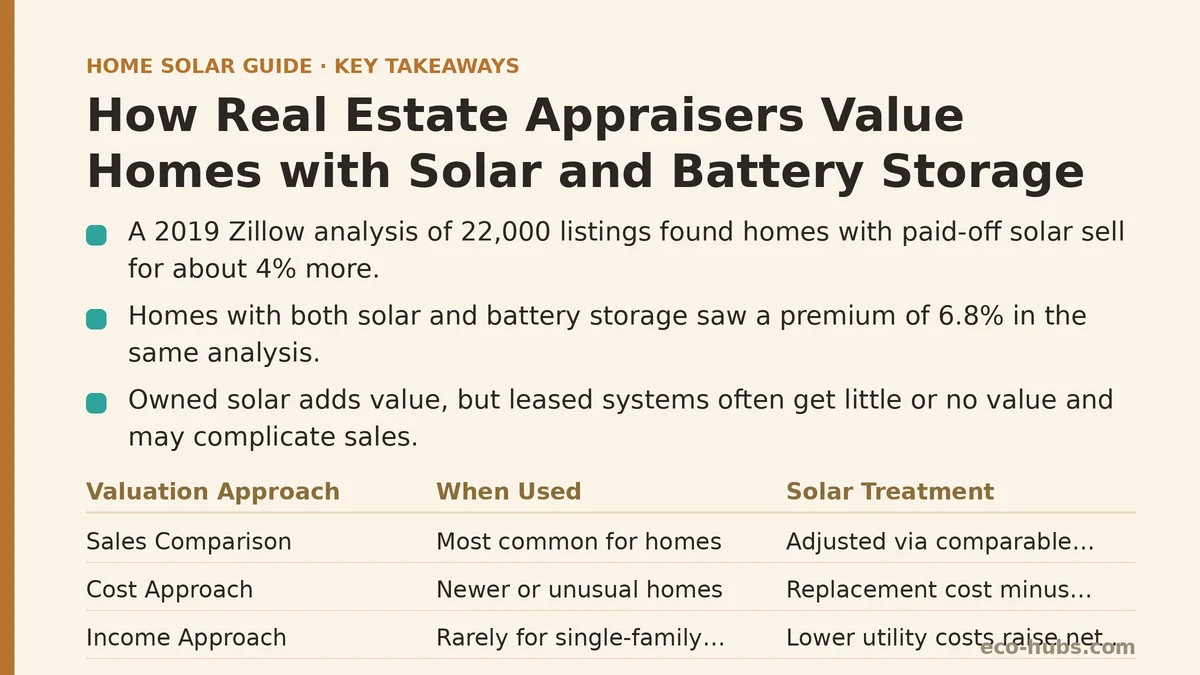
A house with a fully paid-off 6 kW solar array sells for about 4% more than an identical house without one, according to a 2019 Zillow analysis of 22,000 listings. That same analysis found the premium for a home with both solar and battery storage jumps to 6.8%. But those are averages across entire markets. Your home’s actual appraisal premium could be double that — or it could be zero, depending on how the appraiser approaches your property.
Step 1: Understand the Appraiser’s Three Methods
Every residential appraisal relies on one of three valuation approaches. Understanding which one your appraiser will use tells you what evidence matters most.
Sales comparison approach (most common for homes). The appraiser finds three to five recently sold homes in your area that are similar in size, age, condition, and location. Each comparable sale gets adjusted up or down to account for differences — extra bathroom, larger lot, updated kitchen. Solar and battery systems fall into this adjustment process.
Cost approach (used for newer or unusual homes). The appraiser calculates what it would cost to rebuild your home from scratch, then adds the value of the land. Solar equipment is valued at its replacement cost minus depreciation. This approach favors newer systems because depreciation starts immediately.
Income approach (rarely used for single-family homes). This treats the home as a rental property and values it based on net operating income. Solar’s impact here flows through lower utility costs, which increase net income.
For a typical single-family appraisal, expect the sales comparison approach to dominate. That means your system’s value depends on what similar homes with solar have sold for in your immediate market. If solar is rare in your neighborhood, the appraiser may struggle to find direct comparables — and that’s where the premium often shrinks.
Step 2: Know What Appraisers Are Trained to Do
The Appraisal Foundation’s Uniform Standards of Professional Appraisal Practice (USPAP) requires appraisers to analyze “the effect on value of known and readily known amenities.” Solar panels qualify as a readily known amenity. But the standards don’t prescribe a specific dollar amount per kilowatt. Each appraiser interprets the data themselves.
Fannie Mae’s Selling Guide provides more concrete direction. It states that appraisers must consider the value of solar panels and other energy-efficient features, and that “the appraiser must analyze the effect on value of the solar panels.” Fannie Mae also clarifies that if the appraiser can’t find sufficient comparable sales with solar installations, they may need to use the cost approach as a secondary method.
In practice, this means most appraisers will do all three calculations in their head — sales comparison primarily, cost approach as a sanity check, and income approach to consider the utility savings angle — then choose a final number that reconciles them.
Step 3: Recognize the Three Value Drivers That Matter Most
Not all solar systems appraise equally. Three factors consistently separate full-value systems from discounted ones:
1. Ownership structure. A system you own outright adds value. A leased system with a 20-year contract can complicate a sale because the new owner must qualify to take over the lease — or the seller must buy it out. Appraisers frequently assign little or no value to leased systems, and in some cases the lease is treated as an encumbrance that reduces the buyer pool.
2. System age and performance. An appraiser will look at the year the system was installed and its expected remaining life. Most panels carry a 25-year performance warranty. A 5-year-old system has 20 years of productive life left. A 20-year-old system has 5 years left — and the premium drops accordingly.
3. Local market saturation. In markets where rooftop solar is common — California, Arizona, Massachusetts — appraisers have plenty of comparable sales and can reliably value solar add-ons. In states where solar is rare, comparable sales with solar may not exist, so the appraiser defaults to a conservative estimate or zero adjustment.
Battery storage adds an additional layer. The Zillow data suggests storage boosts the premium beyond solar alone, but appraisers may not have established local comps for storage systems yet. Expect a knowledgeable appraiser to consider the battery’s contribution to outage resilience and time-of-use savings, but don’t be surprised if they undervalue it due to lack of data.
Step 4: Gather the Documents That Help Your Appraiser
Appraisers are not solar experts. They typically spend less than an hour on your property and rely heavily on public records and the data they pull from the county assessor’s office. You can materially improve your appraisal outcome by preparing a folder before the appraiser arrives. Include:
| Document | Why It Matters |
|---|---|
| System spec sheet (panel and inverter model numbers) | Confirms system size and quality |
| Installation date and invoice | Establishes age and original cost |
| Annual production report (last 12 months) | Proves the system works as expected |
| Utility bills showing net metering credits | Documents actual cost savings |
| Warranty documents (panel, inverter, workmanship) | Demonstrates remaining coverage and transferability |
| Proof of ownership (paid invoice or loan payoff letter) | Verifies the system is owned, not leased |
| Battery spec sheet and warranty | Provides data appraisers need when local comps for storage are unavailable |
Hand this folder to the appraiser during the inspection. Most will appreciate it. A few may ignore it — but the ones who use it will produce higher valuations, because concrete data beats the appraiser’s general assumptions about “some solar panels.”
Step 5: Handle the Ownership Question Head-On
If your system is owned, this step is simple. Show the appraiser the paid invoice or loan payoff letter, and state clearly: “This system has no lease or power purchase agreement attached.” If your system is leased, you have a harder conversation ahead.
The common approach for leased systems in an appraisal is to treat the lease payments as an expense that offsets part of the utility savings. Fannie Mae requires the appraiser to analyze the impact of any lease on the property’s marketability. In markets with solar experience, appraisers may adjust the comparable sales for the lease — but the adjustment often reflects a lower value than an owned system.
If you’re planning to sell and your system is leased, you have three options:
- Buy out the lease before listing. This converts the system to owned, which typically adds the most value. Check your lease contract for the buyout price — it may be worth the investment if you plan to sell within the next two years.
- Keep the lease and disclose it clearly. The buyer assumes the remaining lease payments. Some buyers will accept this, but expect a narrower buyer pool and potentially lower offers.
- Transfer the lease to the buyer through an assignment. This works only if the buyer qualifies and agrees. In practice, this adds friction to the transaction.
Step 6: Address the “Zero-Value” Risk in Low-Saturation Areas
Consider a homeowner in Ohio who installs a 10 kW system for $25,000. They plan to sell in three years. If their county has very few solar homes, the appraiser may find no solar comparable sales within a reasonable radius — and without comparables, the sales comparison approach has nothing to adjust.
When this happens, appraisers often default to one of two outcomes:
- The cost approach carries the value. The appraiser estimates replacement cost of the system, applies depreciation, and adds that to the home’s value. For a three-year-old system with a 25-year lifespan, depreciation runs roughly 12% (using straight-line depreciation). A system that cost $25,000 new would add about $22,000 to the appraisal.
- The appraiser ignores the system entirely. This happens more often in markets with zero data points. The appraiser simply says “no reliable comparables exist” and proceeds with sales without solar adjustments.
Your defense is the document folder from Step 4. If you provide production data, warranty documents, and a clear ownership statement, the appraiser has a basis to include the system via the cost approach. Without documentation, they have every reason to default to the conservative path.
Step 7: Know the Premium Range in Your Market
The research on solar valuation consistently shows premiums — but the numbers vary widely by location and time period. Common findings include:
- 12% premium in California (Alvarez and colleagues, 2015 study of 10,000+ sales)
- 4% premium nationally (Zillow, 2019, owned systems)
- 6.8% premium for solar-plus-storage nationally (Zillow, 2019)
- $1,000 per 1 kW of capacity (multiple state-level studies, approximate average)
- Near-zero premium in markets with no solar comparables (observed in rural and low-adoption areas)
For a 6 kW owned system, the typical range is $4,000 to $15,000 added to your home’s sale price. The exact number depends on your market. If you’re in a high-saturation state with strong net metering, expect toward the upper end. If you’re in a low-saturation state with weak net metering, expect toward the lower end — or nothing if the appraiser has no framework to value it.
Battery storage adds $2,000 to $8,000 on top of solar in most markets, though this premium is growing as more appraisers gain familiarity with storage systems.
Step 8: Prepare for the Appraisal — Your Pre-Appraisal Checklist
You don’t control the appraiser’s training or your local market. You control your preparation. Run through this checklist before the appraisal appointment:
- Confirm your system is owned (or understand your lease terms fully)
- Print the system spec sheet and installation invoice
- Download your 12-month production report from your monitoring app
- Gather the last year of utility bills with net metering credits highlighted
- Locate panel, inverter, and battery warranty documents
- Find proof of ownership (paid invoice or loan payoff letter)
- Write a one-paragraph summary: system size, installation date, annual production, and monthly savings
- Check your county assessor’s records to confirm the system is listed as a real property improvement (some counties require this for permit finalization)
One more step: mention the system to the appraiser when they walk through. Don’t assume they’ll see the panels on the roof and adjust automatically. Say it plainly: “We have an 8 kW solar system with a 13 kWh battery, fully owned, installed in 2022, producing about 9,500 kWh annually.” Then hand over the folder.
Step 9: What to Do When the Appraisal Comes in Low
If your appraisal comes back with no solar premium, you have options — but the window to act is narrow. Appraisals are typically valid for 60 to 90 days. Within that window, you can:
- Request a reconsideration of value. Write to the appraisal management company (AMC), not the appraiser directly, citing the document folder and asking for a re-evaluation. Provide the comparable sales you’ve located with solar installations. Roughly half of reconsideration requests result in a revised value.
- Provide additional comparables. Use Zillow or Redfin to find sold homes within a 5-mile radius that had solar at the time of sale. This is the single most persuasive piece of evidence. If the appraiser missed a sale, the AMC may ask them to re-analyze.
- Wait for a new appraisal. If your transaction falls through and a new buyer enters, their lender will order a fresh appraisal. Each appraiser brings a different baseline.
Step 10: Before You Install — Design for Future Appraisal Value
If you’re reading this before installing, the appraisal outcome starts with your equipment and paperwork choices. Three decisions materially affect future resale value:
Choose owned over leased financing. Even if a lease gets you solar today with zero down, a purchase with a solar loan converts to full ownership when the loan is paid. Buyers and appraisers treat owned systems with far more confidence.
Maintain your paperwork from day one. The spec sheets, warranty registrations, and circuit diagrams that arrive with your system might feel like clutter now. Store them in a dedicated file. In five years, that file is worth thousands in appraisal value.
Size the system to your consumption, not to maximize production. An oversized system that exports more than you use may not earn a proportional premium, because appraisers compare systems by size in kW rather than by production history. A 6 kW system that meets your needs beats a 9 kW system that doesn’t, in both cost and appraised value.
If you have a solar or battery system and are planning to sell — or if you’re considering installation and want to understand the resale math — leave a comment with your market state and system size. That context helps narrow the premium range for your specific situation.
Related guides: Is Solar Battery Storage Actually Worth the Additional Cost, Solar and Battery Storage for Financial Advisors: What Clients Should Know, and Solar and Battery Storage for Home Businesses: A Tax and Accounting Guide.
🔗 Recommended Reading
- Solar Incentive Paperwork: Common Filing Mistakes That Delay Your Rebate
- Home Battery Sizing Mistakes That Lead to Blackout Regret
- Common Solar Installer Mistakes Homeowners Should Catch Before Signing
- Common Home Battery Storage Wiring and Placement Mistakes to Avoid
- Solar Payback Period vs Cash-on-Cash Return: Which Metric Should Homeowners Use