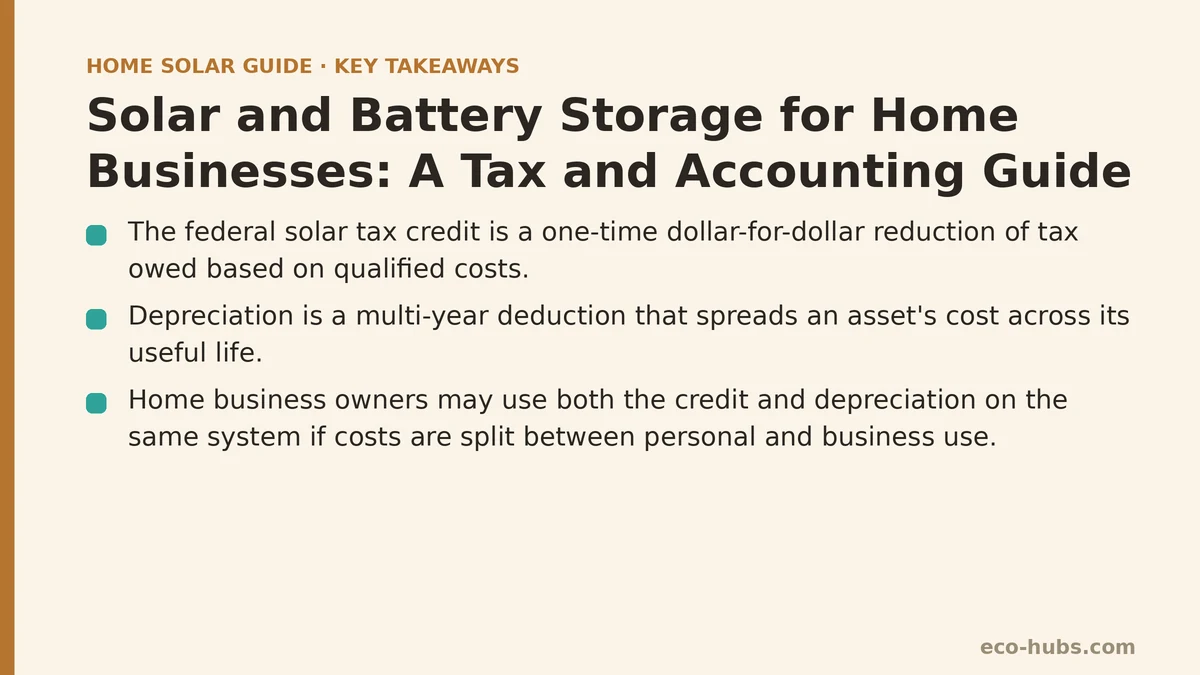
The federal solar tax credit and business depreciation are two different mechanisms that home business owners frequently conflate. The credit is a dollar-for-dollar reduction of tax owed, claimed once, based on a percentage of qualified costs. Depreciation is a multi-year deduction that spreads the cost of an asset across its useful life. If you operate a business from your home, you may be able to use both on the same system — but only if the system’s costs are properly split between personal and business use, and only if you follow the applicable rules for each. This guide walks through the sequence of decisions and filings, using illustrative numbers where helpful and flagging where a tax professional’s input is worth the cost.
Step 1: Confirm Whether You’re a Homeowner or a Business for This System
Before anything else, establish which capacity you are claiming the system under. Three common scenarios:
- Personal residence only. You own the home, the system serves the household, and you have no home office deduction or business use of the property. You follow the residential rules: the federal credit applies to equipment and installation labor, and there is no depreciation because personal-use property is not depreciable.
- Home business with a qualifying home office. You own the home and operate a business from a space that meets the IRS requirements for a home office deduction (regular and exclusive use, principal place of business, etc.). A portion of the system’s cost may be allocable to the business, opening the door to depreciation on that portion.
- Business owns or leases the property. The entity itself is the taxpayer. Different rules apply, including potentially the business-side investment tax credit and bonus depreciation or MACRS treatment. This guide focuses on the first two scenarios; the third typically involves entity-level accounting that should be handled with a CPA.
The distinction matters because the residential credit is claimed on Form 5695, while business credits flow through Form 3468 and business depreciation is reported on the appropriate depreciation schedules for the entity.
Step 2: Understand What Changed With the Battery Storage Rules
Battery storage has been the single biggest source of confusion in home business solar accounting over the past several years.
For residential systems, qualified battery storage technology with a capacity of 3 kilowatt-hours or more has been eligible for the federal residential clean energy credit when installed in connection with a solar system. Standalone batteries (installed without solar) have not generally qualified under the residential rules, though this has shifted at points and you should confirm the current rules with a tax professional or the IRS instructions for the year of installation.
For business systems, the treatment has historically been somewhat broader: storage can qualify for the business energy investment credit when it meets the statutory definition, and it can also be depreciable, sometimes at accelerated rates. The practical takeaway is that a home business owner may face a scenario where the same battery is partially a residential credit item and partially a business credit and depreciation item, depending on how the home office allocation falls out.
Common mistake: assuming that because the battery is “for the solar,” it automatically rides along with the same treatment as the panels. It often does, but not always, and the capacity threshold and installation-context requirements should be checked for your specific year.
Step 3: Split Costs Between Personal and Business Use
If the system serves both your household and a qualifying home office, you need a defensible allocation method. The IRS does not prescribe a single method, but the most common approaches are:
- Square footage method. Business percentage = (home office square footage) ÷ (total home square footage). If the office is 150 sq ft in a 1,500 sq ft home, that’s 10%.
- Usage method. Some taxpayers estimate business versus personal electricity consumption from the system. This is harder to defend without detailed metering.
- Hybrid method. Square footage for the fixed portion (panels, inverter, racking) and usage for the variable portion (the battery, if it primarily serves business equipment during outages).
Illustrative example: A $30,000 solar-plus-battery system with a 12% home office allocation yields roughly $3,600 of potentially business-allocable cost and $26,400 of personal cost. The personal portion follows residential credit rules; the business portion potentially qualifies for the business credit and depreciation. These are illustrative figures only — actual treatment depends on your specific facts.
Get the allocation method in writing and keep the calculation with your tax records. If you’re audited three years later, “I estimated it” is not a strong answer.
Step 4: Apply the Correct Federal Credit to Each Portion
The two credits are claimed on different forms and have different mechanics.
| Feature | Residential Credit (Form 5695) | Business Credit (Form 3468) |
|---|---|---|
| Applied to | Personal-use portion of system | Business-use portion of system |
| Rate | Typically 30% of qualified costs | Typically 30% for solar, subject to annual guidance |
| Carryforward | Unused credit can carry forward | Rules vary by technology and year |
| Interaction with depreciation | None — personal property isn’t depreciated | Business portion is generally depreciable in addition to the credit |
| Basis reduction | No basis reduction for the credit | Business credit typically reduces depreciable basis by the credit amount |
That last row trips people up. On the business side, if you claim a 30% credit on $3,600 of allocable cost ($1,080), your depreciable basis on that portion is commonly reduced from $3,600 to roughly $2,520. The credit is not “free” on top of full depreciation — there is an interaction. On the residential side, no such reduction typically applies.
The exact basis-reduction rules depend on whether the credit is treated as a general business credit and whether you elect to reduce the credit to preserve basis. This is one of the areas where a CPA earns their fee.
Step 5: Depreciate the Business Portion Correctly
Once you’ve isolated the business-allocable cost and applied the credit, the remaining basis is depreciable. Solar and battery storage assets are commonly depreciated under MACRS, and depending on the year and your business’s status, bonus depreciation or Section 179 may be available. The five-year property classification has historically been common for solar energy property, though the exact class life depends on how the asset is characterized.
Two practical points:
- Depreciation begins when the asset is placed in service, not when you pay for it. If permits and interconnection push activation into the following calendar year, the depreciation may shift with it.
- You cannot depreciate more than the business-use percentage. If the system is 12% business, only 12% of the depreciable basis is available to the business, regardless of how much you’d like to expense in year one.
State treatment varies widely. Some states conform to federal depreciation and credit rules; others have their own programs, caps, and carryforward rules. Check your state revenue department’s guidance for the year of installation.
Step 6: Handle the Home Office Deduction Interaction
If you claim the simplified home office deduction, note that it uses a fixed $5 per square foot rate and does not require you to track actual expenses — which means utility-related costs, including any incremental solar benefit, are effectively bundled into that simplified figure. If you claim the regular method, you can include the business percentage of utilities, which in a solar context may be a smaller number because the system is offsetting the utility bill in the first place.
Common mistake: double-counting. Claiming the full business percentage of utilities under the regular method while also claiming the full system cost as a business asset without adjusting for the fact that the system already reduced those utilities. Coordinate the two so the story is consistent.
Step 7: Build the Recordkeeping Packet
Before filing, assemble:
- Invoices and contracts showing system cost broken out by equipment, labor, permits, and any battery line item separately.
- Proof of payment and dates of payment.
- Date of placement in service (often the utility’s permission-to-operate date).
- Home office square footage calculation with a simple diagram.
- Allocation method memo explaining why you chose square footage, usage, or hybrid.
- Credit calculation worksheet showing the split between residential and business portions.
- Depreciation schedule for the business portion, including basis reduction from the credit.
- Manufacturer certifications if applicable (some equipment has specific certification requirements for credit eligibility).
Keep these for at least the later of three years after filing or the applicable depreciation recovery period — and longer if you claimed a carryforward credit.
Common Mistakes and How to Recover
Mistake 1: Claiming the full residential credit when part of the system is business-allocable. Recovery: Amend the return. Move the business portion to the correct form and adjust depreciation. Filing an amended return proactively is generally better than waiting for a notice.
Mistake 2: Taking the business credit but depreciating the full cost without basis reduction. Recovery: File an amended return and recalculate the depreciation schedule. The IRS will typically catch this on audit if not corrected.
Mistake 3: Installing standalone battery without solar and assuming it qualifies for the residential credit. Recovery: Confirm the year’s rules. If it doesn’t qualify, reclassify the cost as a non-credit improvement or, if there’s a business use, consider whether business-side treatment applies.
Mistake 4: Claiming a business percentage that isn’t supported. Recovery: If you can document a reasonable allocation method that yields a similar percentage, provide that documentation. If not, reduce the claimed percentage and amend.
Mistake 5: Forgetting that depreciation starts at placement in service. Recovery: Adjust the first year’s depreciation to reflect the correct in-service date. This is often caught by tax software, but skipped when filing manually.
What to Do Next
- Determine your taxpayer capacity for the system — personal, home business, or entity — before computing anything.
- Document your home office allocation with a written method and a simple calculation sheet.
- Separate your system invoice by line item so equipment, labor, permits, and battery costs are each visible.
- Confirm the current year’s credit rates and rules on the IRS forms and instructions, since both the residential and business credit provisions have been subject to periodic changes.
- Consult a CPA or enrolled agent before filing if any portion of the system is business-allocable — the interaction between the credit and depreciation is one of the more error-prone areas in small business tax.
- Ask your installer for the documentation packet (certifications, in-service date, itemized invoice) at the time of installation, not months later when you’re preparing your return.
If your situation involves a multi-member LLC, S-corp election, or a system that also charges a business vehicle, stop and get professional advice before computing anything — the allocation and credit-flow questions get materially more complex, and the cost of getting it right the first time is usually a fraction of the cost of unwinding a filing mistake.
Related guides: Home Battery Storage Installation: Step-by-Step Guide for First-Time Buyers, Common Home Battery Storage Wiring and Placement Mistakes to Avoid, and Home Battery Storage: Common Mistakes and How to Troubleshoot Them.
🔗 Recommended Reading
- Home Battery Sizing Mistakes That Lead to Blackout Regret
- Common Solar Installer Mistakes Homeowners Should Catch Before Signing
- Common Home Battery Storage Wiring and Placement Mistakes to Avoid
- Solar Payback Period vs Cash-on-Cash Return: Which Metric Should Homeowners Use
- Net Metering Credit Rollover Rules: What Happens at Year End