After reading this, you’ll know exactly what to check on your homeowners policy before and after installing solar, which questions to ask your insurer directly, and how much your answer to “am I covered” depends on whether you’re new to reading policy documents or already comfortable with them. Solar panels are a significant addition to a home’s insured value, and most standard policies were not written with rooftop solar in mind, which means the coverage gaps are often quiet ones — the kind that only surface after a claim, not before.
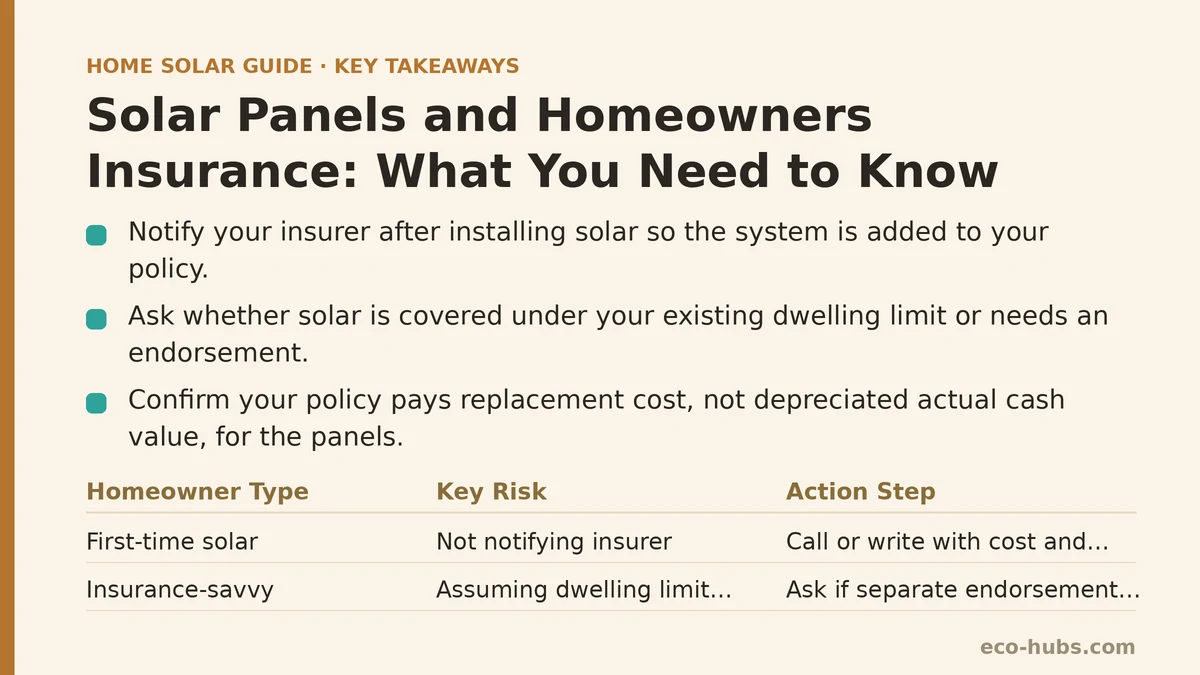
Two Starting Points, One Shared Problem
Not every homeowner approaches an insurance conversation the same way. Some people have never read past the declarations page of their policy and have no reason to have done so before now. Others already track their dwelling coverage limits, understand replacement cost versus actual cash value, and have probably filed a claim or two over the years. Solar panels create work for both groups, but the nature of that work — and the mistakes each group is prone to — differs enough that it’s worth separating them out.
Notifying Your Insurer: The First-Time Solar Homeowner
If you’ve never had a reason to contact your insurance company outside of renewing your policy, adding solar can feel like something you’d rather not bring up. That instinct works against you here. Most policies define covered property based on what was on file when the policy was written, and a $20,000–$30,000 rooftop system installed afterward simply isn’t part of that picture unless you tell your insurer it exists.
For someone unfamiliar with how policies get updated, the practical step is a phone call or written notice to the insurer stating that solar has been installed, along with the system cost and installation date. Some insurers automatically adjust dwelling coverage upward; others require an endorsement or rider specifically for the solar equipment. Not knowing which category your insurer falls into is the single most common gap among people installing solar for the first time.
Notifying Your Insurer: The Insurance-Savvy Homeowner
Someone who already reviews their policy annually is less likely to skip this step, but the risk shifts elsewhere. Experienced policyholders sometimes assume that because their dwelling coverage limit is already generous, the solar system is automatically absorbed into that cushion. That assumption isn’t always correct — some insurers treat solar as a scheduled item requiring its own line, separate from the general dwelling limit, regardless of how much headroom exists elsewhere in the policy.
The more useful habit for this group is asking the insurer directly whether solar is covered under the existing dwelling limit or requires a specific endorsement, rather than inferring the answer from overall coverage size.
Dwelling Coverage Limits and Replacement Cost
Coverage amount is only half the question; how a claim gets paid out is the other half.
For the first-time solar homeowner: the distinction between replacement cost and actual cash value matters more than it might seem. Actual cash value accounts for depreciation, meaning a five-year-old solar system damaged in a storm could be reimbursed at a fraction of what it would cost to replace it new. Confirming that your policy — or the specific endorsement covering the panels — pays replacement cost rather than depreciated value is worth doing before a claim ever becomes necessary, not after.
For the insurance-savvy homeowner: you likely already know your base policy’s payout structure, but the solar-specific endorsement doesn’t always inherit those same terms automatically. It’s worth confirming the endorsement itself states replacement cost coverage, since some insurers issue solar riders under different payout terms than the rest of the dwelling policy without making that distinction obvious in the paperwork.
Liability Considerations Tied to the Roof
Solar panels add physical load, mounting hardware, and wiring to a roof structure, all of which introduce liability questions that didn’t exist before installation.
For the first-time solar homeowner: the relevant concern is usually installation-related roof damage — a leak that develops around mounting points, for instance — and whether that falls under your homeowners policy, the installer’s workmanship warranty, or neither. This is worth clarifying with your insurer directly, since “damage caused by home improvement work” is sometimes excluded or handled differently than storm damage to the same roof.
For the insurance-savvy homeowner: the more relevant liability question tends to involve third-party injury, particularly if panels or mounting hardware were to detach in high wind and cause damage to a neighboring property. Confirming that your existing liability coverage extends to damage caused by solar equipment specifically — not just general dwelling liability — closes a gap that’s easy to overlook when you already assume broad liability coverage handles everything.
Deductibles and the Claims Process
For the first-time solar homeowner: it helps to understand that a claim involving solar damage is still subject to your standard deductible, and that deductible applies to the combined claim, not separately to the roof and the panels. A homeowner unfamiliar with this can be caught off guard when a repair estimate that sounded significant results in a modest payout after the deductible is applied.
For the insurance-savvy homeowner: the more practical step is understanding how your insurer documents solar equipment for claims purposes before anything happens — specifically, whether they require an itemized equipment list, installation invoice, or specification sheets on file in advance. Homeowners who already keep organized records for other claims purposes tend to have an easier time here, since solar claims frequently require documentation that a standard roof or siding claim wouldn’t.
Premium Changes: What Each Group Should Expect
Solar panels can raise a premium slightly due to the added insured value, though the increase is often smaller than homeowners expect, particularly relative to the value of the system itself. For someone new to solar, this modest increase can be mistaken for the full cost of insuring the system, when in reality it may not include the specific liability or replacement cost protections discussed above — those sometimes come as separate add-ons with their own cost. An insurance-savvy homeowner is more likely to ask for a full breakdown of what a quoted premium increase actually includes, rather than treating the total dollar figure as a complete answer.
Where Ground-Mounted Systems Change the Picture
A less commonly discussed distinction is between roof-mounted and ground-mounted solar arrays. Ground-mounted systems are sometimes classified as a separate structure rather than part of the dwelling, which can place them under a different coverage category — often “other structures” coverage — with its own, typically lower, limit. Homeowners considering a ground-mounted array, regardless of their experience level with insurance, should confirm this classification specifically, since assuming the dwelling coverage limit applies could leave a meaningful portion of the system’s value unprotected.
Where the Two Groups Actually Align
Despite the differences above, both first-time and experienced homeowners run into the same blind spot eventually: assuming that because solar was mentioned to the insurer once, the coverage question is permanently settled. Policies renew annually, insurers occasionally revise their solar-specific terms, and a system that was properly covered at installation isn’t guaranteed to remain covered under identical terms years later without periodic confirmation. This is one area where prior insurance experience doesn’t fully protect you — it only shortens how long the gap tends to go unnoticed.
Quick Comparison
| Consideration | First-Time Solar Homeowner | Insurance-Savvy Homeowner |
|---|---|---|
| Notifying insurer | Often skipped or delayed | Usually done, but coverage category assumed incorrectly |
| Replacement cost vs. actual cash value | Frequently unaware of the distinction | Aware generally, but may miss endorsement-specific terms |
| Roof liability | Unsure whether installer or insurer is responsible | May overlook third-party liability specifics |
| Deductible expectations | Often surprised by payout after deductible | Usually understands deductible mechanics |
| Documentation for claims | Rarely kept in advance | More likely to be organized already |
| Ongoing review | Rarely repeated after initial notice | Also prone to treating it as a one-time step |
A Short List Worth Bringing to Your Insurer
Regardless of which profile fits you better, a few questions are worth asking your insurer directly rather than assuming the answer: Does my current dwelling limit include the solar system’s value, or does it require a separate endorsement? Does that endorsement pay replacement cost or actual cash value? Does my liability coverage extend to damage caused by the panels or mounting hardware to a neighboring property? And what documentation do you require on file before a claim, rather than after one is filed?
Solar panels are a substantial investment, and the paperwork that protects that investment deserves the same attention as the installation itself. Have you confirmed with your insurer how your specific system is currently classified on your policy — and if not, is that a call worth making this week rather than after the next storm? Related guides: Solar Panel Maintenance: What to Actually Expect Over Time, Off-Grid Solar System Design: The Right Order of Decisions, and Solar Panel Brands Compared: Tesla, SunPower, Panasonic, and More.
🔗 Recommended Reading
- How to Size a Solar System for Your Home: A Beginner's Step-by-Step Walkthrough
- Solar Panel Monitoring Apps: A Setup Guide for Beginners
- How to Read Your Electricity Bill After Solar: A Line-by-Line Walkthrough
- Solar Incentive Paperwork: Common Filing Mistakes That Delay Your Rebate
- Home Battery Sizing Mistakes That Lead to Blackout Regret