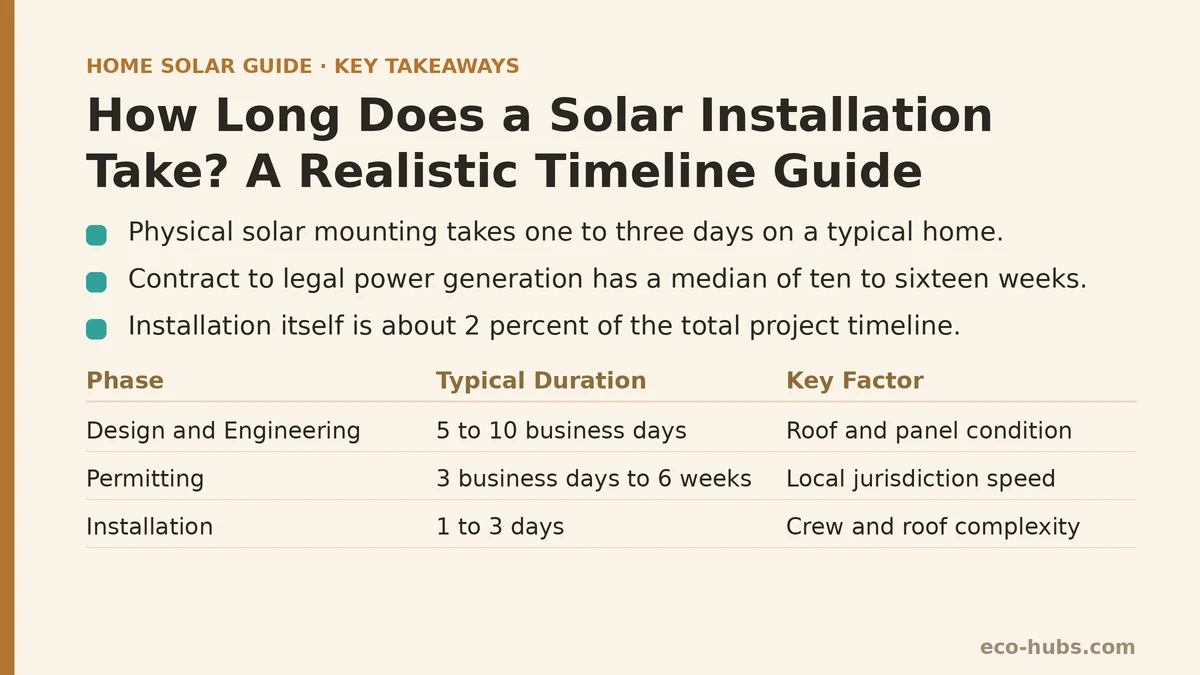
Most homeowners assume that a solar installation is a one-week job: panels in, inverter on, done. In practice, the physical mounting work takes one to three days on a typical home. But the full process — from signed contract to a system that is legally generating power — lands at a median of ten to sixteen weeks. The gap between those two numbers is where projects stall, and understanding that gap before you sign is the difference between planning around a three-month wait and being blindsided by one.
The Case That Took Fourteen Weeks
A homeowner in suburban Austin signed a contract in early March. The installation crew arrived in late April and finished the physical work in two and a half days. The system was not exporting power to the grid until mid-June. Between the contract and that final utility approval, exactly fourteen weeks elapsed. The installation itself consumed roughly 2 percent of the total timeline.
That ratio is not unusual. The physical work is the fastest, most predictable segment of a solar project. Everything else — design, engineering, permitting, inspection, utility interconnection — moves slower, involves third parties, and follows a queue completely outside the installer’s control.
Week 1–2: Design and Engineering
After signing, the installer sends out a site survey team. Roof measurements, panel layout, electrical panel assessment, and shading analysis all happen here. This phase usually takes five to ten business days, assuming your roof is accessible and your electrical panel is in reasonable condition.
The engineering review is where the first delays commonly appear. A structural engineer validates that your roof can support the added weight. An electrical engineer confirms the inverter and wiring plan meets code. For most single-family homes, this is routine. For older roofs, unusual angles, or homes with complex electrical panels, revisions add one to three weeks.
What moves this faster: Schedule the site survey within the first week of signing. Ask your installer what their engineering backlog looks like. Some companies batch these reviews weekly rather than continuously.
Week 3–6: Permitting
This is the first third-party checkpoint. Your installer submits the design package to the local building department, and the city or county reviews it for code compliance. Review times vary enormously.
- Fast jurisdictions (Houston, Phoenix, parts of Florida): 3–7 business days.
- Average jurisdictions: 2–3 weeks.
- Slow jurisdictions (many coastal California cities, some Midwest suburbs): 4–6 weeks, occasionally longer.
The permit is issued, and then the clock resets. Your installer schedules the installation based on their crew availability, which means you may wait another one to three weeks even after the permit is approved.
What moves this faster: Ask your installer before signing how many permits they’ve pulled in your specific city or county in the past year. Installers with established relationships navigate initial submissions more cleanly, reducing the back-and-forth that extends review times.
Week 6–8: Installation
Your one-to-three-day physical install finally arrives. A crew of four to six people handles the roof mounting, panel placement, conduit runs, and inverter wiring. The crew should be on site early, and the work should complete within the quoted window. Extensions happen when roofs are steeper than expected, when conduit runs require more length than the design anticipated, or when the electrical panel needs a replacement that was not planned for.
What moves this faster: Confirm the crew size and whether the same team stays for the entire job. Some companies send a partial crew and stretch the work over several days. Ask directly: “Will the installation complete in one or two consecutive days, or is it broken up?”
Week 8–10: Local Inspection
The county or city inspector visits the site to verify that the installation matches the approved permit. This is a single-visit event, but scheduling the visit is where time disappears. Inspectors have their own calendars, and your installer may have to wait one to two weeks for an available slot. The inspection itself takes thirty to sixty minutes.
Failures are not uncommon. The most frequent issues: grounding connections not properly bonded, conduit not secured to spec, or panel labels missing. Each failure requires a re-inspection, which adds another one to two weeks.
What moves this faster: Ask your installer about their inspection failure rate. A rate under 10 percent suggests they build to code the first time. Walk your roof before the inspector arrives and check for loose conduit or unsecured panels — a quick self-review can catch issues before the official visit.
Week 10–14: Utility Interconnection
This is the final gate, and it is the one homeowners most consistently underestimate. Your installer submits the interconnection application to your utility after the local inspection passes. The utility then reviews the application, may send their own meter technician, and schedules the final approval and meter swap.
Utilities are not fast. Rural electric cooperatives and municipal utilities often process these in two to four weeks. Large investor-owned utilities in populous states — California, Texas, Florida, New York — commonly run four to ten weeks. Some utilities batch approvals monthly, which means missing a cutoff date adds a full cycle.
The meter swap itself is a separate appointment. The utility sends a technician to exchange your standard meter for a bidirectional one. That appointment is often the single longest wait in the entire process, with some homeowners reporting three to six weeks just for the meter visit.
What moves this faster: Some utilities allow net metering to begin before the physical meter swap, using the existing meter’s backward rotation as a temporary measure. Ask your installer if your utility offers this. It does not shorten the approval timeline, but it lets your system operate and offset usage while the paperwork completes.
Timeline Compression: Where You Have Leverage
| Project Phase | Typical Duration | Homeowner Leverage |
|---|---|---|
| Design & engineering | 1–2 weeks | Schedule site survey immediately |
| Permitting | 1–6 weeks | Choose installer with local permit history |
| Physical installation | 1–3 days | Confirm crew size and consecutive-day completion |
| Local inspection | 1–2 weeks | Self-review for common failure points |
| Utility interconnection | 4–10 weeks | Verify early if temporary net metering is allowed |
The utility stage is the largest single block of time. It is also the one you have the least control over. The permitting stage is the most compressible, but only if you select an installer who works your jurisdiction regularly.
The Hybrid Reality
The fourteen-week Texas case did not involve any major failures. The homeowner did everything correctly. The permit cleared on the first submission, the inspection passed, and the utility approved the interconnection without a single resubmission. Even with all green lights, the system took over three months from contract to activation. Projects that hit delays — permit resubmissions, inspection failures, utility application errors — routinely run to twenty weeks or more.
The practical takeaway: plan for sixteen weeks as your baseline. If your system activates in ten, you are ahead of schedule. If your installer quotes a “six-to-eight-week” timeline, ask them, in writing, to break down each phase and identify which third-party controls each step. A timeline that does not explicitly account for utility wait times is a timeline that has not been fully stress-tested.
A Final Walkthrough of the Fourteen-Week Case
That Austin homeowner’s system powered on in mid-June, three months after signing. The panels themselves took two and a half days. The remaining ninety-four days were consumed by a system of checks and approvals that any standardized timeline must accommodate. The sharpest lesson from that project: the physical installation is the least risky, least time-consuming part of going solar. The process around it — the engineering, the permits, the inspectors, the utility — is the actual timeline, and it moves at the pace of institutions, not contractors.
What stage of the process are you in right now — are you still selecting an installer, waiting on a permit, or already scheduled for installation? Describe where you are and I can help you estimate what the remaining timeline looks like and where the most likely delay points are for your specific situation.
Related guides: Home Battery Storage Installation: Step-by-Step Guide for First-Time Buyers, Solar Panel Installation Process Step by Step: What Actually Happens, and A Beginner’s Step-by-Step Guide to Getting Your First Solar Quote.
🔗 Recommended Reading
- Solar Incentive Paperwork: Common Filing Mistakes That Delay Your Rebate
- Home Battery Sizing Mistakes That Lead to Blackout Regret
- Common Solar Installer Mistakes Homeowners Should Catch Before Signing
- Common Home Battery Storage Wiring and Placement Mistakes to Avoid
- Solar Payback Period vs Cash-on-Cash Return: Which Metric Should Homeowners Use