Say you are trying to decide between a $25,000 solar installation and a $25,000 kitchen remodel. The kitchen will clearly raise your home’s assessed value, and you are already bracing for a higher property tax bill next year. The solar array, though, feels different — it’s generating electricity, not just aesthetics. Does the assessor see it the same way? The answer is not uniform across the country, and understanding the differences before you sign can save you a rude surprise when the tax bill arrives.
Will Adding Solar Panels Increase My Property Assessment?
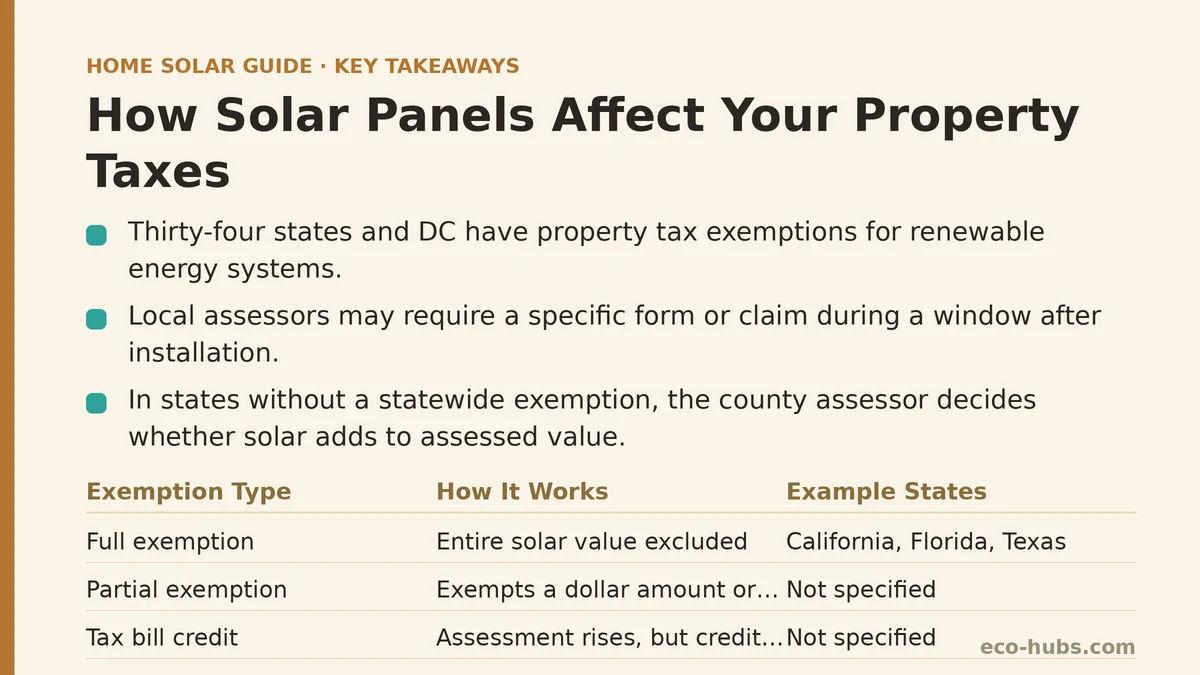
In most states, the short answer is no — because the law says so. Thirty-four states and the District of Columbia have enacted property tax exemptions specifically for renewable energy systems. These laws typically prevent the added value of a solar installation from being included in your home’s assessed value for property tax purposes. In those states, a $20,000 solar array won’t raise your assessment by a single dollar.
The critical detail, however, is that state law sets the baseline, but local assessors apply it. Some counties have adopted the exemption uniformly; others require you to file a specific form or claim during a window after installation. And a handful of states do not have a statewide exemption at all, which means your local taxing authority makes the call on its own.
How Does a Property Tax Exemption for Solar Work?
The mechanics differ from state to state, but four models are common.
The first is a full exemption. Your entire solar installation value is excluded from the assessed value of your home. This is the most common structure, and it’s what homeowners in states like California, Florida, and Texas enjoy.
The second is a partial exemption. Some states exempt a dollar amount or a percentage of the system’s value. For example, a state might exempt the first $50,000 of a residential solar system’s appraised value for a period of ten years. Anything above that threshold gets taxed.
The third is a rebate or credit against your tax bill, rather than an exclusion from the assessment itself. The assessment goes up, but you receive a credit that offsets the increase. This achieves the same net effect but requires different paperwork each year.
The fourth is a restricted exemption tied to specific conditions. Some states condition the exemption on using a state-approved installer, or on the system being sized below a certain capacity, or on the home being your primary residence. Miss one condition, and the exemption may not apply.
Are There States Where Solar Raises Your Property Taxes?
Yes. In states without a statewide exemption, the decision falls to the county assessor. Practice varies widely even within the same state. Assessors in areas with active solar markets often exclude solar value voluntarily, treating it as maintenance or efficiency rather than an increase in taxable value. Assessors unfamiliar with solar, or operating in jurisdictions under fiscal pressure, might include the full replacement cost.
A few states have taken the opposite stance. In states where solar installations are assessed as personal property rather than real property, you may face not only a higher real property assessment but a separate tax bill on the equipment itself. This is rare for residential systems, but it does occur, and it is why checking your state’s specific rules is a necessary pre-installation step, not a pleasant-to-have.
What If My Home Is Sold? Does the Buyer’s Assessment Change?
This is where homeowners often run into confusion. The exemption typically applies to the homeowner who owns the system. When you sell the house, the buyer’s assessed value may reset. Some states carry the exemption forward to the next owner automatically; others do not.
A buyer purchasing a home with an existing solar array in a non-exemption state needs to understand that their property tax bill may reflect the system’s value from the first year of ownership. This can create a negotiating point in the home sale — but only if both parties understand the local assessment rules before closing.
What Documents Do I Need to Claim the Exemption?
Start with your state energy office or the assessor’s office in your county. Request the exemption form, which typically asks for:
- The date of system installation
- The system’s capacity in kilowatts (kW)
- A copy of the interconnection agreement with your utility
- The total installed cost, including equipment and labor
- A copy of your installation contract
File the form within the window specified by your state — commonly 30 to 90 days after installation — and retain a stamped copy for your records. In states where the exemption renews annually, you may need to confirm continuation each year, though many states now apply the exemption automatically after the initial claim.
How Does This Interact With the Federal Tax Credit?
The federal solar Investment Tax Credit (ITC) and your state property tax exemption operate independently. The ITC reduces your federal income tax liability based on a percentage of your total system cost. The property tax exemption reduces your local property tax assessment. Neither affects the other’s eligibility or calculation.
One practical note: if your county assessor asks you to report the installed cost of the system for assessment purposes, you may be tempted to report the cost net of the ITC. Do not do this. The ITC is a federal income tax benefit, not a rebate that reduces the installed cost at the time of installation. Your assessor will typically want the gross installed cost, and providing an inaccurate figure can trigger an audit or a reassessment.
Is It Better to Lease or Purchase to Avoid Property Tax Increases?
The ownership structure does not eliminate the property tax question, but it changes how the assessor values the system.
Purchased systems are what most exemption laws refer to. The full value is excluded by state law or considered by the assessor based on your ownership.
Leased systems are generally considered personal property owned by the leasing company, not real property owned by you. In most states, this means the system is not included in the assessed value of your home at all — but you are also not eligible for the state property tax exemption, because there is no assessable interest for you to exempt.
Power purchase agreements (PPAs) follow the same logic as leases. The system is owned by a third party, so it does not count toward your assessment. The practical tax impact is neutral to positive.
The tradeoff is real, though. Purchasing gives you the ownership asset and the exemption. Leasing avoids the property tax question entirely but gives you no exemption benefit. If you live in a non-exemption state, the lease structure offers a clean way to avoid the assessment issue altogether.
Should I Notify My Assessor or Wait for Them to Notice?
You have two options, and both carry risk.
If you file the exemption form proactively, you ensure the exemption applies from day one, but you also put your system on the assessor’s radar. In an exemption state, this is fine. In a state without an exemption, this may result in the assessor deciding to include the system in your assessment — a decision you would have faced anyway, but now with documentation in hand.
If you wait and say nothing, the assessor may or may not discover the installation. Some jurisdictions do routine property inspections; others simply adjust for building permits. Solar installations typically require a building permit, and that permit record goes to the assessor’s office. The realistic scenario is that the assessor will learn of the system within one to two assessment cycles, regardless of whether you file anything.
The prudent approach is to check your state’s law first. If you are in an exemption state, file the form. If you are in a non-exemption state, make a deliberate decision about timing, and recognize that deferring the issue only postpones an assessment you will likely face anyway.
| State Law Status | What Happens to Your Assessment | What You Should Do |
|---|---|---|
| Statewide full exemption | No increase; must file the exemption form | Apply within the required window after installation |
| Partial exemption | Portion of system value may be assessed | Determine the exempt amount and expected annual tax increase |
| No statewide exemption | Local assessor decides; may include full system value | Check county practices, consider financing structure |
| Lease or PPA ownership | System not assessed as real property | Confirm with your leasing company that they pay any associated taxes |
The Realistic Bottom Line for a Homeowner
Property tax treatment of solar is a state-level decision that most homeowners can navigate with a few hours of research. The vast majority of solar-active states have exemptions, and those exemptions are straightforward to claim. The minority of states without exemptions are not a reason to avoid solar — they are a reason to price the annual tax increase into your overall cost calculation, alongside the equipment warranty, the payback period, and the inverter replacement cycle.
One question that many homeowners skip is this: has your county ever reassessed a home specifically because of a solar installation? That’s a question a phone call to your local assessor’s office answers in under ten minutes, and it will tell you more than any national summary.
Are you in the middle of deciding on solar, and if so, which state or county is your home located in? Share that detail, and I can help you determine whether your jurisdiction’s property tax treatment changes the economics of your installation.
Related guides: A Financial Advisor’s Guide to Calculating Client Solar ROI Scenarios, State-by-State Solar Incentives and Rebates: A Complete Guide, and Do Solar Panels Work During a Power Outage? It Depends on Your System Type.
🔗 Recommended Reading
- Solar Incentive Paperwork: Common Filing Mistakes That Delay Your Rebate
- Home Battery Sizing Mistakes That Lead to Blackout Regret
- Common Solar Installer Mistakes Homeowners Should Catch Before Signing
- Common Home Battery Storage Wiring and Placement Mistakes to Avoid
- Solar Payback Period vs Cash-on-Cash Return: Which Metric Should Homeowners Use