By the end of this guide, you will know exactly which categories of incentives to search for in your own state, how those categories typically interact with the federal solar tax credit, and how to avoid the common mistake of assuming a program that exists in one state applies everywhere. Solar incentives are not a single national system with minor local variations — they are a patchwork of separate programs, and the difference between states can change a project’s payback period by several years.
To make this concrete, we’ll follow the research process of a household in South Carolina evaluating a system, then compare what the same system would look like under a different state’s incentive stack. The specific programs mentioned reflect the kind of structure homeowners commonly encounter, though program details change frequently and should always be confirmed directly before a purchase decision.
Starting With the One Constant: The Federal Tax Credit
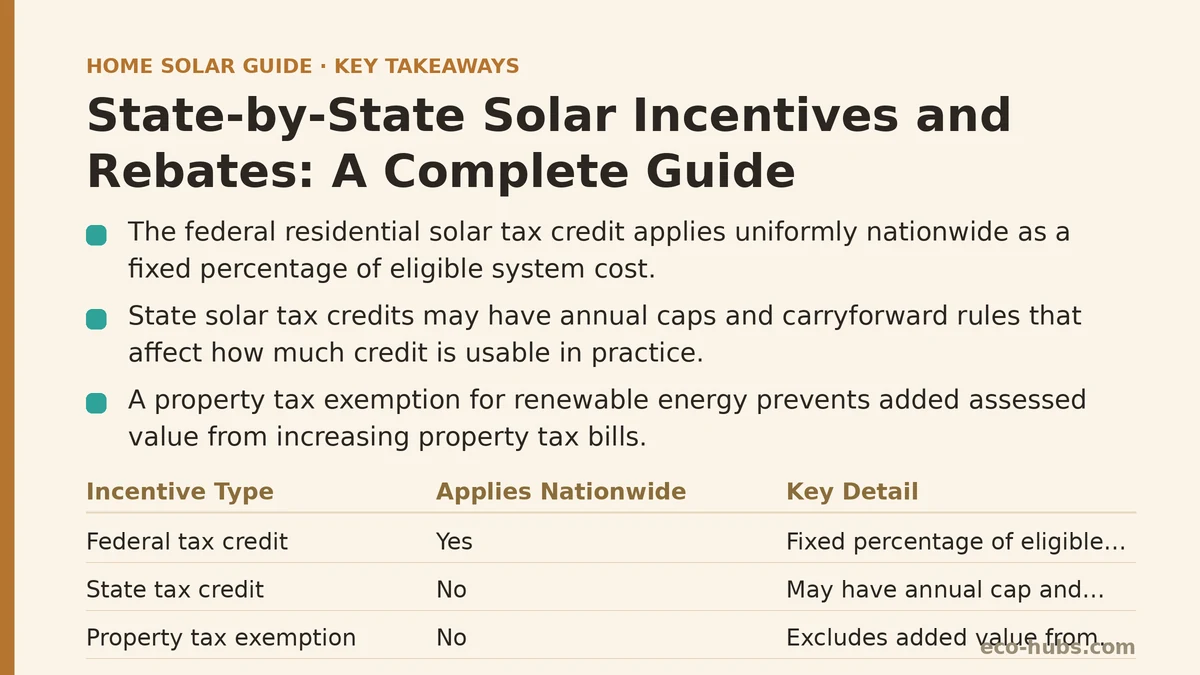
Before looking at anything state-specific, the Alvarez household in Columbia, South Carolina started where every homeowner should start: the federal residential solar tax credit, covered in detail in our dedicated guide. This credit applies uniformly nationwide, reducing the eligible cost of a system by a fixed percentage regardless of state. It is the one piece of the incentive picture that does not change based on zip code, which makes it a useful fixed reference point before layering in anything state-specific.
With a quoted system cost of $24,000, the federal credit alone brought their effective cost down meaningfully before a single state program was even considered. Everything below built on top of that baseline.
Finding the State Income Tax Credit
South Carolina offers its own state-level solar tax credit, separate from and stacked on top of the federal credit, though capped at a lower dollar amount per year with the ability to carry forward unused credit into future tax years. This detail — the annual cap and carryforward provision — turned out to matter more than the headline percentage. The Alvarez family’s tax liability in a single year was not large enough to use the entire credit at once, so understanding the carryforward rule directly affected how they modeled their payback timeline.
This is a pattern worth flagging for any homeowner: a state credit’s percentage is only half the story. The annual cap, the carryforward or refundability rules, and any minimum tax liability requirements determine whether that percentage is fully usable in practice or only partially realized over several years.
Checking for a Property Tax Exemption
Adding solar panels typically increases a home’s assessed value, which would normally raise property taxes. Many states address this directly through a property tax exemption specific to renewable energy systems, effectively excluding the added value from the tax assessment. South Carolina includes such an exemption, meaning the Alvarez family’s property tax bill would not increase as a direct result of the installation.
This exemption is easy to overlook because it produces no immediate paperwork or rebate check — it simply prevents a cost that would otherwise appear years later. Confirming this exists in your own state (and understanding whether it requires a specific application or applies automatically) is worth doing before assuming your property tax bill will remain unaffected.
Checking for a Sales Tax Exemption
Separately from the property tax question, some states exempt solar equipment purchases from sales tax entirely. This applies at the point of purchase rather than at tax filing time, and it is usually built directly into the installer’s quote rather than requiring a separate claim. South Carolina’s exemption meant the Alvarez family’s original quote already excluded sales tax on the equipment, which they confirmed by asking their installer directly whether the quoted price reflected this exemption or whether tax would be added separately at signing — a question worth asking any installer regardless of state, since assuming an exemption applies without confirming it can lead to an unpleasant surprise on the final invoice.
Net Metering: Where the Real Variation Begins
Net metering policy is where state-by-state differences start to compound significantly, and it is also where homeowners are most likely to assume their state’s rules match what they’ve read about elsewhere. Net metering determines how much credit you receive for excess electricity your system sends back to the grid, and the structure varies from full retail-rate credit to reduced wholesale-rate credit to no net metering at all in favor of a different compensation structure entirely.
South Carolina’s investor-owned utilities operate under a net metering framework that has shifted over recent years as caps on program enrollment were reached and revised. The Alvarez family discovered that the specific utility serving their address — not just the state as a whole — determined which version of the policy applied to them, since different utilities within the same state can operate under different approved tariffs. This single detail is worth double-checking directly with your utility rather than relying on a general state-level summary, because two households in the same state served by different utilities can end up with meaningfully different compensation structures.
Finding a Utility-Specific Rebate
Beyond net metering, some utilities offer their own rebate programs independent of state or federal incentives, often funded through utility efficiency or renewable program budgets rather than tax revenue. These programs tend to be smaller in dollar amount, frequently capped by an annual budget that can run out before the calendar year ends, and are rarely advertised as prominently as tax credits.
The Alvarez family’s utility offered a modest per-watt rebate for systems installed by approved contractors, available on a first-come basis until that year’s program budget was exhausted. Finding this required checking the utility’s own website directly rather than relying on their installer’s marketing materials, which mentioned the federal and state credits prominently but did not initially surface this narrower utility program.
The Program That Doesn’t Exist Everywhere: SRECs
This is where the comparison with a different state becomes useful. South Carolina does not have an active SREC (Solar Renewable Energy Certificate) market. In states that do — Massachusetts and New Jersey among the more established examples — homeowners can earn certificates for the electricity their system generates and sell those certificates on an open market, sometimes generating meaningful annual income well beyond simple bill savings, separate from any one-time credit or rebate.
Had the Alvarez family’s identical system been installed in a state with an active SREC market instead, their total incentive picture would look considerably different — not because the panels or the federal credit changed, but because an entire additional revenue stream would exist. This comparison illustrates the central point of this guide: the same system, same cost, and same electricity usage can produce a substantially different financial outcome purely based on which state-level programs happen to be available where you live.
Building Your Own Research Checklist
Following the Alvarez family’s process, here is the sequence worth working through for any state:
| Step | What to Check | Where to Confirm It |
|---|---|---|
| 1 | Federal tax credit basis and eligible costs | IRS guidance / our federal tax credit guide |
| 2 | State income tax credit, cap, and carryforward rules | State department of revenue |
| 3 | Property tax exemption for added system value | County assessor’s office |
| 4 | Sales tax exemption on equipment purchase | Installer’s itemized quote |
| 5 | Net metering policy for your specific utility | Utility’s tariff filings or customer service |
| 6 | Utility-specific rebate programs and remaining budget | Utility’s renewable energy program page |
| 7 | SREC market availability, if any | State energy office or SREC marketplace registry |
Working through this list in order mirrors roughly how incentives tend to stack in practice: federal first, then state-level tax treatment, then property and sales tax adjustments, then the ongoing compensation structure through net metering, and finally any narrower utility or certificate-based programs layered on top.
What This Means for Comparing Quotes Across States
If you are relocating, comparing a vacation property in a different state, or simply reading about a neighbor’s experience from another part of the country, resist the instinct to assume their incentive stack matches yours. The questions to ask a solar installer, covered in our dedicated guide, should include a direct request to itemize which specific state, utility, and federal programs their quote assumes — rather than a single bundled “savings” figure that obscures which program is doing the work.
Programs also change. Net metering caps get revised, state credits get renewed or allowed to expire, and utility rebate budgets reset annually. A program that applied to a neighbor’s installation two years ago may not apply identically to a new system today, even at the same address.
Have you started researching what’s available in your own state yet? If you share your state and utility, we can help you work through which categories from this checklist are most likely to apply to your situation.
Related guides: A Financial Advisor’s Guide to Calculating Client Solar ROI Scenarios, How Solar Panels Affect Your Property Taxes, and A Beginner’s Step-by-Step Guide to Getting Your First Solar Quote.
🔗 Recommended Reading
- Solar Incentive Paperwork: Common Filing Mistakes That Delay Your Rebate
- Home Battery Sizing Mistakes That Lead to Blackout Regret
- Common Solar Installer Mistakes Homeowners Should Catch Before Signing
- Common Home Battery Storage Wiring and Placement Mistakes to Avoid
- Solar Payback Period vs Cash-on-Cash Return: Which Metric Should Homeowners Use