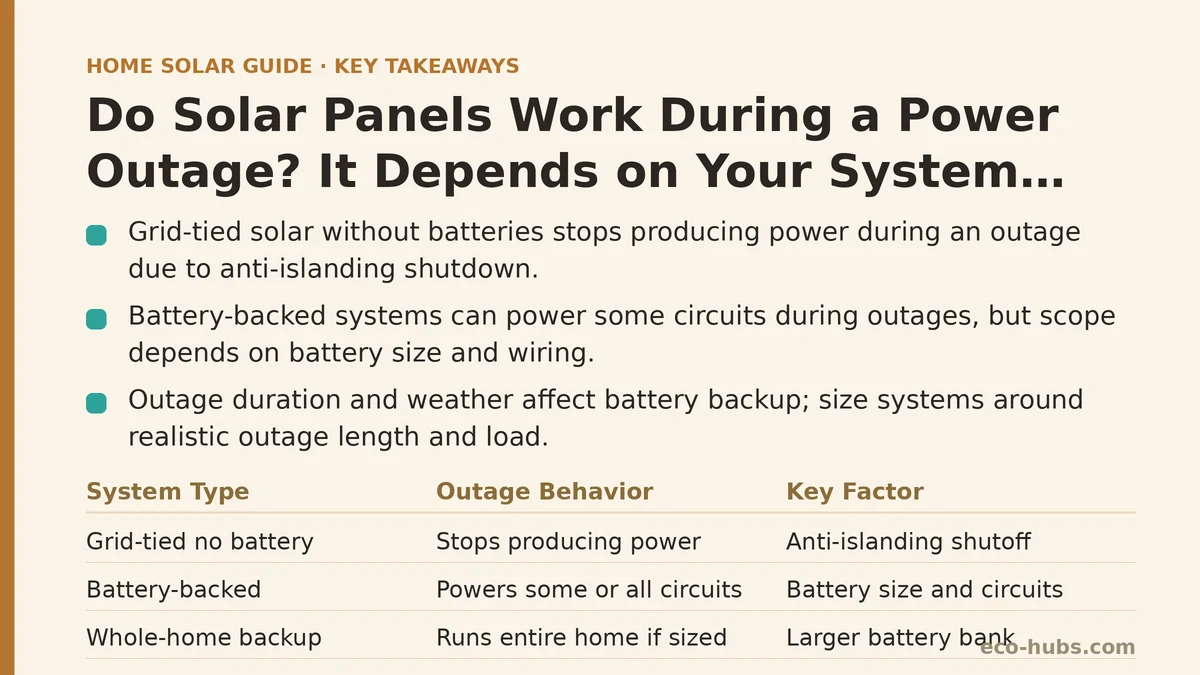
Whether solar panels keep working during a power outage depends entirely on whether the system has anti-islanding shutoff built in, and whether it includes battery storage or a backup transfer switch. A standard grid-tied system without batteries will stop producing usable power the moment the grid goes down, regardless of how sunny it is outside. A system with battery storage, by contrast, can continue supplying power to some or all of a home’s circuits. The panels themselves are not the deciding factor — the inverter and storage configuration are.
This distinction gets lost in a lot of marketing language, and it is one of the more common points of confusion homeowners run into after installation rather than before it.
Myth: Solar Panels Automatically Provide Backup Power
The assumption is understandable. If your roof is covered in panels actively converting sunlight into electricity, it seems reasonable to expect that electricity to be available even when the grid fails. Solar marketing sometimes reinforces this impression by emphasizing energy independence without clarifying which configuration actually delivers it.
Reality: Grid-Tied Systems Shut Off During Outages by Design
A standard grid-tied solar system is required by code to shut down automatically when it detects a grid outage. This safety feature, called anti-islanding, exists to protect utility line workers who might be repairing power lines during that outage. If your panels kept feeding electricity into the grid while a crew was working on a “dead” line, the result could be fatal. So the inverter is designed to sense the outage and stop production within seconds, regardless of how much sunlight is hitting the panels at that moment.
This means the majority of residential solar installations in the U.S. — systems installed without battery storage, sized primarily to offset utility bills through net metering — provide zero backup power during an outage. The panels are physically intact and the sun is still shining, but the system produces nothing until grid power is restored.
Myth: Any Battery Storage Means the Whole House Stays Powered
Once battery storage enters the conversation, a second myth tends to follow: that adding a battery means the entire home runs normally during an outage, indefinitely, exactly as it would on grid power.
Reality: Backup Scope Depends on Battery Size and Circuit Configuration
Battery-backed systems do allow continued power during an outage, but the scope and duration depend on two separate factors: how much energy the battery can store, and which circuits are wired to draw from it. Most residential battery installations are configured with a subset of “critical load” circuits — refrigerator, some lighting, internet equipment, maybe a well pump — rather than the entire home’s electrical panel. Running everything, including central air conditioning or an electric range, typically requires either a much larger battery bank or multiple battery units, which adds substantially to the upfront cost discussed in most system pricing breakdowns.
Duration matters too. A single battery might comfortably power critical circuits overnight, but a multi-day outage during cloudy weather can drain even a well-sized battery if solar production isn’t sufficient to recharge it between uses. Homeowners considering battery backup specifically for outage protection should size the system around realistic outage length and load, not around a generic “whole home backup” claim without specifics attached.
Myth: A Battery and Solar Panels Are Interchangeable Terms
Some homeowners assume that because their solar quote mentioned “backup capability,” the system automatically includes battery storage as a default component.
Reality: Battery Storage Is a Separate, Optional Addition
Solar panels and battery storage are distinct pieces of hardware, priced and installed separately in most cases. A system can be entirely grid-tied with no battery at all, and this is still the more common and lower-cost configuration for homeowners primarily focused on reducing monthly utility bills rather than outage resilience. Adding battery storage — whether at initial installation or as a later addition — requires its own equipment, its own installation labor, and in many cases a separate permitting and interconnection step with the utility.
If backup power during outages is a priority, this needs to be stated explicitly during the quoting process, and confirmed as an included line item rather than assumed based on general solar marketing language. This is a good example of the kind of specific question worth raising directly with an installer before signing anything.
Myth: A Generator and a Battery System Solve the Same Problem the Same Way
Homeowners weighing backup options sometimes treat a battery system and a standby generator as functionally identical choices, differing only in price.
Reality: The Two Technologies Behave Differently During an Outage
A battery system switches over near-instantly and operates silently, drawing on stored energy and recharging from solar production when available. A generator, typically running on natural gas or propane, needs to start up (often within seconds via an automatic transfer switch, but not instantly) and runs as long as fuel supply allows, independent of weather or daylight. Generators can typically sustain higher loads for longer continuous stretches, since they aren’t limited by stored energy capacity, but they require fuel delivery or storage and regular maintenance, and they produce noise and emissions that a battery system does not.
Some homeowners pair both: a smaller battery for short outages and quiet, seamless backup of essential circuits, with a generator as a fallback for extended multi-day outages where battery capacity alone would not be sufficient. This hybrid approach is worth discussing directly with an installer familiar with both technologies rather than assuming one option fully replaces the other.
Comparison at a Glance
| System Type | Produces Power in an Outage? | Scope of Backup | Key Limitation |
|---|---|---|---|
| Grid-tied, no battery | No | None | Anti-islanding shutoff by design |
| Grid-tied with battery, critical loads only | Yes | Selected circuits | Limited by battery size and recharge rate |
| Grid-tied with large battery bank | Yes | Most or all of home | Higher upfront cost |
| Battery paired with standby generator | Yes | Full home, extended duration | Requires fuel supply and generator maintenance |
What to Check If Outage Protection Matters to You
If keeping the lights on during an outage is a real priority rather than an afterthought, the relevant question isn’t “do you offer battery backup” — it’s which specific circuits would stay powered, how many hours or days that battery could realistically sustain those loads, and what happens if the outage outlasts the battery’s charge under low-sun conditions. Ask for these specifics in writing before signing, since “battery backup included” can mean very different things depending on the size and configuration behind that phrase.
Are you evaluating a system with outage protection in mind, or trying to understand what your existing setup actually covers? Share which circuits matter most to you during an outage, and it becomes much easier to work out whether critical-load backup, whole-home battery capacity, or a generator pairing fits your situation best. Related guides: How Solar Panels Affect Your Property Taxes, How to Calculate How Many Solar Panels You Need for Your Home, and Selling Your House With Solar Panels: Owned vs. Leased.
🔗 Recommended Reading
- Solar Panel Monitoring Apps: A Setup Guide for Beginners
- How to Read Your Electricity Bill After Solar: A Line-by-Line Walkthrough
- Solar Incentive Paperwork: Common Filing Mistakes That Delay Your Rebate
- Home Battery Sizing Mistakes That Lead to Blackout Regret
- Common Solar Installer Mistakes Homeowners Should Catch Before Signing