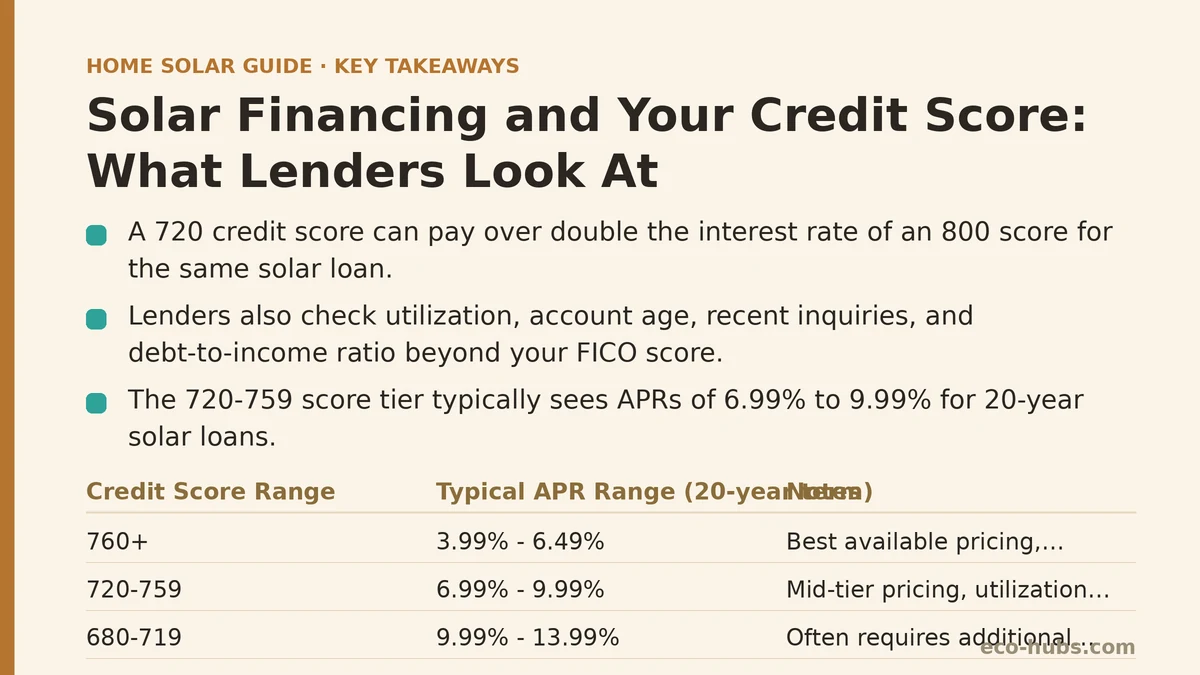
A borrower with a 720 credit score can pay more than double the interest rate of someone with an 800 score for the exact same solar loan amount. Lenders segment solar borrowers far more aggressively than most homeowners anticipate, and the difference between a “good” and “excellent” score translates into thousands of dollars over a typical 20-year term. Most people assume that any score above 700 qualifies them for the best available rates. That assumption costs them.
The Application That Changed How We Explain Financing
Consider a homeowner — call him Marcus — who contacted us after receiving two wildly different loan quotes for a 9.8 kW system. His credit score at the time was 731, which he believed put him in strong territory. One lender quoted him 9.99% APR over 20 years. Another quoted 5.99%. Same system, same down payment, same region. The difference came down to how each lender evaluated his credit profile and which scoring tier they applied.
Marcus’s story illustrates why the credit score conversation for solar loans is different from what most people experience with auto loans or credit cards. The spread between top-tier and mid-tier pricing is wider, the factors beyond the raw score matter more, and the consequences of applying before your profile is ready can follow you for months.
The First Thing Lenders Check: It’s Not Just Your Score
When Marcus’s file was reviewed, the first data pulled was his FICO score — specifically, the FICO Score 8 model, which remains the dominant version used by solar lenders. But the score alone told only part of the story. Lenders also examined:
- Credit utilization ratio — Marcus was using 43% of his available revolving credit. Lenders in the solar space commonly cap “good” utilization at 30%, with 10-20% considered ideal.
- Age of oldest account — His oldest account had been open for 11 years, which helped him. A shorter credit history, even with a high score, often triggers higher rates because lenders cannot assess long-term payment behavior.
- Recent inquiries — Marcus had applied for a car loan four months earlier. That single inquiry had a modest impact on his score, but it appeared recent enough that lenders noted it.
- Debt-to-income ratio — His monthly obligations represented 38% of his gross income. Many solar lenders prefer this under 43%, but the best rates typically require 36% or lower.
The raw score of 731 would suggest a single mid-tier rate. In practice, lenders combine the score with these underlying factors, then apply their own proprietary pricing grids. Two lenders looking at the same data can arrive at different rates because their internal models weigh utilization and history differently.
Where the Lending Tiers Fall
A table becomes useful here, but the numbers tell a sharper story when placed side by side. The standard tier structure across most established solar lenders looks something like this:
| Credit Score Range | Typical APR Range (20-year term) | Notes |
|---|---|---|
| 760+ | 3.99% – 6.49% | Best available pricing, minimal scrutiny of other factors |
| 720–759 | 6.99% – 9.99% | “Mid-tier” pricing, utilization and DTI start to matter more |
| 680–719 | 9.99% – 13.99% | Often requires additional collateral or a larger down payment |
| 640–679 | 13.99% – 18.99% | Limited lender options, frequent denials without a co-signer |
| Below 640 | Often denied outright | Some credit unions offer secured alternatives |
Marcus fell squarely into the 720–759 band. The 5.99% quote he received from one lender was an exception — that lender used a promotional tier for borrowers with a first mortgage already paid down, which Marcus qualified for because his home was mortgage-free. The other lender applied a standard grid without that consideration.
The lesson: the published tiers are a starting point, not a guarantee. Lenders maintain internal overlays that adjust rates based on the mix of factors described above. A score on the low end of a tier paired with high utilization can push you into the next tier down.
How One or Two Points Changes Everything
Marcus’s situation also revealed a specific quirk: his score fluctuated between 727 and 736 over a six-week window depending on when his credit card balances were reported to the bureaus. Had he applied during the high point of that cycle, he might have secured a 6.99% rate instead of the 9.99% he was initially quoted. That single-digit score difference was worth approximately $4,100 in interest over the life of the loan.
This is why timing matters. Credit card issuers typically report balances to the bureaus once per month, usually on the statement closing date. If your statement closes with a high balance, that balance is what appears on your credit report, regardless of whether you pay it off in full before the due date. Solar applicants who pay down their balances to below 10% utilization approximately two weeks before applying can see a meaningful score increase — often 15 to 30 points — without any other changes.
How Lenders Evaluate Your Existing Debt
The debt-to-income ratio deserves its own walkthrough because it functions differently for solar loans than for most other consumer debt. A mortgage lender might accept a DTI up to 50%; solar lenders commonly cap out at 45%, with the most favorable pricing reserved for those at 36% or below. But there is an additional layer: the new solar payment itself counts toward the DTI calculation.
Lenders estimate the new monthly payment based on the loan amount and the highest potential interest rate for your tier, not the rate you are quoted. This conservative approach can push borderline applicants over the threshold. Marcus’s DTI of 38% meant the projected solar payment of roughly $180 per month would bring him to 41% — still under most caps, but close enough that one lender applied a higher rate as a hedge.
A useful workaround exists for homeowners with significant home equity. Some lenders allow a “cash-out refinance” model where the solar loan is treated as a second mortgage. In that structure, the DTI calculation changes because the loan is secured differently, and some applicants with DTIs up to 50% can still qualify. The tradeoff is cosignature requirements are stricter, and the loan becomes tied to your home with the corresponding foreclosure risk.
The Hidden Cost of Applying Before You’re Ready
Marcus’s first loan application resulted in a hard inquiry that dropped his score by three points. That minor drop alone did not cause problems, but it illustrates a broader issue: each hard inquiry on a solar loan application can reduce your score by 2 to 5 points, and the effect compounds if you are shopping with multiple lenders over a short period.
The credit bureaus treat multiple inquiries for the same type of loan within a 14- to 45-day window as a single inquiry, depending on the scoring model. FICO Score 8 uses a 45-day window for rate shopping. If you stretch your lender search beyond that window, the second round of inquiries counts separately, and your score begins to deteriorate. Extending this timeline to a three-month search across five lenders can cost you 10 to 15 points — enough to push you from one pricing tier down to the next.
Marcus learned this the hard way when his lender search spanned eight weeks because he kept waiting for updated quotes. His first inquiry at week one was followed by additional inquiries at week five and week eight, all outside the 45-day consolidation window. The resulting score drop from 731 to 723 contributed to the higher quote he ultimately received.
What You Can Measure and Fix Before Applying
Several aspects of your credit profile are beyond quick repair, but the following areas respond well to focused effort over a 60- to 90-day window:
- Credit utilization: Pay revolving balances down to below 10% of available credit. This is the single fastest lever you can pull, often yielding a 15- to 30-point improvement within one to two billing cycles.
- Derogatory marks: If you have a collection account or late payment older than two years, disputing it or negotiating a pay-for-delete arrangement can remove it from your report. This step requires documentation and persistence, but the score gain can exceed 50 points.
- Credit card age: Do not close old credit cards, even if you do not use them. Closing a card shortens your average account age and raises your utilization ratio simultaneously, a double penalty.
- Recent hard inquiries: Wait at least 60 days after your most recent inquiry before applying. This allows the score impact to fully settle and shows lenders a cleaner recent history.
For homeowners who are several years away from financing, a broader strategy works best. Maintaining a utilization ratio below 10% consistently, keeping every account in good standing, and avoiding new debt for at least 12 months before applying will position you for the top tier when you are ready.
The Secured Option That Bypasses the Credit Score
Not every solar buyer needs to chase the best possible credit score. A significant alternative exists: the home equity loan or home equity line of credit (HELOC). Because these loans are secured directly by your home equity, lenders weigh the equity percentage more heavily than the credit score. A borrower with a 680 score and 40% home equity can often secure rates comparable to someone with a 760 score, because the collateral provides a different kind of risk mitigation.
The catch is twofold. First, your home serves as collateral — a default means foreclosure, not just a damaged credit score. Second, the upfront fees on home equity products run higher than unsecured solar loans, often 2% to 5% of the loan amount. When spread across 20 years, that fee difference can offset much of the interest savings from the lower rate. The math works best for homeowners with substantial equity who plan to remain in the home for the full loan term.
How Marcus Resolved His Situation
After reviewing his options, Marcus took a deliberate path. He paid down his credit card balances from 43% utilization to 9%, waiting six weeks for the updated balances to report. His score moved from 731 to 748. He then submitted a single application through a credit union that offered a promotional rate for members, staying within a single lender to avoid additional inquiries. That application produced a 6.49% APR over 20 years — a substantial improvement over his initial 9.99% quote, and a total interest savings of approximately $5,300.
The process took eleven weeks from his first quote to final approval. The delay was worth it. But Marcus’s experience also highlighted that not every homeowner has that kind of time. If you need solar financing within the next month, your score is close to fixed. In that case, the most productive step is to compare quotes across at least three different lender types — a national solar financing company, a local credit union, and a home equity lender — because each applies different internal grids, and the same credit profile can produce meaningfully different results.
What You Should Do This Week
Pull your current credit report from all three major bureaus through AnnualCreditReport.com, not a third-party scoring site that shows a VantageScore instead of FICO. The score lenders see is almost always a FICO product, and the difference between the two models can reach 40 points. Review your utilization ratio across all revolving accounts, write down your oldest account age, and count any hard inquiries from the previous 12 months. That short exercise tells you which of the levers above are worth pulling before you apply.
What does your current utilization ratio look like, and how far outside the 10% target are you? Share that number along with your timeline for financing, and I can help you identify which specific actions are worth taking before you submit your first application.
Related guides: Solar Panel Financing Options: What Actually Differs Between Loan Types, The Federal Solar Tax Credit Explained for Homeowners, and Solar Lease vs Buy: An Honest Comparison Based on the Actual Numbers.
🔗 Recommended Reading
- Solar Incentive Paperwork: Common Filing Mistakes That Delay Your Rebate
- Home Battery Sizing Mistakes That Lead to Blackout Regret
- Common Solar Installer Mistakes Homeowners Should Catch Before Signing
- Common Home Battery Storage Wiring and Placement Mistakes to Avoid
- Solar Payback Period vs Cash-on-Cash Return: Which Metric Should Homeowners Use