Solar financing is any arrangement that lets a homeowner install a system without paying the full cost upfront in cash, and the term covers a wider range of structures than most quotes make clear. A secured solar loan, an unsecured personal loan, a home equity line of credit, a power purchase agreement, and a lease are all commonly marketed under the umbrella of “financing,” yet they differ on the single point that matters most: who owns the system, and who therefore keeps the tax credit, the long-term savings, and the risk if something goes wrong.
Below is a ranked comparison of the five most common financing structures, ordered from most to least favorable for a typical homeowner planning to stay in the home long-term. Ranking assumes ownership and long-term cost as the priority; a homeowner with different priorities, such as zero maintenance responsibility, might reasonably reorder this list.
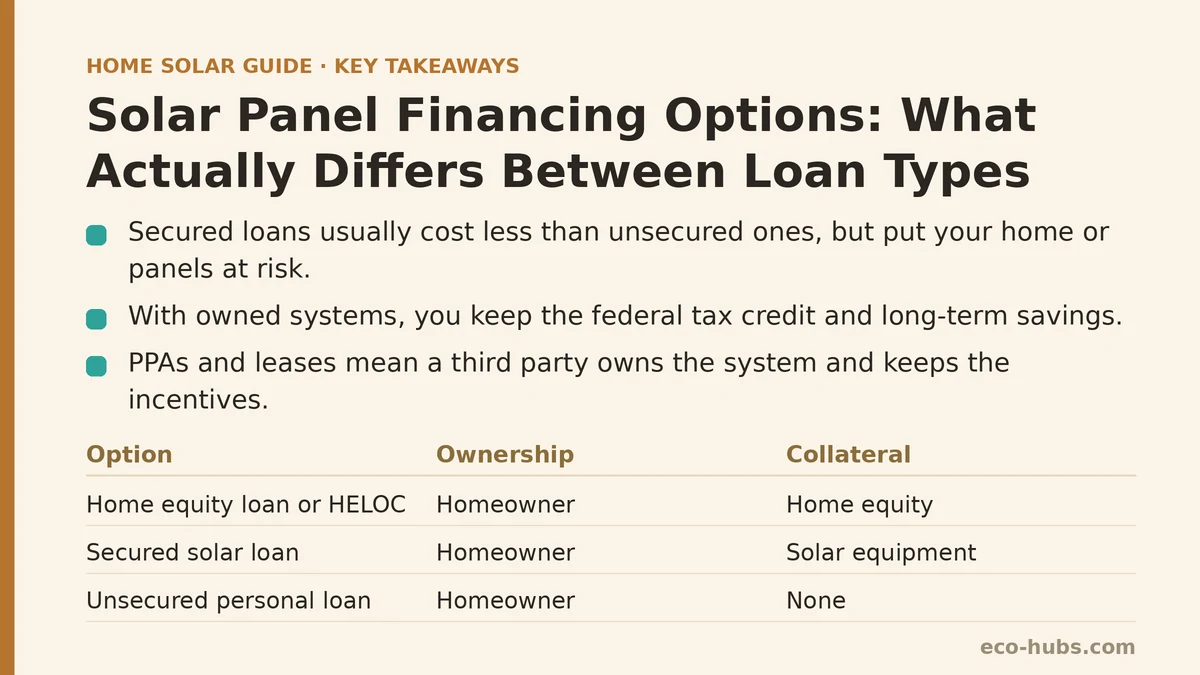
1. Home Equity Loan or HELOC
A home equity loan or home equity line of credit uses the equity already built into your home as collateral, which typically produces the lowest interest rate of any option on this list. Because the loan is secured against real property rather than the solar system itself, lenders view it as lower risk and price it accordingly, often several percentage points below an unsecured solar loan.
Ownership sits entirely with the homeowner from day one, meaning the federal solar tax credit, covered in our dedicated tax credit guide, applies in full and belongs to you rather than a third party. The tradeoff is that your home itself is the collateral. Missed payments carry more serious consequences than with an unsecured product, and closing costs or appraisal requirements can add time and expense to the setup process that a dedicated solar loan typically avoids.
Best suited for: homeowners with substantial existing equity and the discipline to treat this as they would any other secured debt.
2. Secured Solar Loan
A secured solar loan uses the solar equipment itself as collateral rather than the home. Rates land between home equity products and unsecured loans in most cases, and terms are frequently structured to align with the 26-year performance warranty typical of panels, which keeps monthly payments manageable relative to the electricity savings being generated.
You retain full ownership under this structure, so the tax credit and any state incentives flow directly to you. The main friction point is that the lender places a lien on the equipment, which can occasionally complicate a home sale before the loan is paid off, since the new buyer or their lender needs to be informed of that lien and how it will be resolved at closing.
Best suited for: homeowners without significant home equity who still want full ownership and the tax benefits that come with it.
3. Unsecured Personal Loan
An unsecured personal loan requires no collateral at all, which makes it the fastest option to arrange and the one with the least paperwork. Approval can sometimes happen within days rather than the weeks a secured product might require.
That speed comes at a cost. Interest rates on unsecured loans are consistently higher than either home equity or secured solar loans, since the lender is taking on more risk without a lien to fall back on. Ownership still transfers to the homeowner immediately, so the tax credit applies in full, but the higher rate can erode a meaningful portion of the savings that solar is supposed to generate, particularly over a longer repayment term.
Best suited for: homeowners who need to close quickly, don’t want a lien on either their home or the equipment, and can tolerate a higher rate in exchange for that flexibility.
4. Power Purchase Agreement (PPA)
A power purchase agreement flips the ownership question entirely. A third-party company owns the panels, installs them on your roof, and sells you the electricity produced at an agreed rate, typically lower than your utility’s retail rate. There’s no loan to repay and no upfront cost, which explains why PPAs get marketed heavily to homeowners wary of financing altogether.
The catch is that ownership, and everything tied to it, stays with the third party. You do not receive the federal tax credit; the PPA provider claims it. Long-term savings are generally smaller than what an owned system produces over the same period, since you’re paying a rate for electricity indefinitely rather than paying off a fixed loan and then generating electricity at no marginal cost. Selling the home also requires either transferring the agreement to the buyer or paying to terminate it, both of which have created friction in real transactions when a buyer’s lender is unfamiliar with PPA terms.
Best suited for: homeowners prioritizing zero upfront cost and no ownership responsibility over maximizing long-term savings.
5. Solar Lease
A solar lease resembles a PPA in almost every structural respect: a third party owns the system, you make a fixed monthly payment instead of a usage-based one, and you don’t receive the tax credit. Ranked last here primarily because the payment is fixed regardless of how much electricity the system actually produces, which removes the built-in incentive a PPA provider has to keep the system performing well, since their revenue under a PPA depends directly on output while a lease payment does not.
Maintenance and repairs typically remain the leasing company’s responsibility, similar to a PPA, and the no-upfront-cost appeal is identical. But because savings are decoupled from production and ownership never transfers, a lease tends to produce the smallest long-term financial benefit of the five structures compared here, even though the monthly payment may look attractive at signing.
Best suited for: homeowners who want predictable fixed payments and have limited concern about maximizing long-term savings or eventual home resale simplicity.
Comparison at a Glance
| Rank | Financing Type | Ownership | Tax Credit Eligibility | Typical Rate/Cost Position |
|---|---|---|---|---|
| 1 | Home Equity Loan/HELOC | Homeowner | Yes | Lowest rate, home as collateral |
| 2 | Secured Solar Loan | Homeowner | Yes | Moderate rate, equipment as collateral |
| 3 | Unsecured Personal Loan | Homeowner | Yes | Higher rate, no collateral |
| 4 | Power Purchase Agreement | Third party | No | No upfront cost, ongoing usage payments |
| 5 | Solar Lease | Third party | No | No upfront cost, fixed payments |
The Question That Should Drive Your Decision
Before comparing rates or monthly payments across these five options, settle one question first: do you want to own the system, or are you optimizing for zero upfront cost and no ownership responsibility even at the expense of long-term savings? That single decision eliminates roughly half the list immediately and makes the remaining comparison, which is mostly about rate and collateral type, considerably more straightforward.
Which of these five structures is closest to what you’re currently being offered, and do you know yet whether the quote includes ownership of the system? Share the details and we can help you figure out where it actually lands relative to the alternatives above. Related guides: Solar Financing and Your Credit Score: What Lenders Look At, Solar Lease vs Buy: An Honest Comparison Based on the Actual Numbers, and The Federal Solar Tax Credit Explained for Homeowners.
🔗 Recommended Reading
- Solar Panel Monitoring Apps: A Setup Guide for Beginners
- How to Read Your Electricity Bill After Solar: A Line-by-Line Walkthrough
- Solar Incentive Paperwork: Common Filing Mistakes That Delay Your Rebate
- Home Battery Sizing Mistakes That Lead to Blackout Regret
- Common Solar Installer Mistakes Homeowners Should Catch Before Signing