A lot of homeowners picture the federal solar tax credit as something close to a rebate: install the system, submit some paperwork, and a check shows up a few months later covering roughly a third of the cost. That’s not how it works. The credit is a dollar-for-dollar reduction of what you owe the IRS when you file, not a payment issued to you directly, and whether you can use the full amount depends on how much federal tax you actually owe in the first place. That distinction sounds small until you’re the one filing a return and discovering the credit didn’t behave the way you expected.
To make this concrete rather than abstract, it helps to follow one household through the actual process — the contract they signed, the invoice they received, and the return they filed the following spring.
A System, a Contract, and the Numbers on Paper
The Alvarez household in Tucson signed a contract for an 8.2 kW rooftop system in the fall, with a total price of $24,600 covering panels, inverter, mounting hardware, permitting fees, and labor. Installation was completed in December, and the system passed final utility inspection in January. That gap between contract date and inspection date turns out to matter quite a bit, which we’ll get to shortly.
On paper, $24,600 looks like the number the tax credit should apply to. In practice, the credit basis and the contract price aren’t always identical, and understanding the difference is the first place homeowners tend to overestimate what they’ll actually receive.
Calculating the Actual Credit Basis
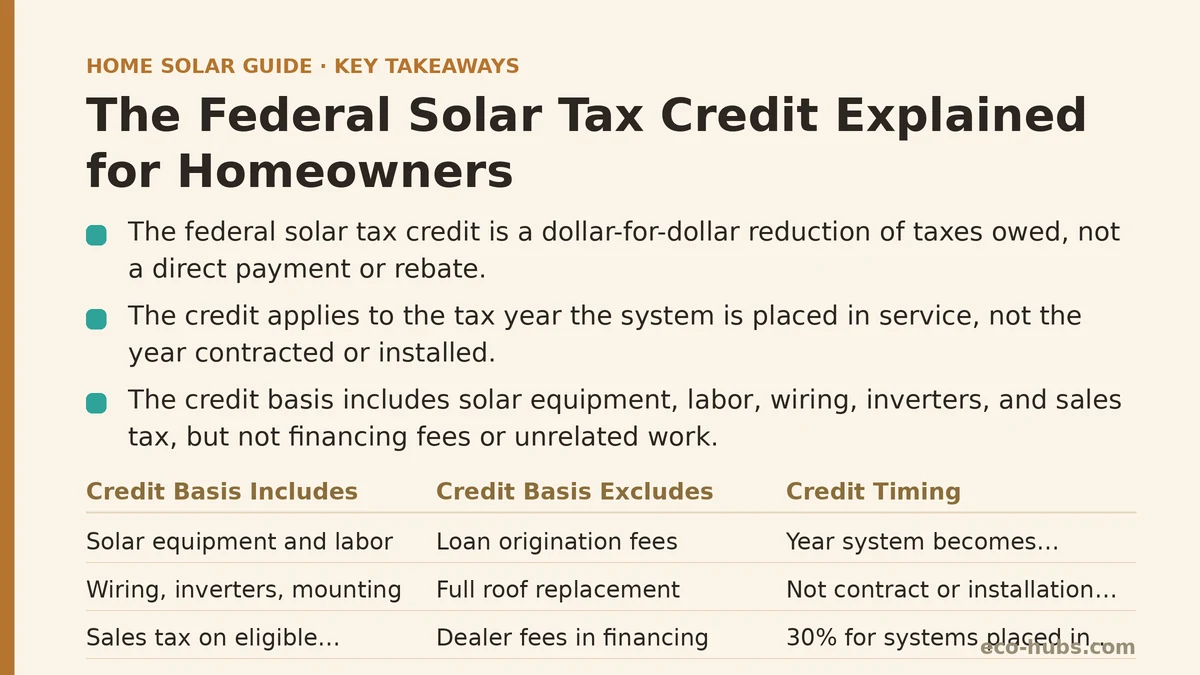
The federal credit applies to the cost of the solar equipment itself, along with labor for on-site preparation, assembly, and installation, plus wiring, inverters, mounting equipment, and sales tax on those eligible expenses. For the Alvarez system, essentially the entire $24,600 qualified, because nothing in the project involved unrelated work.
Where this gets murkier is when a project bundles in something adjacent — a roof replacement, for instance. If a portion of a roof needs to be replaced specifically to support the solar installation, that portion can sometimes qualify, but a full roof replacement done mainly for its own sake generally does not. Homeowners who combine roofing and solar work in one contract should ask their installer for an itemized breakdown rather than assuming the full invoice qualifies, since an inflated basis claimed on a return can create problems well after the fact.
Financing fees are another area worth separating out. If a loan is used to pay for the system, the loan origination fee or any dealer fee baked into the financing itself is typically not part of the eligible basis, even though it appears on the same paperwork as the rest of the project cost.
Where the Percentage Comes From, and Why the Completion Date Matters
The credit is currently set at 30% of the eligible basis for systems placed in service through 2032, after which it’s scheduled to step down before phasing out entirely under current law. For the Alvarez family, 30% of $24,600 comes to $7,380 — assuming the entire contract amount is eligible, which in their case it was.
The phrase “placed in service” is doing real work in that sentence. The credit applies to the tax year in which the system becomes operational, not the year the contract was signed or the year installation began. Because the Alvarez system passed final inspection in January rather than December, the credit applies to the following tax year, not the year the panels went up. A homeowner who assumes the credit applies to whichever year they signed paperwork can end up filing in the wrong tax year and having to amend a return later.
The Nonrefundable Part Nobody Warned Them About
Here’s where the rebate assumption causes the most trouble. The credit is nonrefundable, meaning it can only reduce your federal tax liability down to zero — it cannot generate a refund larger than what you owed before applying it. If the Alvarez family owed $5,000 in federal tax for the relevant year, the $7,380 credit reduces that liability to zero, but the remaining $2,380 doesn’t disappear. It carries forward to the following year’s return, and the year after that if needed, until it’s fully used or the credit expires under current law.
This is the single most common point of confusion homeowners run into after filing. A retiree with modest taxable income, or a household with a large deduction that already brings tax liability close to zero, may need several years to fully use a credit of this size. That’s not a flaw in planning — it’s simply how a nonrefundable credit is designed to work, and it’s worth confirming with a tax preparer before assuming the full amount will land in a single filing year.
State and Utility Incentives Layered on Top
Arizona offered the Alvarez family a modest state tax credit alongside a one-time utility rebate for battery-ready systems. Rebates from a utility company typically reduce the federal eligible basis, since they’re treated as a discount on the purchase price rather than taxable income. State tax credits, by contrast, generally don’t reduce the federal basis the same way, though they may be counted as taxable income on a subsequent federal return depending on how the state structures the credit.
This layering is exactly the kind of detail worth confirming with whoever prepares your taxes rather than guessing, since getting the order of operations wrong — applying the federal percentage before subtracting a rebate, for example — can lead to a basis figure that doesn’t match what a preparer or an IRS review would expect.
Filing the Paperwork
Claiming the credit requires IRS Form 5695, filed alongside your regular federal return for the year the system was placed in service. The form walks through the eligible basis, calculates the credit percentage, and carries any unused portion forward automatically if your tax liability doesn’t absorb the full amount that year. The Alvarez family used a tax preparer for this step rather than filing on their own, mainly because the interaction between the utility rebate and the federal basis wasn’t something they wanted to calculate incorrectly on a form that’s easy to misread on a first attempt.
What They Would Tell Another Homeowner
Looking back, the Alvarez family’s main takeaway wasn’t about the math itself — it was about timing expectations correctly from the start. Knowing that the credit would apply to the following tax year, rather than the year they signed the contract, would have changed how they budgeted for that first tax season. Understanding upfront that the credit might carry forward, rather than assuming it would fully offset one year’s return, would have made the nonrefundable structure feel like a known feature rather than an unwelcome surprise.
Quick Numbers Recap
| Item | Alvarez Household Figures |
|---|---|
| Contract price | $24,600 |
| Eligible basis | $24,600 (no roof or financing exclusions) |
| Credit percentage | 30% |
| Credit amount | $7,380 |
| Tax year applied | Year of utility inspection, not contract signing |
| Amount used year one | Limited to tax liability; remainder carried forward |
Do you already have a signed contract or a completed installation, and are you unsure which tax year it applies to or how a rebate might affect your basis? Share where things stand and we can help you sort out what the numbers are likely to look like on your own return. Related guides: Common Mistakes Homeowners Make When Applying for Solar Tax Credits and Incentives, Solar Financing and Your Credit Score: What Lenders Look At, and Solar Lease vs Buy: An Honest Comparison Based on the Actual Numbers.
🔗 Recommended Reading
- Solar Panel Monitoring Apps: A Setup Guide for Beginners
- How to Read Your Electricity Bill After Solar: A Line-by-Line Walkthrough
- Solar Incentive Paperwork: Common Filing Mistakes That Delay Your Rebate
- Home Battery Sizing Mistakes That Lead to Blackout Regret
- Common Solar Installer Mistakes Homeowners Should Catch Before Signing