A solar lease is an arrangement where a third-party company owns the panels installed on your roof, and you pay a fixed or escalating monthly fee to use the electricity they generate. A solar purchase — whether paid in cash or financed through a loan — makes you the owner of the system from the day it’s installed, with all the costs, tax benefits, and long-term savings that ownership carries. These two structures produce meaningfully different financial outcomes over a 20-to-25-year system lifespan, and the gap between them is larger than most upfront sales conversations tend to convey.
Ranking the factors that separate these two paths by financial impact makes the comparison easier to hold in your head than a wall of disclaimers would.
1. Total Cost Over the System’s Lifetime
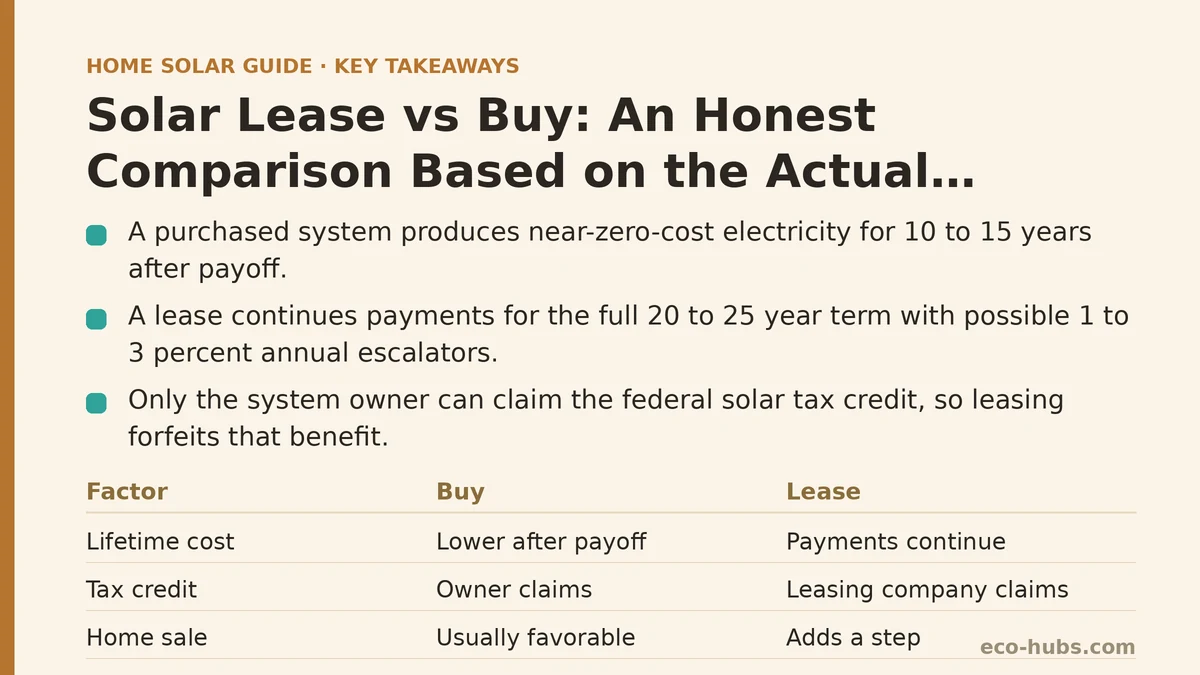
This is the single largest differentiator, so it earns the top spot. A purchased system, once paid off, produces electricity at close to zero marginal cost for the remaining 10 to 15 years of its usable life. A lease never reaches that point. The monthly payment continues for the full term of the agreement, typically 20 to 25 years, and many lease contracts include an annual escalator — often in the 1 to 3 percent range — that raises the payment every year regardless of what the utility does with its own rates.
Over two decades, this compounding difference tends to add up to tens of thousands of dollars separating the two paths, with ownership almost always coming out ahead in raw dollar terms. The exception is a homeowner who plans to sell the property well before the system would have been paid off anyway, which shifts the math in ways addressed further down this list.
2. Who Gets the Federal Tax Credit
The federal solar tax credit, covered in more detail in our dedicated guide, applies to the person or entity that owns the system. If you buy your system — cash or financed — that credit is yours to claim against your own tax liability. If you lease, the leasing company owns the system and claims the credit itself, not you.
Leasing companies often build this credit into their pricing to offer a lower monthly rate than they’d otherwise need to charge, but the value doesn’t pass through to you directly, and you have no visibility into exactly how much of that benefit is reflected in your rate versus retained as company margin. This is one of the more overlooked distinctions in a lease-versus-buy conversation, largely because it’s invisible in the monthly bill comparison that most sales pitches lead with.
3. What Happens When You Sell the House
A purchased solar system, particularly one that’s paid off, tends to be viewed favorably by buyers and appraisers, since it lowers their future electricity costs without adding any ongoing obligation. A leased system complicates the sale in a different way: the new buyer either needs to qualify to take over the lease payments, or you need to pay off the remaining lease balance before closing, or the buyer needs to be comfortable with an existing multi-decade contract attached to a house they didn’t originally agree to.
This isn’t a disqualifying issue — leases transfer at closing more often than not — but it does add a step to the sale process that a purchased system doesn’t require, and some buyers simply prefer not to deal with it, which can narrow your pool of interested purchasers at the margin.
4. Responsibility for Maintenance and Repairs
Here the comparison tilts back toward leasing, at least for the length of the lease term. Most lease agreements include monitoring, maintenance, and repair coverage for the full contract period, meaning a failed inverter or an underperforming panel is generally the leasing company’s problem to fix, not yours.
A purchased system relies instead on the manufacturer’s product warranty and the installer’s workmanship warranty, discussed in our warranty guide, both of which have defined term lengths and defined limits on what they cover. Once those warranties expire — commonly somewhere between 10 and 25 years depending on the component — any repair costs fall to the owner. For someone who prefers to hand off equipment risk entirely and doesn’t mind paying for that transfer over time, this is a legitimate point in the lease column, even though it doesn’t outweigh the lifetime cost gap in factor one for most homeowners.
5. Monthly Payment Predictability at the Outset
Ranked last because it matters most in the short term and least over the full comparison window, but it’s still a real consideration for household budgeting. A lease payment is usually easy to calculate in advance and is frequently marketed as lower than a comparable loan payment in the first year or two, which is part of why leasing appeals to homeowners focused on immediate monthly cash flow rather than long-term ownership cost.
A financed purchase can carry a similar or sometimes higher initial payment, depending on the loan term and interest rate, but that payment eventually ends — typically after 10 to 20 years — while the lease payment continues for the duration of its own term and keeps escalating in the meantime. Homeowners who prioritize short-term budget certainty over long-term savings sometimes lean toward leasing for this reason alone, even when the other four factors point the other way.
Ranked Comparison at a Glance
| Rank | Factor | Advantage |
|---|---|---|
| 1 | Total lifetime cost | Buying, usually by a wide margin |
| 2 | Federal tax credit | Buying, credit goes to the owner |
| 3 | Ease of selling the home | Buying, fewer transfer complications |
| 4 | Maintenance responsibility | Leasing, during the active lease term |
| 5 | Initial monthly payment | Leasing, in the first few years |
Where This Leaves Most Homeowners
For a homeowner who intends to stay in the house long-term and has the credit or cash to buy, ownership wins on nearly every measure that compounds over time — total cost, tax credit access, and resale simplicity all favor buying. Leasing remains a reasonable option specifically for homeowners who want equipment risk handled by someone else, expect to move within the next several years, or are prioritizing the lowest possible payment in the near term over savings that would only materialize a decade or more down the road.
Which of these five factors carries the most weight for your own situation — the long-term savings, the tax credit, or the flexibility of walking away from equipment maintenance? Knowing which one matters most to you is usually enough to settle the lease-versus-buy question on its own. Related guides: How to Actually Calculate Your Solar Panel Payback Period, Solar Financing and Your Credit Score: What Lenders Look At, and Solar Panel Financing Options: What Actually Differs Between Loan Types.
🔗 Recommended Reading
- Solar Panel Monitoring Apps: A Setup Guide for Beginners
- How to Read Your Electricity Bill After Solar: A Line-by-Line Walkthrough
- Solar Incentive Paperwork: Common Filing Mistakes That Delay Your Rebate
- Home Battery Sizing Mistakes That Lead to Blackout Regret
- Common Solar Installer Mistakes Homeowners Should Catch Before Signing