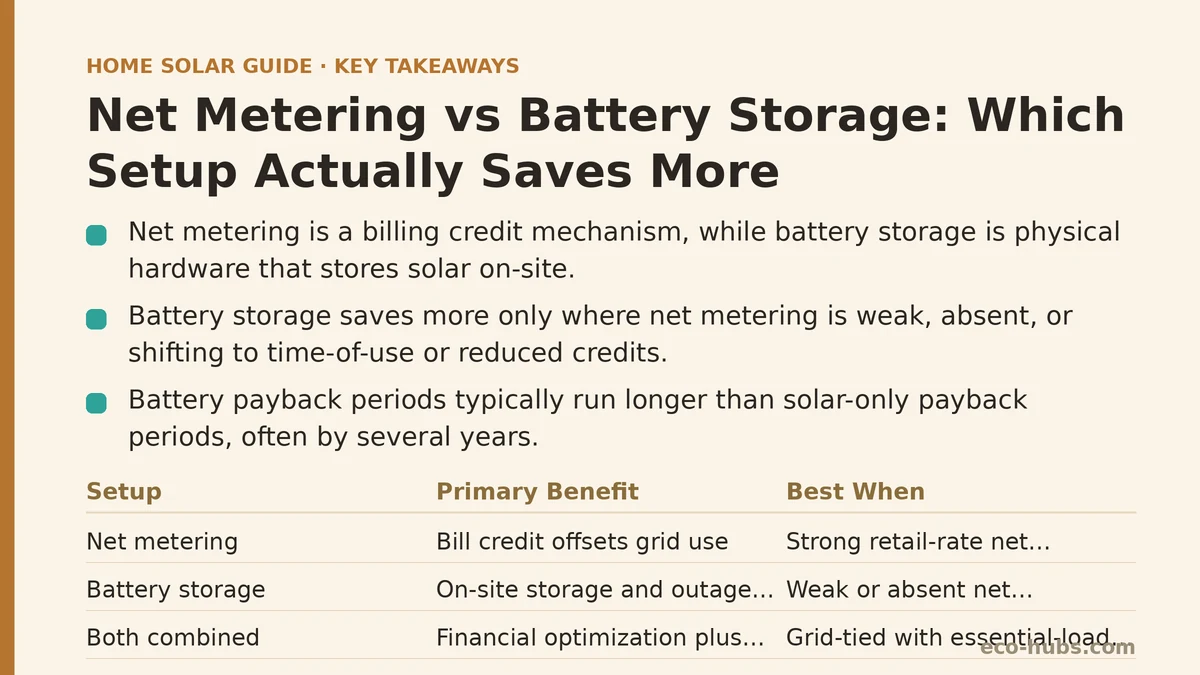
Net metering is a billing arrangement in which excess solar production sent back to the grid earns a credit, typically at or near the retail electricity rate, that offsets electricity drawn from the grid later. Battery storage, by contrast, is a physical system that stores excess solar production on-site so it can be used directly by the household, without ever passing through the utility’s meter at all. One is a financial mechanism; the other is a piece of hardware. Confusing them — or assuming one simply replaces the other — is where most of the bad comparisons start.
Myth: Battery Storage Always Produces Bigger Savings
This assumption shows up constantly in sales conversations, and it isn’t automatically true. In a location with strong net metering — where the credit rate matches full retail price and rolls over month to month — a homeowner can effectively use the grid as a free, unlimited battery. Sending 10 kWh to the grid at noon and pulling 10 kWh back at 9 p.m. costs nothing extra under a strong net metering policy. Adding a physical battery to that same setup introduces equipment cost, installation labor, and a finite lifespan, none of which improve on a deal that’s already dollar-for-dollar.
Reality: Battery storage saves more money specifically in situations where net metering is weak, absent, or being phased toward time-of-use or reduced-credit structures — not as a universal upgrade over net metering itself.
Myth: Net Metering Makes a Battery Pointless
The opposite overcorrection is just as common. Some homeowners assume that if they have decent net metering, a battery adds nothing of value. This ignores the fact that net metering and battery storage solve different problems entirely. Net metering addresses the financial mismatch between when solar is produced and when it’s used. It does nothing for a homeowner during a grid outage, since most grid-tied inverters shut down automatically when utility power fails, for safety reasons, regardless of how much solar the panels are producing at that moment.
Reality: A battery still provides backup power during outages even under generous net metering, so the decision isn’t purely financial — resilience has its own value that a monthly bill credit can never replicate.
Myth: Payback Periods Look Roughly the Same Either Way
Sales materials sometimes present battery and net-metering-only setups with similar-looking payback charts, which creates a false sense of comparability. The math behind these two setups is structurally different. A net-metering-only system’s payback, as discussed in our payback period guide, is driven mainly by system size, local electricity rates, and how much production the credit rate captures. A battery adds a second, separate cost layer with its own degradation curve and its own — often much longer — payback timeline, since battery hardware costs considerably more per kWh of capacity than solar panels do per kWh of production.
Reality: Battery payback periods typically run longer than solar-only payback periods, sometimes by several years, particularly when the local net metering policy is already reasonably favorable.
Myth: You Have to Pick One or the Other
Framing this as an either-or decision misses how these systems are commonly deployed together. A grid-tied system paired with net metering handles the day-to-day financial optimization, while a modest battery — sized for essential loads rather than the whole house — handles outage resilience without needing to store enough capacity to fully replace the grid. This hybrid setup is increasingly common precisely because it captures the strength of each option instead of forcing a tradeoff between them.
Reality: Combining a right-sized battery with net metering, where local policy allows both, frequently outperforms either option alone on a cost-plus-resilience basis, even though it costs more upfront than either option by itself.
Myth: Time-of-Use Rates Don’t Change This Calculation
Where a utility has moved to time-of-use pricing, the comparison shifts meaningfully. Under time-of-use billing, the credit a homeowner earns for solar sent to the grid during a low-price window may be worth far less than the electricity they buy back during a high-price evening window, even if the kWh amounts are identical. This is a structural gap that plain net metering can’t close, since the credit is tied to when the export happens, not when the homeowner needs power later.
Reality: Under time-of-use rate structures, a battery lets a household store cheap midday solar and use it during expensive evening hours, which can outperform net metering credits by a wide margin — this is one of the clearest cases where storage has a genuine financial edge, not just a resilience one.
Net Metering vs Battery Storage at a Glance
| Factor | Net Metering | Battery Storage |
|---|---|---|
| Primary function | Financial credit for exported solar | Physical on-site energy storage |
| Works during outages | No, in most grid-tied systems | Yes, if sized for backup loads |
| Best financial fit | Strong, flat-rate credit policies | Weak net metering or time-of-use rates |
| Upfront cost | None beyond the solar system itself | Substantial additional equipment cost |
| Typical payback | Shorter, tied to solar system economics | Longer, tied to battery-specific costs |
| Can be combined | Yes | Yes |
The Question That Actually Determines the Right Setup
None of these comparisons matter much in the abstract — what matters is the specific policy a homeowner’s utility offers. A flat, full-retail net metering credit with no export limits changes this calculation considerably compared to a reduced-rate or time-of-use structure, and the local rules described in our net metering guide are worth confirming before assuming either setup is the obvious winner. The honest answer for most homeowners isn’t “net metering” or “battery storage” as a category, but whichever setup responds correctly to the specific rate structure and outage risk they’re actually facing.
Do you know whether your utility offers full retail net metering, a reduced credit rate, or time-of-use pricing? That single detail narrows this decision more than almost anything else — share it and we can help work out whether a battery would add real value in your specific case. Related guides: Is Solar Battery Storage Actually Worth the Additional Cost, Common Home Battery Storage Wiring and Placement Mistakes to Avoid, and Home Battery Storage Installation: Step-by-Step Guide for First-Time Buyers.
🔗 Recommended Reading
- Solar Incentive Paperwork: Common Filing Mistakes That Delay Your Rebate
- Home Battery Sizing Mistakes That Lead to Blackout Regret
- Common Solar Installer Mistakes Homeowners Should Catch Before Signing
- Common Home Battery Storage Wiring and Placement Mistakes to Avoid
- Solar Payback Period vs Cash-on-Cash Return: Which Metric Should Homeowners Use