A ground-mount solar system is an array installed on a freestanding rack anchored directly into the earth, separate from any building structure. A roof-mount system is an array attached to the existing roof surface of a home or outbuilding, using the roof itself as the mounting platform. Both configurations use the same panels, inverters, and wiring principles — the difference lies entirely in what the racking is attached to, and that single distinction cascades into differences in cost, permitting, maintenance access, and long-term performance.
This guide works through the decision as a series of symptoms — conditions on your property or in your goals — matched to the underlying cause and a practical fix or recommendation. Rather than declaring one option universally better, it isolates the specific factors that tend to push a homeowner toward one mount type over the other.
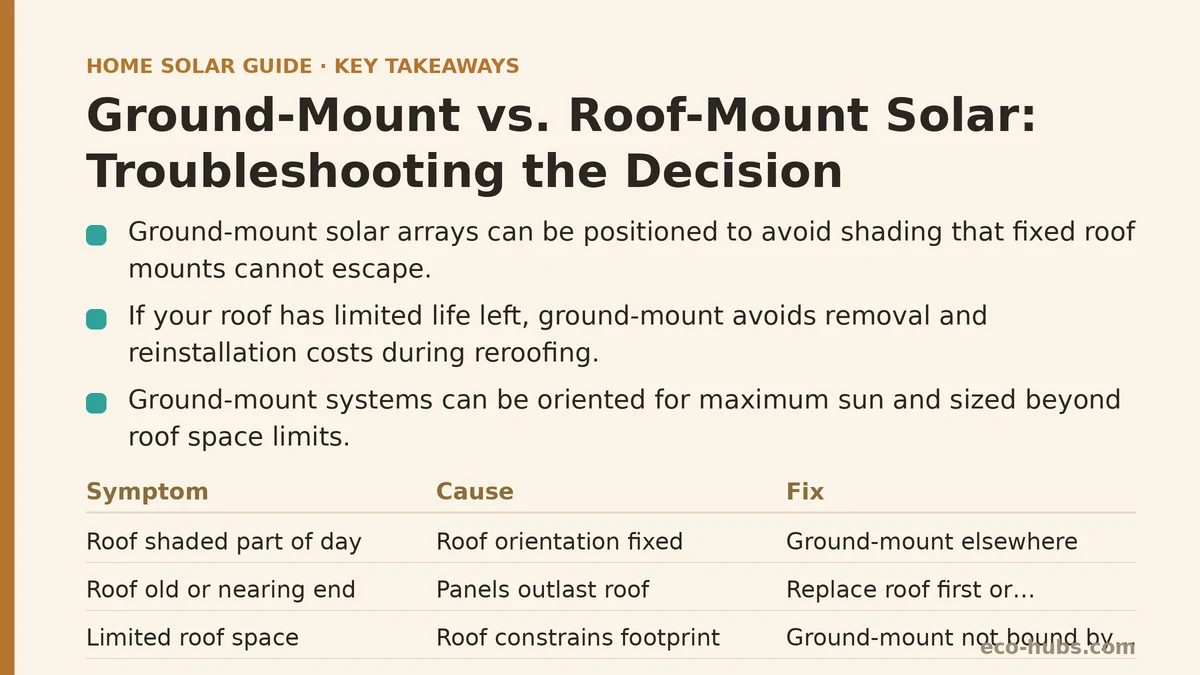
Symptom: Your Roof Is Shaded for Part of the Day
Cause: Roof orientation is fixed. If mature trees, a neighboring structure, or a chimney casts shadow across part of the roof during peak sun hours, panels mounted there will underperform regardless of panel quality, and there is no way to adjust the roof’s angle or position after the fact.
Fix: A ground-mount system, sited elsewhere on the property, can be positioned to avoid that shading entirely. If you have open yard space even a short distance from the shaded structure, moving the array off the roof often recovers production that no amount of panel upgrading would fix on the original surface.
Symptom: Your Roof Is Old or Nearing the End of Its Service Life
Cause: Panels are typically rated for 25 years or more. If your roof has 10 years of life left, you are looking at removing and reinstalling the array mid-warranty to replace the roofing underneath — an added cost that is easy to underestimate at the outset.
Fix: Either replace the roof before installation (bundling the two projects can reduce redundant labor), or consider a ground-mount system so the roof’s condition becomes irrelevant to the solar decision. A ground-mount array also avoids any roof penetrations altogether, which removes one common source of leaks that roof-mounted systems have to manage carefully.
Symptom: You Have Limited Roof Space but Ample Land
Cause: A small or steeply pitched roof, or one broken up by dormers and vents, may not offer enough contiguous space for the system size your usage requires. Roof-mount systems are constrained by the physical footprint available on the structure itself.
Fix: Ground-mount systems are not bound by roof geometry. Array size is limited mainly by available land and local setback requirements, which makes ground mounts a common choice for homes needing a larger system than their roof can physically support.
Symptom: Your Roof Faces the Wrong Direction
Cause: In the Northern Hemisphere, south-facing roof planes generally produce the most consistent output. A roof oriented primarily east-west, or one with only a north-facing usable plane, will produce measurably less energy per panel than an optimally oriented array.
Fix: Ground-mount racking can be oriented to true south (or whatever direction maximizes local production) independent of how the house itself sits on the lot. This is one of the clearest production advantages ground-mount systems offer over a roof stuck with a fixed, less favorable orientation.
Symptom: You Want to Track or Adjust Panel Angle Over Time
Cause: Roof-mounted panels are fixed at the roof’s pitch, and adjusting that angle after installation is impractical. Seasonal sun angle changes mean a roof-fixed tilt is a compromise across the year rather than an optimum for any single season.
Fix: Ground-mount systems can use adjustable or tracking racking, letting the tilt angle change seasonally or, with tracking systems, follow the sun throughout the day. This adds cost and mechanical complexity, but it is a capability roof-mount systems simply cannot offer.
Symptom: Your Upfront Budget Is Tight
Cause: Ground-mount systems require additional structural components — concrete footings or driven piles, longer wire runs back to the house, and sometimes trenching for underground conduit — that roof-mount systems do not need, since the roof structure already provides the mounting surface.
Fix: If minimizing installed cost per watt is the priority and your roof is in good condition, unshaded, and reasonably oriented, a roof-mount system is typically the less expensive path. Reserve ground-mount for situations where the roof genuinely cannot support the system you need, rather than defaulting to it for flexibility alone.
Symptom: You Are Concerned About Long-Term Maintenance Access
Cause: Cleaning panels, clearing debris, or servicing wiring on a roof-mounted system means working at height, often requiring a ladder, harness, or a professional service call for anything beyond a visual inspection.
Fix: Ground-mount panels sit at or near eye level, making cleaning, snow removal, and routine inspection considerably simpler and safer to handle yourself. If ease of ongoing maintenance matters to you more than upfront cost, this is a point in ground-mount’s favor that is easy to underweight during initial planning.
Symptom: Local Zoning or HOA Rules Restrict Ground Structures
Cause: Some municipalities and homeowners associations regulate freestanding structures, setbacks from property lines, or maximum structure height more strictly than they regulate rooftop equipment, which may fall under different or more lenient rules.
Fix: Check local zoning ordinances and any HOA covenants specifically for ground-mounted structures before committing to that route. In jurisdictions with restrictive ground-structure rules, roof-mount may be the only permitted option regardless of which system would otherwise perform better on your property.
Symptom: You Are Worried About Snow Load or Wind Exposure
Cause: Roof-mount systems inherit whatever structural rating the roof itself carries, and adding panel weight requires confirming the roof can handle the combined snow and wind load in your climate. Ground-mount racking, meanwhile, needs its own foundation engineered for local frost depth and wind conditions.
Fix: Have a structural engineer or your installer confirm load ratings for either option before finalizing a design — this is not a step to skip in regions with heavy snowfall or high wind exposure. Ground-mount footings in cold climates typically need to extend below the frost line, which adds cost but is a solved engineering problem your installer should already account for.
Quick Reference: Matching Symptom to Mount Type
| Symptom | Points Toward |
|---|---|
| Roof shading during peak hours | Ground-mount |
| Aging roof needing replacement soon | Ground-mount (or roof-mount after re-roofing) |
| Limited roof space, ample land | Ground-mount |
| Poor roof orientation | Ground-mount |
| Desire for adjustable/tracking tilt | Ground-mount |
| Tight upfront budget, good roof condition | Roof-mount |
| Preference for easy maintenance access | Ground-mount |
| Restrictive local zoning on structures | Roof-mount |
| Uncertain roof or foundation load capacity | Engineering review needed either way |
If More Than One Symptom Applies to You
Most homeowners will recognize themselves in more than one row above, and the two options are not always mutually exclusive — some properties even split systems between a partial roof array and a supplemental ground-mount array to reach a target system size. When symptoms point in different directions, the load-bearing question is usually cost versus production: a cheaper roof-mount system that underperforms due to shading or orientation may cost more per kilowatt-hour produced over 25 years than a pricier ground-mount system built for optimal conditions from the start.
Related guides: Common Solar Installation Mistakes and How to Avoid Them, Common Solar Panel Problems: A Myth vs. Reality Troubleshooting Guide, and How to Compare Solar Installer Quotes for an Apples-to-Apples Decision.
🔗 Recommended Reading
- How to Prepare Your Home for a Solar Site Assessment: A Beginner's Checklist
- How to Size a Solar System for Your Home: A Beginner's Step-by-Step Walkthrough
- Solar Panel Monitoring Apps: A Setup Guide for Beginners
- How to Read Your Electricity Bill After Solar: A Line-by-Line Walkthrough
- Solar Incentive Paperwork: Common Filing Mistakes That Delay Your Rebate