Say you are trying to figure out whether a solar quote you just received for $28,400 is a fair price, a good deal, or something you should push back on. The number itself tells you almost nothing without knowing what it includes, what it leaves out, and how it compares to what a similar household paid this year. That’s the gap this post is meant to close — not with a generic price-per-watt average, but by walking through one representative 2026 quote line by line and showing where the real cost actually sits once every adjustment is applied.
The Household Behind This Quote
The homeowner in this case study lives in a 2,100-square-foot single-story house in central Ohio, with an average monthly electric bill of $178 and a south-facing roof with minimal shading. Three installers were asked to quote a system sized to offset roughly 100% of annual usage, which landed all three proposals in the 8.2 to 8.6 kW range. The middle quote — $28,400 for an 8.4 kW system — is the one we’ll break down in detail, since it fell squarely between the cheapest and most expensive bids and reflects pricing that shows up often in this size range this year.
At first glance, $28,400 divided by 8,400 watts works out to roughly $3.38 per watt, which sits near the middle of the national average range for 2026. But that per-watt figure hides more than it reveals, so the next step is pulling the quote apart into its actual components.
Breaking the $28,400 Down Into Its Real Components
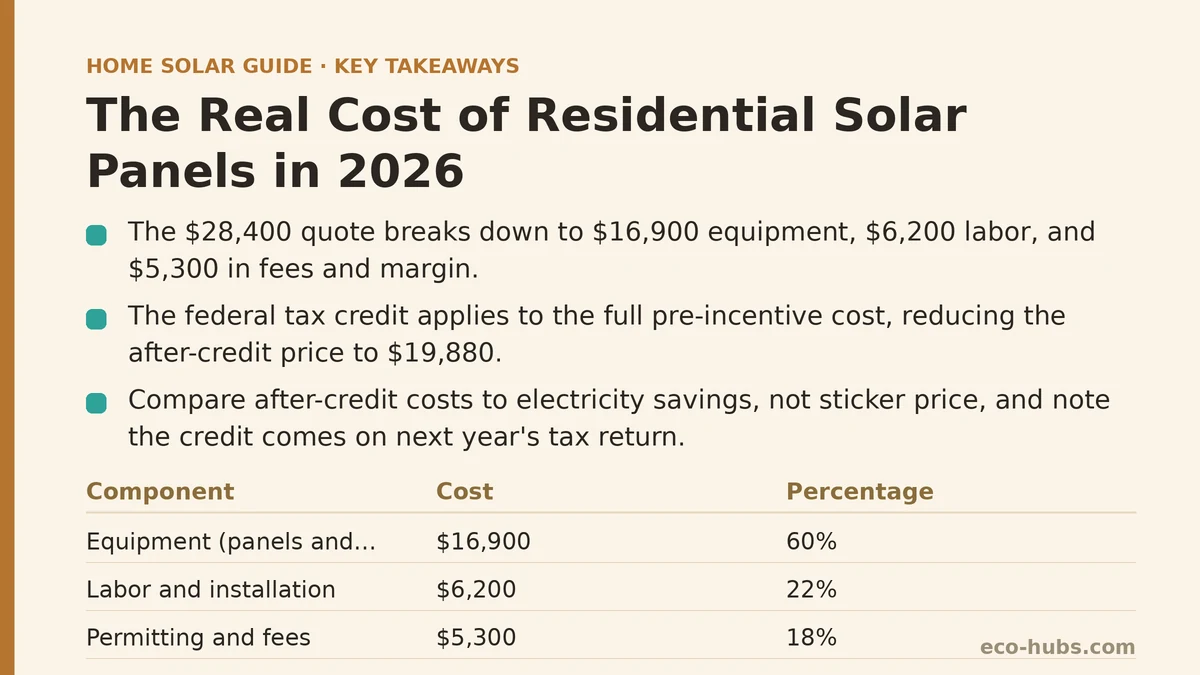
Itemized, this particular quote broke down as follows: $16,900 for the panels and inverter equipment itself, $6,200 for labor and installation, $1,800 for permitting and inspection fees, $1,100 for the interconnection application and utility coordination, and $2,400 in company overhead, sales commission, and margin built into the total. None of these categories are unusual on their own, but seeing them separated makes clear that equipment is only about 60% of the total price — the remaining 40% covers labor, paperwork, and the installer’s own business costs.
This matters because homeowners comparing quotes often focus entirely on the bottom-line number without asking what’s driving the difference between two proposals. A competitor’s quote for the same house came in at $24,600, and the equipment line was nearly identical — the gap came almost entirely from a smaller margin and a flat permitting fee rather than the itemized $1,800 the first installer charged. Knowing this made the lower quote easier to trust, since the savings traced back to overhead rather than to cheaper panels or shortcuts in the electrical work.
Where the Tax Credit Actually Lands
The federal solar tax credit, at its current rate, applies to the full pre-incentive cost, including labor and permitting, not just the equipment portion. On this $28,400 quote, that credit reduced the effective cost by $8,520, bringing the after-credit price down to $19,880. This is the number that should be compared against a household’s electricity savings, not the sticker price — a distinction that trips up a fair number of first-time buyers who assume the credit only applies to the panels themselves.
It’s worth noting that this credit is claimed on the following year’s tax return rather than subtracted at signing, so the homeowner in this example still had to finance or pay the full $28,400 upfront and wait for the credit to offset their tax liability months later. That timing gap is a detail installers don’t always volunteer, and it changes the actual cash flow picture considerably compared to seeing “$19,880 after incentives” printed on a glossy brochure.
The Costs That Weren’t in the Original Quote
Two additional expenses surfaced after the initial contract was signed, and both are common enough to flag here. The first was a $1,400 charge for replacing a section of roof decking that the installer discovered was too deteriorated to safely mount panels on — something that couldn’t be assessed until the crew was on the roof taking measurements. The second was a $650 electrical panel upgrade fee, needed because the home’s existing 100-amp panel didn’t have enough capacity for the new solar equipment alongside existing circuits.
Together, these two additions raised the effective project cost from $19,880 to $21,930 after the tax credit — a nearly 10% increase over the original after-credit estimate. Homeowners evaluating quotes should ask directly whether the roof and electrical panel have been inspected closely enough to rule out these kinds of surprises, since a quote that looks $2,000 cheaper on paper can easily lose that advantage once one of these issues appears mid-installation.
Financing Changes the Real Cost Again
This particular homeowner financed the project through a solar loan at 6.99% over 15 years rather than paying cash. On the $21,930 adjusted total, that loan structure added approximately $12,600 in interest over the full term, bringing the true total cost of the system to just over $34,500 across the life of the loan — well above the original $28,400 sticker price, even after accounting for the tax credit’s initial benefit.
This isn’t a reason to avoid financing outright, since many households don’t have $22,000 in available cash and the monthly payment still landed below their prior electric bill in this case. But it’s a reminder that “cost of solar” means something different depending on whether you’re asking about the upfront price, the after-credit price, or the total amount paid across a financing term. Each of these numbers is accurate; they just answer different questions.
Running the Payback Math With Real Numbers
Using the adjusted $21,930 cash-equivalent cost and this household’s actual utility rate, the system was projected to save approximately $2,340 per year in avoided electricity costs, which put the simple payback period at just under 9.4 years — longer than the 6-to-7-year figure that had been verbally mentioned during the initial sales conversation. The difference traced back almost entirely to the roof and panel upgrade costs that weren’t part of that early estimate, underscoring why a written, itemized quote should always take precedence over a rough number given before a site visit.
For context, panel warranties in 2026 commonly run 25 years, meaning this system had roughly 15 years of projected savings remaining after reaching payback — a comfortable margin, but one that would have looked considerably tighter if the unexpected roof and panel costs had been larger or if local electricity rates had stayed flatter than the utility’s stated rate trajectory suggested.
What This Case Study Suggests for Your Own Quote
If you’re evaluating a solar quote right now, this walkthrough points to a few specific checks worth running before signing anything. Ask for an itemized breakdown rather than a single total, so you can see how much is equipment versus labor versus overhead. Confirm whether a roof and electrical panel inspection has already happened or is still pending, since that’s where surprise costs most often originate. And run the payback calculation using the after-credit, after-financing number rather than the number printed at the top of the proposal.
Cost summary from this case study:
| Stage | Amount |
|---|---|
| Original quoted price | $28,400 |
| After federal tax credit | $19,880 |
| After roof and panel upgrade costs | $21,930 |
| Total cost including 15-year loan interest | ~$34,500 |
| Annual electricity savings | $2,340 |
| Simple payback period | 9.4 years |
The gap between the first number in that table and the last one is the real story of solar pricing in 2026 — not because anyone was misled, but because a single upfront figure was never going to capture incentives, financing, and site-specific conditions in one line. What does your own quote look like once you break it into these same categories, and have you confirmed whether your roof and electrical panel have already been checked closely enough to rule out the kind of mid-project surprises this household ran into? Related guides: Solar Panel Costs by Region: Why Prices Vary So Much by State, Common Home Battery Storage Wiring and Placement Mistakes to Avoid, and Bifacial Solar Panels Explained: Are They Worth the Extra Cost.
🔗 Recommended Reading
- Solar Panel Monitoring Apps: A Setup Guide for Beginners
- How to Read Your Electricity Bill After Solar: A Line-by-Line Walkthrough
- Solar Incentive Paperwork: Common Filing Mistakes That Delay Your Rebate
- Home Battery Sizing Mistakes That Lead to Blackout Regret
- Common Solar Installer Mistakes Homeowners Should Catch Before Signing