After reading this, you’ll be able to look at a community solar offer, identify which of five common structures it falls into, and know which specific terms in that offer determine whether it’s a good deal or a mediocre one dressed up in good marketing. That’s the practical goal here — not a general overview of the concept, but a way to sort real offers into categories you can compare.
Community solar lets people who can’t or don’t want to put panels on their own roof still get credit for solar generation, usually through a subscription to, or share of, a solar array built somewhere else in their utility territory. The idea sounds simple. The execution varies enormously depending on who’s running the program, how the contract is structured, and what happens if you move or the program underperforms. Ranking the common structures from weakest to strongest, on the criteria that matter most to a homeowner, makes the differences easier to see.
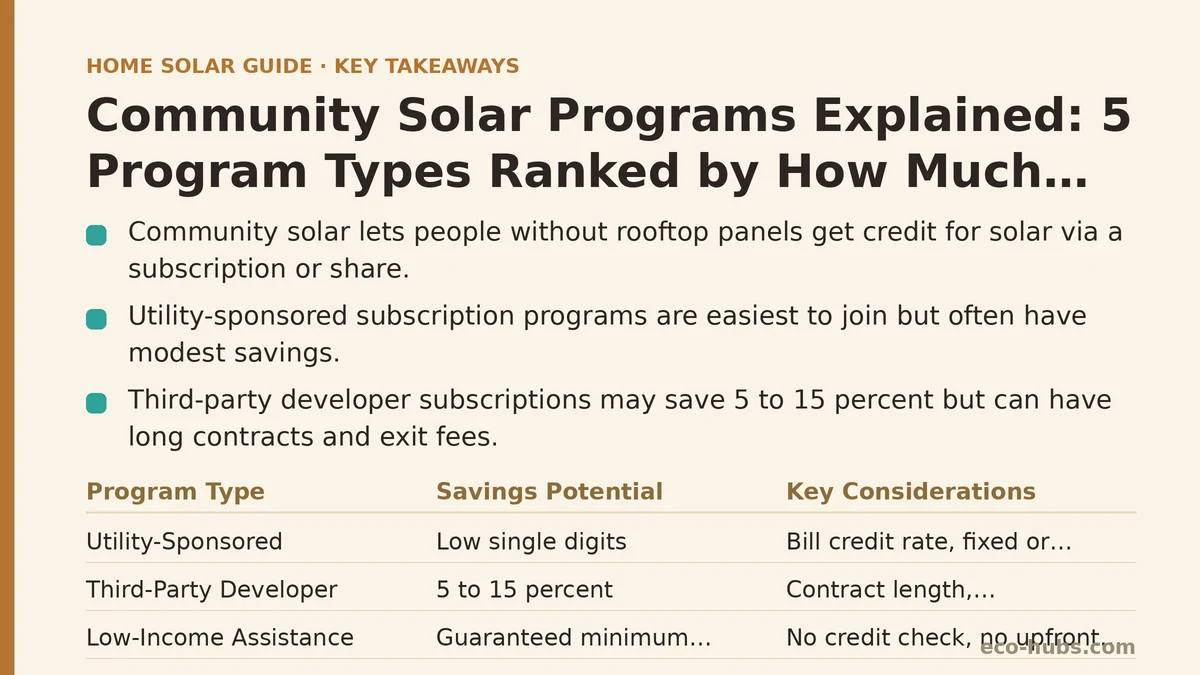
5. Utility-Sponsored Subscription Programs (Ranked Lowest for Savings Potential)
Many utilities run their own community solar programs, letting customers subscribe to a portion of a solar facility the utility owns or has contracted with a developer to operate. These programs are usually the easiest to sign up for, since you’re dealing with the same company that already bills you for electricity, and cancellation terms tend to be straightforward.
The tradeoff is savings. Utility-run programs often set the bill credit rate conservatively, and the discount over standard rates can be modest — sometimes in the low single digits. They’re a reasonable entry point if your main goal is supporting renewable generation without dealing with a third party, but they rarely produce the kind of savings that make community solar attractive on cost alone.
Worth confirming before signing: the exact bill credit rate, whether it’s fixed or adjustable, and whether the utility has a track record of maintaining that rate over time.
4. Third-Party Developer Subscriptions (Ranked Fourth for Flexibility)
A large share of community solar comes from independent developers who build a facility and sell subscriptions directly to nearby residents, with credits applied to your regular utility bill through an arrangement with the utility. These programs often advertise higher savings than utility-run alternatives — commonly in the 5 to 15 percent range off your electricity costs.
The catch is contract length and exit terms. Some developer subscriptions run for 20 to 25 years, matching the facility’s expected operating life, and early termination fees can be significant if you move somewhere the subscription doesn’t transfer. Before signing, it’s worth reading the cancellation and transfer clauses as carefully as the savings projections, since the second thing determines how much the first thing actually matters to you.
Worth confirming before signing: whether the subscription transfers if you move within the utility territory, what happens if it doesn’t, and whether there’s an early exit fee.
3. Low-Income and Bill-Assistance Community Solar Programs (Ranked Third for Accessibility)
A growing number of states require or incentivize community solar programs specifically designed for lower-income households, often with no credit check, no upfront cost, and guaranteed minimum savings written into the program rules rather than left to market conditions. These programs rank above standard developer subscriptions on accessibility, since they’re built to remove the barriers — credit history, upfront deposits — that exclude some households from other options.
They rank lower on availability. Not every state has these programs, and where they exist, enrollment can be capped or have waitlists. If you qualify based on income or program eligibility criteria in your area, this category is usually worth checking first, before comparing standard subscription offers.
Worth confirming before signing: the specific eligibility criteria, whether there’s a waitlist, and whether the guaranteed savings percentage is written into the enrollment agreement rather than described only in marketing materials.
2. Shared Ownership and Solar Co-ops (Ranked Second for Long-Term Value)
Instead of subscribing to someone else’s array, some programs let participants buy an actual ownership share in a portion of a community solar facility — a defined number of panels or a percentage of the system’s output. This structure behaves more like owning a small slice of a solar installation than renting access to one, and it can qualify for a portion of the federal solar tax credit depending on how the ownership is structured, which is a meaningful advantage over subscription models.
The upfront cost is the tradeoff. Buying a share requires capital in a way that subscriptions don’t, and the payback period stretches out over years rather than delivering savings from month one. For homeowners with the capital and a long enough time horizon in their current location, though, this structure tends to produce better lifetime value than a subscription, simply because you’re building equity in generation capacity rather than paying for access to someone else’s.
Worth confirming before signing: what happens to your ownership share if you sell your home, whether it can be transferred or must be sold back to the program, and at what price.
1. Virtual Net Metering Community Solar (Ranked Highest for Predictability)
Virtual net metering programs allow your share of a community solar facility’s output to be credited against your usage at a rate that’s directly tied to your utility’s retail electricity rate, rather than a separately negotiated discount. This structure ranks highest here because it removes a lot of the guesswork: as your utility rates rise, your credit value tends to rise proportionally, keeping the relative savings roughly stable over time instead of eroding as flat-rate subscription discounts sometimes do against rising utility prices.
Availability is the limiting factor. Virtual net metering depends on specific state policy, and it isn’t offered everywhere — some states have robust frameworks for it, others have none. Where it is available, it’s generally the structure worth prioritizing first, since the credit mechanism itself is more resilient to the kind of rate changes that can quietly shrink the value of other program types over a contract’s lifespan.
Worth confirming before signing: whether your state’s virtual net metering framework applies to the specific program you’re considering, and how the credit rate is calculated relative to your retail rate.
How These Five Stack Up Side by Side
| Rank | Program Type | Strongest For | Watch Out For |
|---|---|---|---|
| 1 | Virtual net metering | Savings that keep pace with rate increases | Limited to certain states |
| 2 | Shared ownership/co-op | Long-term value, potential tax credit eligibility | Upfront capital requirement |
| 3 | Low-income/bill-assistance | Accessibility, guaranteed minimum savings | Eligibility limits, waitlists |
| 4 | Third-party developer subscription | Higher advertised discounts | Long contracts, transfer restrictions |
| 5 | Utility-sponsored subscription | Simplicity, easy cancellation | Modest savings |
Matching a Program Type to Your Situation
None of these five structures is universally correct — the right one depends heavily on how long you expect to stay in your current home, whether you have capital available for an ownership stake, and whether your state even offers the higher-ranked options above. Someone planning to move within a few years should weight transfer and cancellation terms far more heavily than the headline discount percentage. Someone settled long-term, with capital to invest, has more to gain from ownership structures than from any subscription.
What matters most is reading the actual contract terms rather than the marketing summary, since the difference between a mediocre program and a strong one usually lives in the fine print around credit rates, contract length, and what happens when circumstances change.
Have you come across a community solar offer in your area and aren’t sure which category it falls into? Share the basic terms — credit rate, contract length, and whether it’s utility-run or third-party — and we can help you figure out where it ranks and what to check before signing.
Related guides: Bifacial Solar Panels Explained: Are They Worth the Extra Cost, Solar Panel Financing Options: What Actually Differs Between Loan Types, and Solar Panel Warranties: What They Actually Cover and What They Do Not.
🔗 Recommended Reading
- Solar Incentive Paperwork: Common Filing Mistakes That Delay Your Rebate
- Home Battery Sizing Mistakes That Lead to Blackout Regret
- Common Solar Installer Mistakes Homeowners Should Catch Before Signing
- Common Home Battery Storage Wiring and Placement Mistakes to Avoid
- Solar Payback Period vs Cash-on-Cash Return: Which Metric Should Homeowners Use