After reading this guide, you will be able to decide whether to remove and reinstall your solar panels, leave them in place during a roof replacement, or replace the roof before new panels go up — and you will know what questions to ask your roofer and solar installer before any work begins.
Step 1: Establish the Age and Condition of Both Systems
The first decision point involves two independent timelines: the remaining life of your roof and the remaining life of your solar array. A roof with five years of useful life left is a different scenario from one with fifteen. Similarly, a solar system installed two years ago has most of its 25-year panel warranty ahead of it, while a system that has been running for eighteen years may be approaching the point where replacement makes more sense than expensive removal and reinstallation.
Check your roof’s age and material condition first. Asphalt shingle roofs typically last 20 to 30 years. If you have a metal roof, you might be looking at 40 to 50 years of service life. If your roof is already leaking or has visible decking damage, delaying the replacement is not an option regardless of your solar situation.
Then check your solar system’s age and performance. If the array is more than 15 years old, the cost of removal, reinstallation, and any needed new racking hardware could approach half the cost of a brand-new system. In those cases, a full solar replacement alongside the new roof is often the more economical path — you are paying for labor once rather than paying for the same labor twice within a short span.
Step 2: Understand That “Removal and Reinstall” Is Never a Do-It-Yourself Task
Unlike the DIY solar installation scenario discussed in other posts on this site, removing and reinstalling a solar array is not a weekend project. Professional removal involves disconnecting the DC wiring, labeling every connector, carefully lifting each panel without cracking the glass, unbolting the racking system, and hauling everything to temporary storage. Any mistake during removal — cracked panel glass, damaged junction boxes, bent racking rails — voids equipment warranties and converts a routine job into an expensive repair.
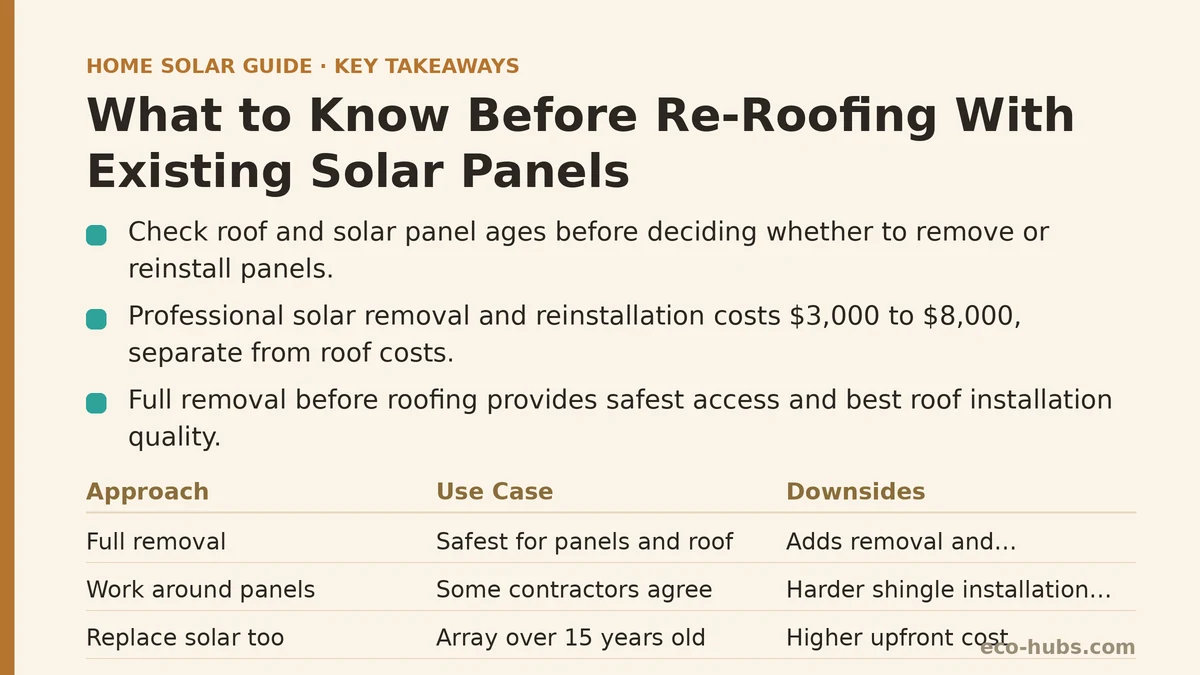
Plan for a licensed solar installer to handle the removal. Your roofer will not do this, and asking them to “just take the panels off” is a recipe for damaged equipment. The typical cost for professional removal and reinstallation ranges from $3,000 to $8,000 depending on array size, roof pitch, and how complicated the racking layout is. This figure is separate from the roof replacement cost itself.
Step 3: Decide Whether Panels Stay On or Come Off
There are three valid approaches, and each has a clear use case. The first approach is full removal before the roof replacement begins. This is the safest method for the panels and the roofers. It gives your roofing crew unobstructed access to the entire roof surface, which means better flashing, more thorough decking inspection, and faster shingle installation. It also adds the removal and reinstallation labor cost to your total project budget.
The second approach is to leave the panels in place and have the roofer work around them. Some roofing contractors will agree to this, but it has serious downsides. Shingles below and around the array are harder to install correctly, which increases the risk of future leaks between panel rows. The roofers cannot inspect the decking underneath the racking feet. If the solar installation is older and the racking was mounted with sealant rather than flashed, the risk of water intrusion around existing penetrations rises sharply. This approach only makes sense if you plan to replace the solar array at the same time the roof is stripped — and even then, most experienced contractors will tell you to remove old panels before tearing off old shingles.
The third approach is to replace the entire roof before installing solar panels in the first place. This applies to homeowners who do not yet have solar but are planning it soon. If your roof has fewer than 10 years of life left, installing panels now means paying for a removal and reinstall in the near future. Instead, do the roof replacement first, then install solar on the new surface. The solar tax credit covered in our dedicated guide applies to new installations, and once the roof is new, you can wait for the ideal time to install panels without the pressure of a roof tear-off looming overhead.
Step 4: Coordinate the Two Contractors Before Starting Any Work
Whether you choose full removal or a hybrid approach, the solar installer and the roofer must talk to each other before the first shingle is lifted. It is not enough to schedule the solar removal for Monday and the roof tear-off for Tuesday. You need a shared plan for how the roof will be protected once the panels are off, where the panels will be stored, and who is responsible for any damage that occurs during the transition.
A written scope of work from both contractors, with clear demarcation of responsibilities, prevents most disputes. Your solar installer should provide a detailed line item for removal, storage, protective measures, and reinstallation. Your roofer should provide a line item specifically for flashing any existing racking penetrations that are no longer in use, if those penetrations are to be sealed rather than reused. If you are reusing the same racking system, the roofer must know exactly where the racking feet were located so new shingles can be installed around them or so new deeper flashing can be installed at each foot location.
Step 5: Assess Whether the Old Racking Can Be Reused
Racking systems are not infinitely reusable. The screws, washers, and flashing boots that secure the racking to your roof are often one-time-use components. During removal, the solar installer can save the rails and the clamps, but the penetration hardware — the lag bolts and the flashing boots that create a watertight seal around those bolts — typically needs replacement.
If your system is more than ten years old, check whether the racking manufacturer still makes compatible components. Some manufacturers have discontinued older rail profiles, and replacing an entire racking system during reinstallation adds several thousand dollars to the project. If the racking is discontinued or if the system has been through a prior removal and reinstall already, budgeting for a full new mounting system is the more reliable path.
Step 6: Verify Your Insurance and Warranty Coverage Before Signing Anything
Two distinct warranty questions apply here. First, what does your solar panel manufacturer’s warranty say about removal and reinstallation? Most panel warranties cover manufacturing defects but exclude damage caused by handling, transport, or reinstallation labor. That means if a panel is cracked during removal or if an installer damages a connector during reinstallation, the cost of that panel replacement falls to you unless the solar installer’s own workmanship warranty covers their laborers’ mistakes.
Second, what does your homeowner’s insurance policy cover? Some policies cover removal and reinstallation of solar equipment under their “building property” or “improvements and betterments” provisions, but others exclude solar specifically. Ask your insurance agent for a written clarification before the project begins. If your policy does not cover solar removal, request a rider or addendum before the roofer and solar installer arrive.
Step 7: Understand How the Tax Credit Applies to Removal and Reinstall Costs
The federal solar investment tax credit covers equipment and installation labor for new solar systems, but it does not cover removal and reinstallation labor paid to a roofer or a separate solar installer when the work is tied to a roof replacement. If the solar system itself remains on your roof and is simply disconnected and reconnected around new shingles, the reconnection labor might qualify — but the removal labor and the roof replacement itself do not. If you are replacing the solar array entirely along with the roof, then the new panels, new inverters, and new racking all qualify for the credit under the current rules detailed in our tax credit guide. The roof replacement does not qualify, even if the roof is necessary for the solar system’s functionality.
Step 8: Build in Time for Permitting and Inspection
Reinstallation of a solar array frequently triggers a new inspection, even if the system itself was never touched electrically beyond disconnection and reconnection. Many jurisdictions require a permit for any work that involves changing the roof penetrations or reinstalling a racking system. The solar installer will handle this permitting on your behalf, but the timeline for approval and the eventual city inspection adds two to four weeks to your project. Coordinate this schedule with the roofer’s completion date so the solar installer can reconnect the system and have the inspector visit before the scaffolding is removed and before the job is considered fully closed out.
A Quick Financial Comparison at a Glance
| Approach | Upfront Cost | Key Tradeoff |
|---|---|---|
| Full removal & reinstall | $3,000–$8,000 plus roof replacement | Safest for panels and roofers, highest labor cost |
| Leave panels in place | $0 solar labor, but higher risk | Faster, but leak risk rises and warranty exposure grows |
| Replace roof first, then install solar | Roof cost now + full new solar cost later | Ideal when roof is near end of life and solar is planned |
| Replace solar array with roof replacement | New system cost minus useful life remaining | Most economical when existing array is 15+ years old |
The Most Common Mistake to Avoid
The single most expensive mistake homeowners make in this scenario is waiting until the roof starts leaking to think about solar removal. Once water is entering the home, the timeline tightens, the roofer gets selected in a rush, the solar installer is forced to work around an active leak, and the whole project is executed under pressure. That combination measurably increases the chance of damaged panels, incomplete flashing, and a warranty dispute nobody anticipated. Start this planning process a year before you expect to need a new roof, not a week before.
What is the current age of both your roof and your solar panels, and have either of them shown signs of needing replacement soon? Share those two numbers and you will leave this guide with a clear answer for which of the four approaches fits your situation best.
Related guides: Combining Solar With Heat Pumps: What Homeowners Should Know, Solar Panel Permits and HOA Restrictions: What to Know Before You Apply, and Solar Panels and Homeowners Insurance: What You Need to Know.
🔗 Recommended Reading
- Solar Incentive Paperwork: Common Filing Mistakes That Delay Your Rebate
- Home Battery Sizing Mistakes That Lead to Blackout Regret
- Common Solar Installer Mistakes Homeowners Should Catch Before Signing
- Common Home Battery Storage Wiring and Placement Mistakes to Avoid
- Solar Payback Period vs Cash-on-Cash Return: Which Metric Should Homeowners Use