A common assumption among homeowners planning a solar installation is that HOA approval and a building permit are essentially the same box to check — get one, and the other follows automatically. That is not how it works. These are two separate approval processes, run by two entirely different entities, with different criteria, different timelines, and different consequences if you skip one of them. Treating them as a single step is one of the more common reasons installations stall.
Below is a sequential walkthrough of how to work through both processes without letting one blindside the other.
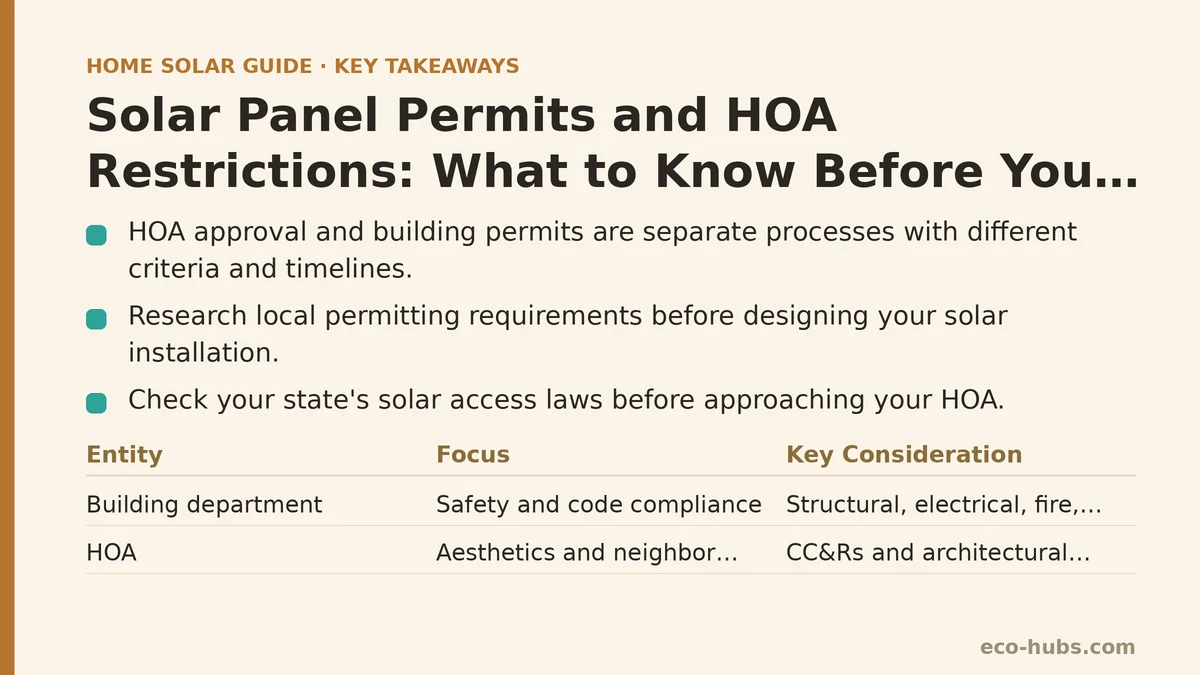
Step 1: Recognize That You’re Dealing With Two Independent Approval Tracks
Your local building department cares about safety and code compliance: structural load on your roof, electrical work meeting code, fire setbacks, and proper interconnection with the grid. Your HOA, by contrast, cares about how the installation looks and where it sits relative to your neighbors’ sightlines and the community’s aesthetic standards. Passing one process tells you nothing about your standing with the other.
This distinction matters practically because a design that clears your HOA’s guidelines might still need adjustment to satisfy your local code, and a design engineered to meet code might still get flagged by your HOA’s architectural review committee for something like panel placement or visible conduit. Plan for both from the outset rather than assuming success on one front covers the other.
Step 2: Research Local Permitting Requirements Before You Design Anything
Start with your local jurisdiction, since its requirements will shape the physical design your HOA eventually reviews. Contact your local building department directly and ask what a solar permit application requires in your area — structural plans, electrical diagrams, a site plan showing panel placement, and often a review by your utility for interconnection, which we cover in more depth in our interconnection guide. Requirements vary meaningfully between jurisdictions, so don’t assume what applied to a neighbor’s installation applies identically to yours.
Worth confirming early: whether your jurisdiction has any solar-specific permit streamlining programs. Some cities have adopted expedited or online-only solar permitting to reduce delays, and knowing this upfront can shape your timeline expectations considerably.
Step 3: Check Your State’s Solar Access Laws Before Approaching Your HOA
Before you submit anything to your HOA, find out whether your state has a solar access law, sometimes called a solar rights law. Many states have enacted these to prevent HOAs from banning solar installations outright, though the specifics of what protection they offer vary widely. Some limit HOAs to only “reasonable” restrictions on placement and screening; others go further in limiting what an association can require.
Knowing this in advance changes how you approach the HOA conversation. If your state law limits what your association can deny, you’re in a stronger position to push back on an overly restrictive request. If no such law exists where you live, your HOA’s own governing documents carry more weight, and your negotiating room may be narrower.
Step 4: Read Your HOA’s CC&Rs and Architectural Guidelines Closely
Pull your community’s Covenants, Conditions, and Restrictions (CC&Rs) and any separate architectural review guidelines, and read the sections relevant to exterior alterations and solar installations specifically. Look for anything addressing panel visibility from the street, roof-mounted versus ground-mounted systems, approved colors or frame finishes, and required screening for equipment like inverters or battery enclosures.
Some associations have adopted solar-specific provisions already, reflecting the state laws mentioned above. Others still rely on general exterior-alteration language never written with solar in mind, which can lead to ambiguous or inconsistent rulings. If your documents are unclear, ask the HOA board or management company directly for clarification before you submit a formal application, rather than guessing at intent.
Step 5: Submit a Complete, Well-Documented HOA Application
Once you understand the guidelines, put together an application that anticipates the board’s likely concerns rather than the bare minimum required. Include a site plan showing exact panel placement, manufacturer specification sheets, photos or renderings of how the system will look from the street, and a note on how any visible equipment will be screened if required.
A thin or vague submission is one of the most common reasons for delay, since it typically prompts a request for more information rather than an outright denial — which simply restarts your timeline. A thorough package the first time around gives the board less reason to table your request for a follow-up meeting.
Step 6: Move Into the Local Permit Application Once Design Is Settled
With HOA-approved plans in hand, move to your local building department for the permit itself. This is typically where structural calculations, electrical schematics, and your utility’s interconnection requirements come into play, and where an inspector will eventually need to sign off on the completed work. If a professional installer is handling your project, they usually manage this step directly; if you’re pursuing a DIY approach, as we discuss in our DIY solar guide, this step tends to demand more of your own time and attention than expected.
Timelines here vary by jurisdiction and season, since permitting offices see seasonal surges in solar applications. Ask directly for a realistic estimate rather than relying on a generic published turnaround time.
Step 7: Handle a Denial or Requested Modification Without Losing Momentum
If your HOA denies your application or asks for design changes, don’t treat this as final without understanding the actual basis for it. Ask the board in writing what specific provision of the CC&Rs the denial relies on, and whether your state’s solar access law, if one exists, limits their ability to enforce that provision as applied to your request. In many cases, a denial softens once a homeowner points to the relevant state statute directly, since boards are not always aware of how it applies to their own governing documents.
If a permit application is delayed or rejected at the local level instead, ask the reviewing official specifically what needs to change, and get that feedback in writing so your revised submission addresses the stated issue precisely rather than a guessed-at one.
Step 8: Keep Every Document for Interconnection, Warranty, and Resale
Once both approvals are secured and installation is complete, keep copies of the HOA approval letter, the permit, the final inspection sign-off, and any correspondence tied to design modifications. Your utility will typically want proof of a passed inspection before granting interconnection approval and activating net metering, covered in our dedicated net metering guide. Down the road, a future buyer’s lender or insurer may also ask for this documentation, and having it organized in one place saves a scramble later.
A Quick Reference Overview
| Step | Handled By | What It Covers |
|---|---|---|
| Building permit | Local jurisdiction | Structural safety, electrical code, utility interconnection |
| HOA approval | Community association | Placement, visibility, aesthetic standards |
| Solar access laws | State legislature | Limits on how restrictive an HOA can be |
| CC&R review | Homeowner, before applying | Understanding association-specific rules |
| Final documentation | Homeowner, ongoing | Interconnection, warranty claims, future resale |
Where Does Your Own Situation Stand?
If you’re at the early stages of planning an installation, which of these two processes have you looked into so far — your HOA’s guidelines, your local permitting office, or neither yet? Knowing where you’re starting from makes it easier to sequence the rest of the process without one approval catching you off guard midway through the other.
Related guides: Solar Panel Performance in Extreme Heat: What Homeowners Should Know, Solar Panel Repair After Storm or Hail Damage: What to Know, and What to Know Before Re-Roofing With Existing Solar Panels.
🔗 Recommended Reading
- Solar Incentive Paperwork: Common Filing Mistakes That Delay Your Rebate
- Home Battery Sizing Mistakes That Lead to Blackout Regret
- Common Solar Installer Mistakes Homeowners Should Catch Before Signing
- Common Home Battery Storage Wiring and Placement Mistakes to Avoid
- Solar Payback Period vs Cash-on-Cash Return: Which Metric Should Homeowners Use