Most new solar owners expect their electric bill to shrink to a few dollars, or disappear entirely. In practice, the bill doesn’t just shrink — it changes structure, often becoming harder to read than the original. Before you installed solar, you had one meter reading, one rate, and one total. After solar, most utilities introduce multiple line items, separate charges for per-kWh consumption and per-kWh production, and sometimes a monthly grid connection fee that exists regardless of how much power your system generates. The confusion between “I owe nothing for electricity” and “my bill shows a $15 charge anyway” is common, and it comes from not recognizing what each section of the new bill represents.
Here are the five most important line items and billing structures to understand after your system goes live.
5. Delivery vs. Supply Charges Split Into Two Sections
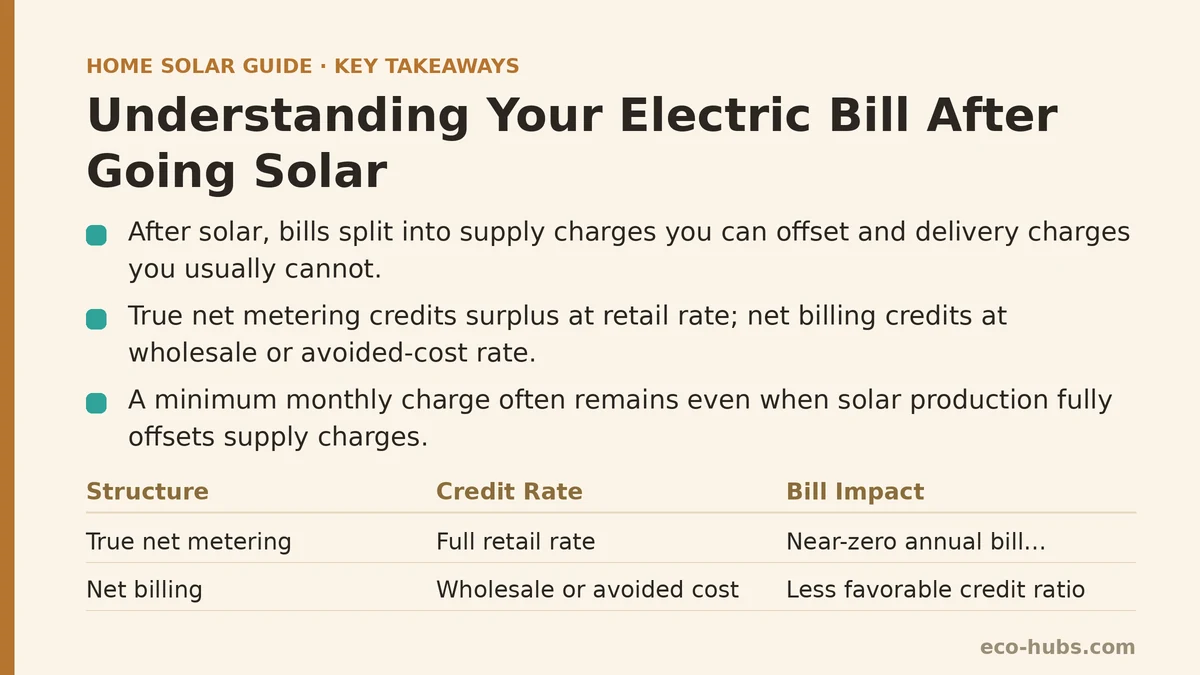
Many utilities bill separately for the electricity itself (supply) versus the infrastructure that carries it (delivery). Before solar, these appeared as a single total on many statements. After solar, the split becomes more visible, and the two categories can behave differently.
Supply charges cover the actual generation of power — the fuel and the power plant. When your solar system produces more than your home uses at a given moment, surplus kilowatt-hours flow to the grid and typically earn you a credit against supply charges. Delivery charges cover the poles, wires, and transformers. These are frequently a flat monthly fee or a per-kWh charge that your solar production does not offset.
If your bill after solar seems “too high,” look first at whether the bulk of the balance is a delivery fee. Many homeowners mistake a persistent delivery charge for a sign their solar system is underperforming when, in practice, the system is working fine and the fee is simply not eligible for net metering credits.
4. The Difference Between Net Metering and Net Billing
The terminology varies by region, but two common structures exist. Under true net metering, surplus kilowatt-hours produced in the daytime are credited at the full retail rate toward electricity you draw from the grid at night. Under net billing, surplus production is credited at a wholesale or avoided-cost rate (usually a few cents per kWh) rather than the retail rate (often 15 to 30 cents per kWh).
For your bill, the practical difference is sizeable. With true net metering, a system sized slightly larger than annual consumption often results in a near-zero annual bill, only the fixed delivery fee remaining. With net billing, you may see a meaningful credit balance on your statement, but applying that balance to your monthly consumption happens at a less favorable ratio, which can stretch your payback period by several years.
Check your original utility agreement or the interconnection paperwork you signed — the word “retail” versus “wholesale” or “avoided cost” in the compensation clause tells you which structure you are on.
3. The “Minimum Bill” Line Item and Why It Exists
Many utilities include a minimum monthly charge, regardless of net consumption. This might appear under various names: customer charge, basic service fee, administrative fee, or grid connection charge. For a solar home generating surplus power, the supply portion of the bill may show zero or even a credit, while this fixed fee remains untouched.
This charge is often the single most misunderstood line item on a solar owner’s bill. It is not a penalty for producing solar power, and it is not avoidable by sizing a larger system. It covers meter maintenance, billing costs, and grid availability. If your bill shows a $10 to $25 monthly charge that never changes, that is typically this category.
Do not confuse this minimum bill with a usage charge. A bill that shows a fixed fee only — with no usage line — means your solar system covered your net consumption for the month, and the only remaining obligation is the grid connection fee.
2. How to Read a Two-Way Meter Statement
After installing a bidirectional meter, your statement will show two separate readings or a net reading. Older one-way meters only measured imports from the grid. A two-way statement shows energy delivered from the grid (what you consumed) and energy delivered to the grid (what your system exported). Some utilities report these as two separate rows, others show a single net value.
If your statement shows both numbers, the math is: (consumption × rate) minus (export × credit rate) plus (any fixed fees) equals your total due. A common misreading occurs when the export number appears larger than the consumption number, and an owner assumes the bill must be negative. That only happens if, after applying the credit rate, your export credits exceed your consumption costs and your utility allows this balance to roll over month to month rather than paying it out.
1. Seasonal Credits and the Annual True-Up
Because solar production peaks in summer and consumption often peaks in winter (heating), many policies operate on an annual settlement cycle rather than monthly. Your monthly bills during sunny months may show a growing credit balance. During winter months, that balance is drawn down. The utility then performs a true-up either annually or semi-annually, reconciling total annual production against total annual consumption.
This creates a common misperception: a solar owner in November sees a bill with a balance due even though their system ran a surplus in July. That is not a system failure. The seasonal credit from summer is being applied to winter usage, and the true-up date — not the calendar year — determines whether you owe a small settlement or receive a carryover credit.
Check your net metering agreement for the true-up date and whether credits expire or are paid out in cash at that point. Some utilities expire unused credits at $0 value, meaning a system sized far above annual consumption may not provide any financial benefit for the excess production beyond a certain threshold.
The Five Line Items at a Glance
| Line Item | What It Represents | Does Solar Production Offset It? |
|---|---|---|
| Supply charge | Cost of generated electricity | Yes, via net metering or net billing credits |
| Delivery charge | Cost of grid infrastructure | Usually not, often a fixed fee or per-kWh surcharge |
| Minimum bill / customer charge | Metering and administrative cost | No, fixed regardless of production |
| Net usage row | Your consumption minus exports | This row is the result of netting |
| Seasonal credit balance | Summer surplus applied to winter usage | Yes, but on an annual cycle, not monthly |
A Sample Bill Walked Through Step by Step
Imagine a July statement from a home with a 6 kW system on true net metering. The bill shows: consumption of 400 kWh, export of 650 kWh, a supply rate of $0.16/kWh, and a delivery fee of $25 flat.
First, net the consumption against the export. Net export is 250 kWh. That yields a $40 credit (250 × $0.16). Subtract the $25 delivery fee. The bill shows a credit balance of $15, which rolls forward to the next month. No amount is due.
In January, the same home consumes 800 kWh and exports 100 kWh. Net consumption is 700 kWh. The charge is $112. The delivery fee of $25 is added. The $15 credit from July is applied, leaving $122 due. This pattern — zero or credit-summed summer bills, higher winter bills — is expected behavior under an annual true-up.
What does your current bill show as the largest line item — a fixed delivery fee, a net usage charge, or a seasonal credit balance? Share which section is unclear, and we can help you interpret what it means for your system’s actual performance.
Related guides: How to Read Your Electric Bill After Going Solar, Common Net Metering Application Mistakes That Delay Your Solar Connection, and Net Metering Explained: Why Your Utility’s Policy Matters More Than You Think.
🔗 Recommended Reading
- Solar Incentive Paperwork: Common Filing Mistakes That Delay Your Rebate
- Home Battery Sizing Mistakes That Lead to Blackout Regret
- Common Solar Installer Mistakes Homeowners Should Catch Before Signing
- Common Home Battery Storage Wiring and Placement Mistakes to Avoid
- Solar Payback Period vs Cash-on-Cash Return: Which Metric Should Homeowners Use