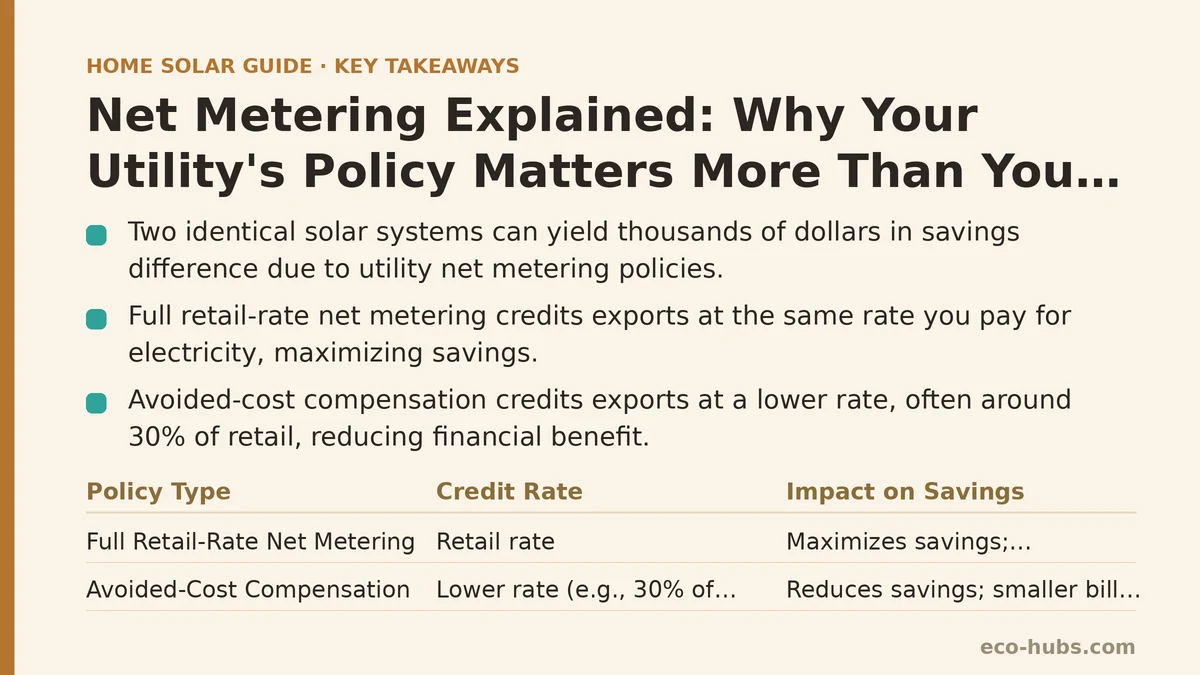
Two homeowners can install the exact same solar system — same panel count, same orientation, same installer — and end up with savings that differ by thousands of dollars over the system’s lifetime. The panels aren’t the variable. The utility’s net metering policy is.
A Tale of Two Neighbors, One Utility Boundary
Consider a case that illustrates this cleanly: two households sit roughly a mile apart, both served by different utilities because of where a service territory boundary happens to fall. Both install a 7-kilowatt rooftop system in the same month, from the same regional installer, using the same equipment. Their production numbers, month over month, come out nearly identical — both systems are well-sited, unshaded, and correctly angled.
Their savings do not come out identical. One household’s electricity bill drops close to zero for eight months of the year. The other’s drops by roughly 60%, even in months when their system produces more energy than they consume. The panels didn’t cause that gap. The compensation structure each utility applies to exported solar energy did.
What Net Metering Actually Determines
Net metering is the mechanism that determines what happens to solar energy your system generates but your household doesn’t use in that moment — the excess that flows back onto the grid. Under a full retail-rate net metering policy, that exported energy is credited at the same rate you’d pay to buy electricity from the utility. One kilowatt-hour sent out is worth one kilowatt-hour pulled back in later, regardless of the time of day either transaction happens.
That’s the policy the first household in this case has. Their utility credits exports at retail rate, on a rolling monthly basis, and any unused credits carry forward. In practice, this means their system doesn’t need to match their consumption pattern hour by hour — it just needs to produce enough over the course of a month.
Where the Second Household’s Numbers Diverge
The second household’s utility uses a different structure, often called net billing or avoided-cost compensation. Exported energy is credited not at the retail rate but at a lower rate meant to reflect what the utility itself would have paid to generate or purchase that power on the wholesale market. In this case, that rate is roughly 30% of the retail price.
The practical effect shows up in the math immediately. When this household’s system produces more than they’re using — which happens for several hours most sunny days — that surplus energy earns a credit worth a fraction of what it would be worth to offset a future purchase. A kilowatt-hour exported at midday for a 30%-value credit does not fully cancel out a kilowatt-hour purchased back at full price in the evening, even though the two amounts of energy are physically identical.
This is the entire explanation for the savings gap between these two households. Same production, same consumption pattern, dramatically different financial outcome, purely because of how each utility values exported energy.
Why This Detail Rarely Gets Surfaced Before Signing
Installer proposals typically model savings using assumptions about the local net metering policy, but the difference between full retail-rate crediting and avoided-cost crediting isn’t always presented in a way that makes its financial weight obvious. A proposal might mention “net metering available” without specifying which version applies, and a homeowner comparing quotes has no easy way to know that this single policy detail could swing their actual payback period by several years.
This is worth asking about directly and specifically, in the same spirit covered in our guide on questions to ask a solar installer before signing anything: what is the exact export compensation rate, is it retail or avoided-cost, and is there a cap on how many credits can roll over month to month?
How System Sizing Should Respond to the Policy Difference
The two households in this case also diverge on what “correctly sized” means for their situation. Under full retail net metering, oversizing a system slightly to cover winter production dips carries little financial penalty — any summer surplus is worth full value and simply banks against future usage. Under avoided-cost crediting, that same oversizing strategy is less appealing, since summer surplus is worth substantially less than the electricity it’s meant to offset later.
For the second household, the more financially sound approach would have been sizing the system closer to their own real-time consumption, potentially paired with a smaller battery to shift self-generated energy into evening hours rather than exporting it at a discounted rate. Their installer, working from a template proposal rather than a policy-specific one, did not build sizing around this distinction.
The Time-of-Export Problem Batteries Can Solve
A battery doesn’t change the utility’s compensation rate, but it changes when energy leaves the home. Instead of exporting midday surplus at 30% of retail value, a household under avoided-cost net billing can store that surplus and use it during evening hours instead of buying it back from the grid at full price. The value captured shifts from “sell low” to “avoid buying high” — a meaningfully better outcome under this specific policy structure, even though the same math wouldn’t move the needle much for a household already under full retail net metering.
This is one of the clearer cases where battery economics depend heavily on local policy rather than on battery technology itself. A battery attached to a full-retail-net-metering system mostly buys backup power and independence. The same battery attached to an avoided-cost system can materially improve the financial return of the solar investment itself.
What Changed Once the Second Household Understood Their Policy
After identifying the compensation structure as the source of their lower-than-expected savings, the second household revisited their setup with their installer. They added a modest battery, shifted their thermostat and appliance scheduling toward using more self-generated power during daylight hours rather than exporting it, and reduced their effective reliance on evening grid purchases. Their bill offset improved from roughly 60% to closer to 80%, without adding a single additional panel.
Nothing about their system’s production changed. What changed was how well their usage pattern lined up with a policy that punishes export and rewards self-consumption — a distinction that would have been useful to know before the system was sized in the first place.
Quick Reference: What to Ask Before You Sign
| Question | Why It Matters |
|---|---|
| Is export credited at retail rate or avoided-cost rate? | Determines whether oversizing helps or hurts your payback |
| Do credits roll over month to month, or expire? | Affects how much a seasonal production mismatch costs you |
| Is there an annual true-up, and how are leftover credits settled? | Some policies pay out unused credits at a lower rate at year-end |
| Would a battery meaningfully change my numbers under this policy? | Avoided-cost structures often make batteries more financially useful |
| Could my utility’s policy change during my system’s lifetime? | Some jurisdictions have already reduced compensation for new applicants |
Net metering policy isn’t a footnote to a solar quote — for many households, it’s the single factor most responsible for whether the payback period lands where the proposal promised. If you know which structure your utility uses, you’re already positioned to size and configure a system around it rather than discovering the gap after your first few bills arrive. Related guides: Time-of-Use Electricity Rates and How Solar Changes the Math, Common Net Metering Application Mistakes That Delay Your Solar Connection, and Net Metering vs Battery Storage: Which Setup Actually Saves More.
🔗 Recommended Reading
- Solar Panel Monitoring Apps: A Setup Guide for Beginners
- How to Read Your Electricity Bill After Solar: A Line-by-Line Walkthrough
- Solar Incentive Paperwork: Common Filing Mistakes That Delay Your Rebate
- Home Battery Sizing Mistakes That Lead to Blackout Regret
- Common Solar Installer Mistakes Homeowners Should Catch Before Signing