A common misconception is that time-of-use (TOU) rates make solar a worse investment because you are forced to sell your daytime solar power at a low off-peak price and buy it back at a high peak price in the evening. That framing misses the entire point. In practice, TOU rates create one of the strongest financial cases for solar — provided you understand how the billing structure interacts with your panel output and your home’s consumption pattern. The misconception persists because people compare the wrong numbers: you are not comparing what you pay per kilowatt-hour to what you get paid per kilowatt-hour on a one-to-one basis. You are comparing a full-rate purchase against a partial-rate purchase, and solar shifts that balance in your favor.
The Myth: TOU Rates Punish Solar Owners
The claim usually sounds like this: “With TOU, the utility buys my excess solar at $0.07/kWh during the day and sells it back to me at $0.35/kWh at night, so I’m losing $0.28 on every kilowatt-hour I don’t use immediately.”
The flaw in that logic is the assumption that most of your solar generation is “excess” in the first place. For a well-sized system, the majority of daytime solar production offsets consumption that would otherwise be billed at whatever rate applies at that moment — which, under most TOU structures, is already a lower off-peak or mid-peak rate. The excess that does flow back to the grid is often small relative to the total offset. The real dollar impact comes from how much grid-purchased energy you avoid, not from the export rate alone.
The reality: TOU rates punish homeowners without solar who have to buy peak-priced electricity in the evening. Solar lets you avoid that peak purchase almost entirely by generating your own electricity during the day and shifting your heaviest usage — or simply relying on your system’s output — to hours when grid prices would otherwise be highest.
How TOU Rates Work (In Most Territories)
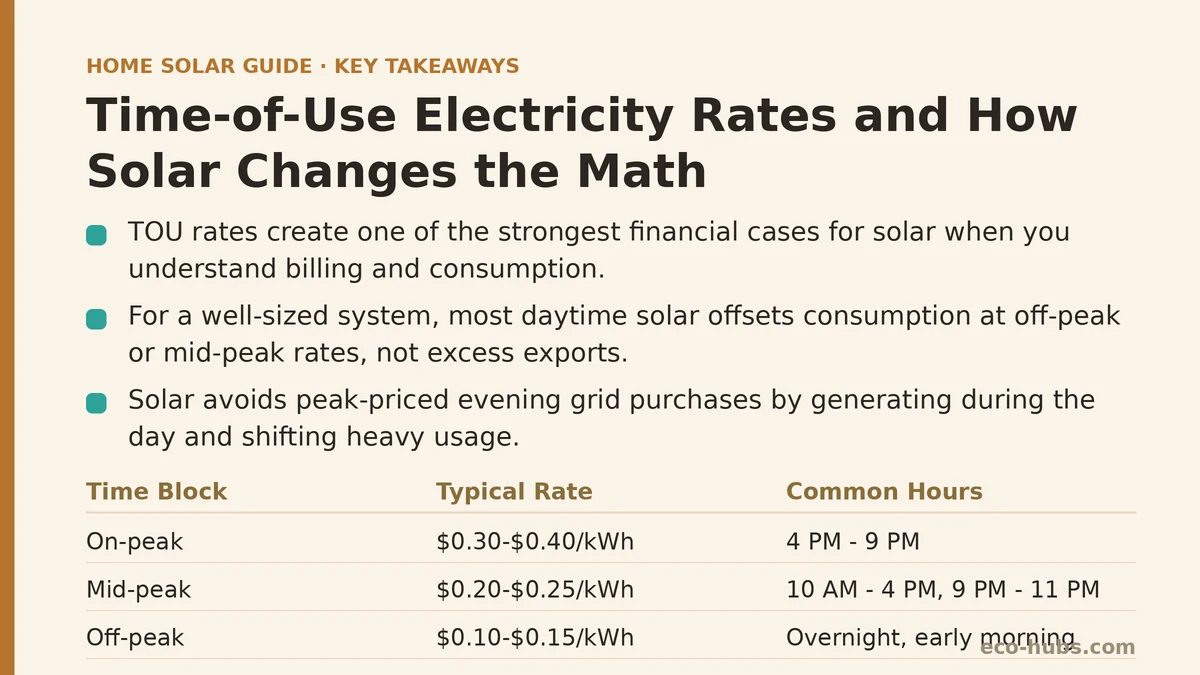
TOU pricing divides the day into blocks, each with a different rate per kilowatt-hour. A typical structure looks like this:
| Time Block | Typical Rate (illustrative) | Common Hours |
|---|---|---|
| On-peak | $0.30–$0.40/kWh | 4:00 PM – 9:00 PM (evenings) |
| Mid-peak | $0.20–$0.25/kWh | 10:00 AM – 4:00 PM, 9:00 PM – 11:00 PM |
| Off-peak | $0.10–$0.15/kWh | Overnight, early morning |
The exact hours vary by utility and season — some use a “super peak” window during summer heatwaves, others compress peak into a shorter evening window during winter. The critical feature is that the rate you pay for grid electricity varies by hour, which changes both the value of every kilowatt-hour you generate and the cost of every kilowatt-hour you consume.
What Solar Does Under TOU
Solar panels produce electricity during daylight hours, which in most regions falls squarely into the off-peak or mid-peak window. This is where the comparison gets interesting.
Without solar: Every kilowatt-hour you use in the evening peak window costs you the peak rate ($0.30–$0.40). You pay that rate regardless of whether the sun is shining. Your daily electricity cost is weighted heavily toward the hours when rates are highest.
With solar: During the day, your panels generate electricity that offsets your daytime consumption — that part is straightforward. But the more meaningful effect is what happens to your evening usage. Many TOU territories use net energy metering (NEM), where any surplus you push to the grid during the day earns a credit that offsets what you draw from the grid in the evening. Even if that credit is valued at the off-peak or mid-peak export rate rather than the peak import rate, it is still reducing the amount of peak-priced electricity you have to buy from the grid.
In practice, the savings come down to a simple calculation: total grid-purchased kilowatt-hours, weighted by the time-of-day rate at which you buy them, minus the export credits you earn for surplus generation. Solar reduces the first number dramatically, and even a modest export rate beats paying full retail peak rates for every watt you consume after sundown.
The Interaction Between TOU and Net Metering
Net metering rules vary significantly by state and utility, and the interaction with TOU rates is where the nuances live. Some utilities offer what is called “time-of-use net metering,” where your exports are credited at the same rate you would have paid for that hour — meaning surplus solar sent to the grid at 2:00 PM gets credited at the off-peak rate, and if you draw that same amount back at 7:00 PM, you pay the peak rate for it. That version is less favorable to solar owners.
Other utilities offer “totalization” or “rolling” credits, where surplus generation in one period can offset consumption in a different time period, sometimes with a rate multiplier applied. Some states require utilities to credit exports at the retail rate regardless of the time block, which is dramatically more favorable to solar owners under TOU.
The key takeaway: check your specific utility’s net metering tariff language. The difference between “credits at generation-time rate” and “credits at average retail rate” can shift your annual savings by thousands of dollars. Solar installers in your region know which utilities use which structure, and the local policy landscape matters more than the TOU rate schedule itself.
How Solar Sizing Changes Under TOU
Under a flat-rate tariff, the goal is simply to size your system to cover your total annual consumption. Under TOU, the goal shifts — you want to maximize the amount of peak-evening consumption that is offset by daytime generation, because that is where the rate differential is largest.
This has a practical implication: a system sized to cover 100% of annual usage on a flat tariff may leave you short under TOU if your evening consumption is heavy and your utility credits exports at the lower daytime rate. Conversely, a system that overshoots your annual usage can still make financial sense under TOU if the surplus exports are credited at a rate that beats your avoided peak-import cost.
For most homeowners, a system sized to cover between 100% and 120% of annual usage is the sweet spot under TOU, with the exact target depending on your utility’s export credit rate. The math is not complicated, but it does require looking at your hourly consumption patterns, not just your monthly bill total.
Load Shifting Is the Underrated Lever
TOU rates give you two separate financial levers. The first is solar generation — producing your own electricity to avoid grid purchases. The second is load shifting — moving your own consumption from peak to off-peak hours. Together, they compound.
Practical load-shifting moves that work well with solar:
- Run your dishwasher, washing machine, and dryer during midday hours when your panels are producing (off-peak or mid-peak, depending on your utility).
- Pre-cool your home during the afternoon so your HVAC system runs less during the evening peak window — or invest in a smart thermostat with “peak demand” settings.
- Charge your electric vehicle during midday hours rather than overnight, if your solar production covers it. This converts a peak-hour or mid-peak purchase into an off-peak purchase and uses solar generation directly.
- Schedule your pool pump, water heater, and other high-draw equipment for solar production hours. Many utilities have specific off-peak windows for these devices that align with solar generation.
The savings from load shifting are separate from solar savings. A home with solar and load shifting can measurably reduce its grid purchases during peak windows to near zero, which is where the financial return on solar is strongest.
What the Numbers Look Like (Illustrative Example)
Here is a concrete example for a typical 4-person household using 900 kWh/month, with a TOU structure of $0.35 peak (4–9 PM), $0.25 mid-peak (10 AM–4 PM), and $0.12 off-peak (all other hours), and net metering that credits exports at the generation-time rate.
Without solar (annualized):
| Time Block | Monthly Usage (kWh) | Rate ($/kWh) | Monthly Cost |
|---|---|---|---|
| On-peak | 250 | $0.35 | $87.50 |
| Mid-peak | 200 | $0.25 | $50.00 |
| Off-peak | 450 | $0.12 | $54.00 |
| Total | 900 | — | $191.50 |
With a 6 kW solar system (approximately 700 kWh monthly offset):
| Time Block | Grid Purchases (kWh) | Export Credits (kWh) | Net Cost/Revenue |
|---|---|---|---|
| On-peak | 100 | 0 | $35.00 |
| Mid-peak | 50 | 50 (credited at $0.25) | $12.50 – $12.50 = $0 |
| Off-peak | 150 | 350 (credited at $0.12) | $18.00 – $42.00 = −$24.00 |
| Total | 300 | 400 | Net cost: $11.00/month |
In this example, the solar home cuts monthly electricity cost from roughly $192 to roughly $11 — a 94% reduction. The export credits at off-peak rates are smaller than the avoided peak purchases, but the total grid purchases drop so dramatically that the overall bill shrinks to near zero. The math works not because export rates are generous, but because solar eliminates the vast majority of high-rate evening purchases that the utility would otherwise bill at full peak price.
Myth vs. Reality: A Side-by-Side Look
| Claim | Reality |
|---|---|
| “TOU makes solar less valuable because export rates are low.” | Export rates only affect the surplus you send back. The larger financial win comes from avoiding peak-hour retail purchases entirely, which solar does naturally during daylight. |
| “You need battery storage to make solar work under TOU.” | Battery storage helps push daytime generation into evening hours, but it is not required. Most TOU-solar homes see strong savings from generation offset alone, and batteries add value primarily when your utility’s export credit is near zero or when peak rates are exceptionally high. |
| “Your solar system should be sized to cover 100% of your bill.” | Under TOU, the optimal size may be slightly above or below 100% of annual usage, depending on your export credit rate and your consumption profile. Sizing to maximize the peak-offset ratio is the better target. |
| “The exact TOU hours don’t matter much for solar.” | They matter enormously. A utility with peak hours from 4–9 PM aligns well with solar production in most regions, but a utility with peak hours from 10 AM–3 PM (rare, but exists in some southern territories) reduces the value of evening solar offset. Always check your specific tariff hours. |
When TOU Rates Do Make Battery Storage Attractive
Battery storage becomes part of the conversation under TOU for two distinct reasons: arbitrage and backup. Arbitrage means charging the battery from solar during off-peak hours and discharging during peak hours, capturing the rate differential. If your utility’s peak rate is $0.35 and its off-peak export credit is $0.10, each kilowatt-hour you shift from peak to off-peak through a battery saves $0.25. Over a 10 kWh usable battery cycled daily, that is roughly $75/month in avoided peak purchases — enough to help offset battery costs, though battery prices still make the pure financial case marginal without additional incentives.
Backup value is separate and harder to quantify. If your utility has frequent outages or you are in a wildfire or hurricane zone, a battery is a resilience purchase first and a TOU-arbitrage tool second. The TOU structure just makes that purchase slightly more rational on the financial side.
Verifying Your Own Numbers
The illustrative example above uses specific rates and hours that will differ in your region. To apply this framework to your situation, you need three pieces of information:
- Your utility’s full TOU rate schedule — not just the peak rate, but all time blocks, all seasons, and any demand charges that apply separately.
- Your hourly or interval usage data — most utilities provide this through a smart meter portal or downloadable CSV export. Look for the “usage by hour” or “interval data” option online.
- Your utility’s net metering tariff — specifically, how exports are credited relative to your import rates, and whether there are caps, rollover rules, or time-of-day multipliers.
With those three items, the math is a simple spreadsheet exercise. If you are evaluating a solar quote, any reputable installer should be able to produce this calculation using your actual utility data — not a generic national average.
A Few Questions Worth Asking Your Installer About TOU
If you are in the process of getting solar quotes, raise these points specifically:
- “Does your savings projection use my utility’s TOU rate schedule, or a flat average rate? If it uses a flat rate, what would the same system produce under the TOU schedule?”
- “What is my utility’s export credit rate under net metering — is it at the generation-time rate, retail rate, or something in between?”
- “Are there seasonal TOU changes (summer vs. winter) that would affect the savings projection you are showing me?”
- “Would battery storage materially improve the economics under my specific utility’s TOU tariff, or is it purely a backup benefit in my case?”
Are you on a TOU tariff right now, or is your utility planning to switch to one? If you are comfortable sharing your utility name and rate schedule, I can help you identify which specific cost levers would move your solar savings the most.
Related guides: Net Metering Explained: Why Your Utility’s Policy Matters More Than You Think, Common Net Metering Application Mistakes That Delay Your Solar Connection, and How to Actually Calculate Your Solar Panel Payback Period.
🔗 Recommended Reading
- Solar Incentive Paperwork: Common Filing Mistakes That Delay Your Rebate
- Home Battery Sizing Mistakes That Lead to Blackout Regret
- Common Solar Installer Mistakes Homeowners Should Catch Before Signing
- Common Home Battery Storage Wiring and Placement Mistakes to Avoid
- Solar Payback Period vs Cash-on-Cash Return: Which Metric Should Homeowners Use