The common assumption is that solar panels and a backup generator are competing technologies — that you choose one or the other depending on whether you prioritize long-term savings or short-term reliability. That framing misses the more useful question. In practice, solar and generators serve different parts of the outage problem, and pairing them thoughtfully can cover gaps that either system leaves open on its own. The real decision is not which one to buy, but how to combine them so each handles what the other cannot.
Myth: Solar Eliminates the Need for a Generator
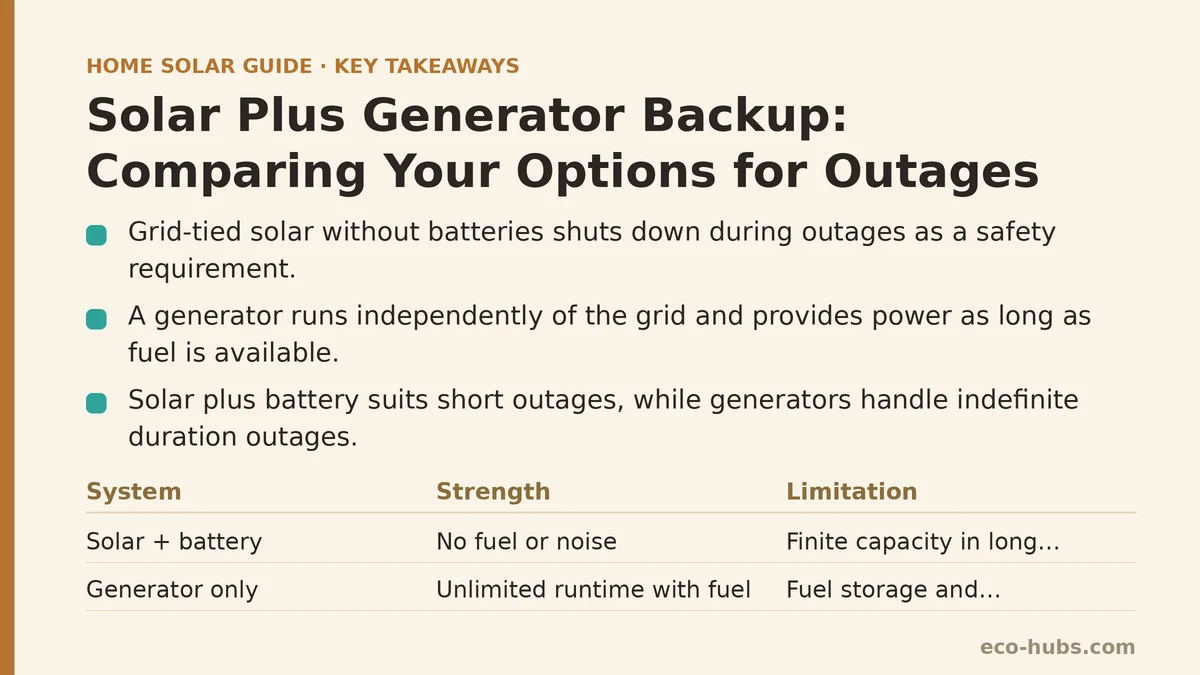
The reality is that solar without battery storage simply stops producing during a grid outage. This is a safety requirement, not a design flaw. If your panels are feeding power back into lines that utility workers are repairing, you create a serious hazard, so grid-tied inverters are required to shut down automatically when the grid goes down.
A generator, by contrast, runs independently of the grid and produces power as long as fuel is available. This makes generators fundamentally better suited for one thing: keeping your home powered through an outage that lasts longer than daylight hours, stretches across multiple cloudy days, or occurs during winter when solar production is at its lowest.
That is not to say solar is useless during outages. With the right battery setup and a critical-loads panel, solar can cover you for short outages and recharge during the day. But a generator answers a different question — the one about indefinite duration.
The Case for Solar-Only Backup
For homeowners in areas with short, infrequent outages — think a few hours a couple of times a year — solar plus battery storage can comfortably cover the gap. The battery handles the evening and overnight hours, and the panels replenish it the next day. If the outage is brief, you may never notice a disruption beyond a few seconds of switchover time.
The tradeoff is cost. A battery system sized to run essential loads for 24 hours or more will set you back considerably more than a portable generator, and the capacity is still finite. If a winter storm knocks out power for four days straight with heavy cloud cover, a solar-plus-battery system will run out of stored energy by the second day unless you have aggressively conservative load management.
For the right homeowner, though, this tradeoff is acceptable. No fuel to store, no maintenance schedule, no noise, and the equipment is doing double duty — saving you money on every regular day and providing backup on the rare day you need it.
The Case for Generator-Only Backup
A generator, whether portable or permanently installed, offers something solar and battery cannot: unlimited runtime as long as fuel is available. A 500-gallon propane tank can power a whole-house generator for weeks. Even a portable unit running on a few cans of gasoline can get you through a multi-day outage if you ration carefully.
The downsides are equally real. Generators require fuel storage, which is itself a vulnerability — during widespread outages, gas stations lose power too, and propane delivery can be delayed. You also need to run the generator periodically to keep it healthy, and the noise and exhaust management are a constant consideration.
For homeowners who lose power multiple times per year, especially for extended periods, a generator alone may be the most straightforward and cost-effective resilience investment. The calculation changes when you already have solar on the roof or are planning to add it.
Where the Two Systems Fall Short Alone
A generator cannot reduce your monthly electric bill. It sits idle, consuming nothing, producing nothing, until an outage occurs. In the meantime, you are paying full retail rates for every kilowatt-hour you consume from the grid.
Solar without battery cannot power your home during an outage at all. Unless you have a generator to act as a power source that your solar equipment can work with, your panels are simply dead weight until utility service is restored.
So the honest summary of each standalone option is this: a generator gives you resilience but zero daily value, and solar gives you daily value but zero outage protection unless paired with battery storage.
The Coordinated Approach: Hybrid Configurations
The most practical hybrid arrangement involves using solar plus battery for daily savings and short outages, and a generator as a fallback for extended outages or periods when solar production cannot keep up.
Here is how that works in practice. Your home is wired with a critical-loads panel that separates essential circuits — refrigeration, heating, lighting, medical equipment, internet — from non-essential loads. Solar and battery power these critical loads as long as the battery holds charge. When the battery drops to a set threshold, the generator starts automatically and either powers the loads directly or recharges the battery, whichever your system is configured to do.
This setup accomplishes two things. First, the generator does not run constantly — it only kicks in when the battery is low, so fuel consumption drops substantially compared to running a generator around the clock. Second, the solar array continues to recharge the battery during daylight hours, which means the generator may run only a few hours per day rather than continuously.
Reality Check: What This Configuration Costs
| Component | Typical Cost Range | What It Adds |
|---|---|---|
| Solar array (existing) | Already installed | Daily bill reduction, daytime recharge during outages |
| Battery storage (10-15 kWh usable) | $10,000 – $15,000 installed incl. hardware | Instant switchover, quiet overnight coverage |
| Critical-loads panel + wiring | $2,000 – $4,000 | Isolates essential circuits, enables coordination |
| Automatic transfer switch | $1,500 – $3,000 | Coordinates generator and battery without manual steps |
| Generator (7-10 kW standby) | $4,000 – $7,000 incl. installation | Unlimited-runtime fallback for extended outages |
The combined system is a meaningful investment, but note that you do not need the largest generator available. Because the battery handles most short outage durations, a smaller generator that runs only occasionally is sufficient in most cases. Sizing the generator to recharge the battery rather than to power the entire home directly often cuts the generator cost substantially.
When the Hybrid Does and Does Not Make Sense
The hybrid approach is most defensible for homeowners who already have solar, experience occasional multi-day outages, and want to avoid the noise and fuel costs of running a generator continuously. The battery does the quiet work of overnight coverage, and the generator simply tops things up when the battery runs low.
The approach is harder to justify if you have neither solar nor battery yet and your outage history is limited to a few hours once a year. In that case, a small portable generator at a few hundred dollars provides better return for the money than a multi-thousand-dollar hybrid system.
One more consideration: coordination complexity. Not every inverter brand communicates cleanly with every generator and transfer switch. If you are designing a hybrid system from scratch, it is worth working with an installer who can confirm component compatibility rather than discovering integration problems after purchase. Ask about the specific communication protocol between the battery inverter and the generator controller before committing.
A Practical Sizing Rule of Thumb
If you are leaning toward the hybrid approach, work backward from your outage history. Look at the longest outage you have experienced in the last five years and the typical duration of most outages. Size the battery to cover the common short outages on its own, and size the generator to cover the rare long one.
For most homes, a 10 kWh usable battery covers 12 to 20 hours of critical loads depending on what you include. A 7 to 10 kW generator running a few hours per day can recharge that battery and power the loads simultaneously. That combination covers nearly any realistic outage scenario while keeping fuel consumption modest.
The Bottom Line
Solar and generator backup are not competitors. They cover different parts of the outage problem — solar provides daily value and quiet short-term coverage, while a generator provides the unlimited-runtime fallback that battery storage cannot match. The hybrid configuration uses each system where it is strongest: the battery handles frequent short disruptions, and the generator handles the rare extended outage without running around the clock.
The question worth asking yourself is not “solar or generator” but “what is my actual outage pattern, and which configuration covers it most cost-effectively?” For homeowners with existing solar and meaningful outage risk, the hybrid approach deserves serious consideration. For everyone else, the choice between solar and a generator is still a choice — just make it based on your outage history, not on the assumption that the technologies are mutually exclusive.
What does your typical outage look like — a few hours a couple of times a year, or multi-day events during storm season? And do you already have solar panels installed, or is that part of a future plan? Tell us your situation and we can help you map out which configuration fits your specific outage pattern and budget.
Related guides: A Beginner’s Step-by-Step Guide to Getting Your First Solar Quote, Common Net Metering Application Mistakes That Delay Your Solar Connection, and Comparing Solar Quotes: What the Numbers Mean.
🔗 Recommended Reading
- Solar Incentive Paperwork: Common Filing Mistakes That Delay Your Rebate
- Home Battery Sizing Mistakes That Lead to Blackout Regret
- Common Solar Installer Mistakes Homeowners Should Catch Before Signing
- Common Home Battery Storage Wiring and Placement Mistakes to Avoid
- Solar Payback Period vs Cash-on-Cash Return: Which Metric Should Homeowners Use