Say you are standing in your backyard the morning after a hailstorm, looking up at your roof with a coffee in hand, trying to figure out if those panels took a hit. From ground level, everything looks fine — no shattered glass, no obviously bent frames, nothing dramatic. But your monitoring app shows production down 15% compared to the same sunny day last week, and you are not sure whether that’s a fluke, a cloud that passed through during the peak hours, or something worth calling someone about. This is one of the most common positions homeowners find themselves in after severe weather, and it is exactly the kind of ambiguity this guide is meant to resolve.
Rather than a general overview, what follows is organized around specific symptoms you might actually be seeing right now, paired with their likely causes and the corresponding fix or next step.
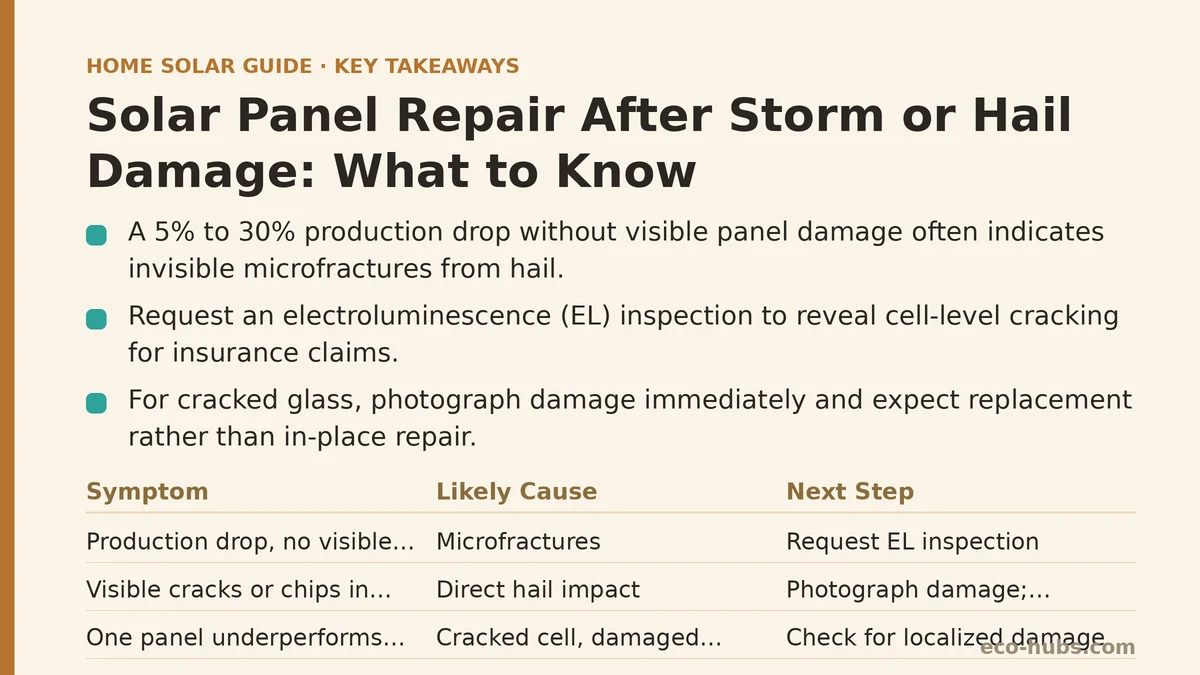
Symptom: Production Drop Without Visible Panel Damage
What you’re seeing: Your monitoring dashboard shows a measurable output decline — anywhere from 5% to 30% — but a visual check from the ground or even a ladder reveals nothing obviously cracked, chipped, or bent.
Likely cause: Microfractures. Hail impacts strong enough to crack the internal solar cells without breaking the outer glass are extremely common, and they are invisible without specialized imaging. A microfracture doesn’t stop a panel from producing power, but it degrades output and, in many cases, worsens over time as the crack propagates with temperature cycling.
The fix: Request an electroluminescence (EL) inspection from your installer or a qualified technician. This imaging technique reveals cell-level cracking that is undetectable to the naked eye, and it is the standard method insurance adjusters and manufacturers use to substantiate a hail damage claim. If EL imaging confirms microfractures, document the storm date and file with your homeowner’s insurance before assuming the panel needs full replacement — many policies cover this specifically as storm damage.
Symptom: Visible Cracks or Chips in the Glass
What you’re seeing: A spiderweb crack pattern, a chip near an edge, or a visibly shattered corner on one or more panels.
Likely cause: Direct hail impact strong enough to compromise the tempered glass surface. The severity ranges considerably — a small edge chip may not affect performance measurably, while a larger crack can allow moisture intrusion that damages the cells underneath over subsequent weeks.
The fix: Photograph the damage immediately, including a wide shot showing the panel’s position on the array and a close-up of the crack itself, before doing anything else. Cracked panels with moisture intrusion risk are generally not repairable in place — they need replacement, not patching. Contact your installer to confirm whether the specific panel model is still in production, since a mismatched replacement panel can create a visible tone difference and, in rare cases, wiring incompatibilities with the rest of the string.
Symptom: One Panel Producing Significantly Less Than Its Neighbors
What you’re seeing: Panel-level monitoring (if you have it) shows one unit dramatically underperforming compared to panels right next to it that faced the same storm and same sun exposure.
Likely cause: This pattern points to something localized — a cracked cell, a damaged bypass diode, or a connector that was jarred loose during high winds rather than hail itself. Wind-driven debris can also cause this kind of isolated underperformance without any visible glass damage.
The fix: An isolated underperformer is usually the easiest damage type to diagnose precisely, because the comparison to neighboring panels does much of the diagnostic work already. Have a technician check the connectors and junction box on that specific panel first, since a loose MC4 connector is a faster and cheaper fix than a panel swap, and it’s a surprisingly common cause of this exact symptom after high-wind events.
Symptom: A Visibly Bent or Lifted Panel Frame
What you’re seeing: One or more panels appear tilted differently than the rest of the array, or the aluminum frame looks warped, with a visible gap between the panel and the racking underneath.
Likely cause: Wind uplift strong enough to partially dislodge the panel from its mounting hardware, or, less commonly, a racking failure that predates the storm and simply got exposed by it. A bent frame can also mean the racking clips themselves were damaged.
The fix: Do not attempt to re-secure this yourself. A partially lifted panel that looks stable can still be one strong gust away from becoming a serious falling hazard, and the mounting hardware underneath needs a full inspection before anyone puts weight on that section of roof again. This is a same-week call to your installer, not a wait-and-see situation.
Symptom: Inverter Error Codes Appearing After the Storm
What you’re seeing: Your inverter display or app is throwing an error code you haven’t seen before, sometimes paired with the system going offline entirely.
Likely cause: Power surges from nearby lightning strikes, even ones that didn’t hit your property directly, can travel through grid connections and damage sensitive inverter electronics. Water intrusion into an outdoor-rated but aging inverter enclosure is another common culprit after wind-driven rain.
The fix: Note the exact error code before restarting anything, since installers use these codes to diagnose remotely and it saves a diagnostic visit in straightforward cases. If a surge protection device (SPD) was installed as part of your original system, check whether it shows signs of having tripped — this is a strong indicator of the cause and is normally a simple component swap rather than a full inverter replacement.
Symptom: No Visible Damage, But You’re Not Sure If You Should Still Get an Inspection
What you’re seeing: Nothing looks wrong, production seems roughly normal, but the storm was severe enough that you’re wondering whether damage might exist regardless.
Likely cause: Not every case of storm exposure produces symptoms right away. Some microfractures and connector issues take weeks of thermal cycling to manifest as measurable output loss, meaning today’s normal-looking dashboard is not a guarantee that nothing happened.
The fix: If the storm involved hail larger than roughly one inch in diameter or winds exceeding 60 mph, a baseline inspection is worth scheduling even without visible symptoms — largely because most insurance policies have a filing window, and waiting until a problem becomes obvious months later can put you outside that window. An inspection now costs far less than a denied claim later.
Quick Reference: Symptom, Cause, and Fix
| Symptom | Likely Cause | Recommended Fix |
|---|---|---|
| Output drop, no visible damage | Cell microfractures | EL imaging, then insurance claim if confirmed |
| Visible glass cracks or chips | Direct hail impact | Photograph, replace panel, check moisture risk |
| One panel underperforming | Loose connector or localized cell damage | Check connectors first, isolate before replacing |
| Bent or lifted frame | Wind uplift or racking damage | Professional inspection before re-securing |
| New inverter error codes | Surge damage or water intrusion | Log error code, check surge protection device |
| No symptoms after severe storm | Delayed-onset damage | Schedule baseline inspection within claim window |
Where Insurance Fits Into This Process
Most homeowner’s insurance policies treat solar panels as part of the structure they’re mounted to, meaning storm and hail damage is generally covered under the same policy that covers your roof — but coverage details, deductibles, and filing windows vary enough between insurers that it’s worth confirming your specific policy language rather than assuming. Documentation matters here: dated photos, the EL inspection report if one was performed, and a written repair estimate from your installer all strengthen a claim considerably compared to a verbal description of the damage after the fact.
If your system is still within its manufacturer or workmanship warranty period, check whether storm damage is excluded before filing solely through insurance — in some cases, a partial repair may be covered under warranty terms even when the broader damage falls under a homeowner’s policy.
Which of these symptoms matches what you’re currently seeing on your own system? Describe what your monitoring app or a visual check is showing, and it becomes much easier to narrow down whether this looks like a quick fix, a warranty matter, or something worth an insurance claim.
Related guides: Solar Panel Critter Guards: Preventing Pest and Animal Damage, Common Solar Panel Problems: A Myth vs. Reality Troubleshooting Guide, and Solar Panel Cleaning: How Often Does It Actually Matter.
🔗 Recommended Reading
- Solar Incentive Paperwork: Common Filing Mistakes That Delay Your Rebate
- Home Battery Sizing Mistakes That Lead to Blackout Regret
- Common Solar Installer Mistakes Homeowners Should Catch Before Signing
- Common Home Battery Storage Wiring and Placement Mistakes to Avoid
- Solar Payback Period vs Cash-on-Cash Return: Which Metric Should Homeowners Use