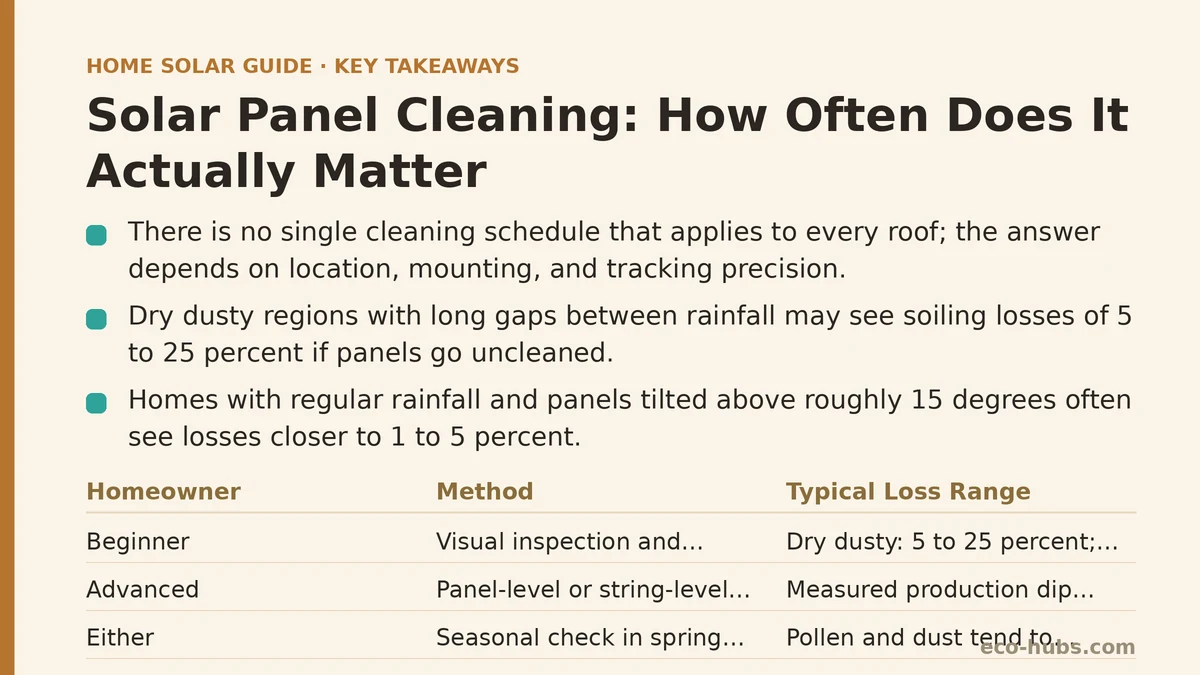
Say you are trying to decide whether the layer of dust settling on your roof panels since installation is something to worry about, or just cosmetic buildup that the next rainstorm will take care of on its own. It is a fair question, and the honest answer depends on where you live, how your system is mounted, and how much precision you want when tracking your own production numbers. There is no single cleaning schedule that applies to every roof, and most of the generic advice floating around online skips over that fact entirely.
Two Very Different Starting Points
Someone who just had a system installed and has never looked closely at a monitoring dashboard is going to approach this question very differently than someone who checks per-panel output weekly and already has a feel for what normal seasonal variation looks like. Neither approach is wrong, but the tools available to each group lead to different conclusions about when cleaning is worth the effort. It helps to separate the two.
Beginner Homeowner: Judging Dirt by Eye
Without production data to lean on, a beginner is mostly working from visual inspection — does the panel surface look dusty, streaked, or covered in something more stubborn like sap or bird droppings? Visual judgment is a reasonable starting point, but it is also unreliable in one specific way: a thin, even layer of dust across an entire panel array can shave off a noticeable percentage of output while barely registering as dirty to the naked eye. Heavy, visible grime is easy to spot; the low-grade haze that builds up over months is not.
Advanced Homeowner: Reading the Production Data
A homeowner with panel-level or string-level monitoring has a real advantage here, because soiling shows up as a measurable production dip rather than a guess. Comparing current output against the same time last year, or against a nearby panel with a different exposure angle, can reveal a consistent underperformance pattern that points fairly directly to dirt rather than shading, temperature, or inverter issues. This group can rule cleaning in or out with actual numbers instead of a visual impression, which is a meaningfully different position to make a decision from.
Beginner Homeowner: Following Climate-Based Rules of Thumb
Without data to guide the decision, the safest approach for a beginner is to lean on regional averages. Homes in dry, dusty regions with long stretches between rainfall — parts of the Southwest, for example — tend to see soiling losses in the range of 5 to 25 percent if panels go uncleaned for an extended period. Homes in areas with regular rainfall, especially where panels are tilted above roughly 15 degrees, often see losses closer to 1 to 5 percent, since rain does most of the cleaning naturally. A beginner without monitoring data is generally well served by defaulting to a seasonal check — spring and late summer, when pollen and dust tend to accumulate most heavily — rather than trying to fine-tune beyond that.
Advanced Homeowner: Calibrating Frequency to Actual Conditions
Someone tracking production can go further than a generic seasonal rule and calibrate cleaning frequency to their own roof’s specific behavior. If the data shows a steady 3 percent seasonal dip that recovers after the first heavy rain, that is a strong signal that natural rainfall is already handling most of the soiling problem and manual cleaning would add little. If the dip is larger, or if it persists through a rain event without recovering — often a sign of bird droppings or sap rather than ordinary dust — that is a much clearer case for scheduling an actual cleaning rather than waiting on the calendar.
Beginner Homeowner: DIY Cleaning Risks
For a beginner, the appeal of DIY cleaning is obvious: it costs nothing but time. The risk is less obvious. Pressure washers can crack panel glass or damage the sealant around the frame, hard water can leave mineral streaks that reduce output more than the dirt did, and — separately from any panel damage — climbing onto a roof without proper fall protection carries real physical risk that is easy to underestimate. Several installer workmanship warranties, discussed in our warranty guide, also specify approved cleaning methods, and using anything outside those guidelines can affect coverage if a problem shows up later.
Advanced Homeowner: Weighing DIY Against Professional Cleaning
An advanced homeowner comfortable with roof safety and basic panel care can often manage light cleaning — a soft brush, deionized water, and a squeegee — without much risk. Where this group still benefits from a professional is with larger arrays, steep or difficult roof pitches, or panels showing the kind of stubborn residue that a soft cloth won’t remove. Professional cleaning services typically run $150 to $350 depending on system size and region, and for someone already tracking production data, that cost can be weighed directly against the measured output recovery a cleaning is expected to produce.
Beginner Homeowner: Is Cleaning Worth the Cost at All?
Without hard production numbers, a beginner is left estimating rather than calculating. A rough way to think about it: if your system produces 8,000 kWh annually and soiling is costing you even a conservative 5 percent, that’s 400 kWh a year, worth somewhere between $50 and $100 depending on local electricity rates. Against a $200 professional cleaning, that math only pencils out clearly in dustier regions or after an unusually long dry spell — which is exactly why the seasonal-check approach tends to serve beginners better than committing to a fixed cleaning contract upfront.
Advanced Homeowner: Running the Numbers Precisely
For someone with real production data, this same calculation gets far more specific. A measured 12 percent output drop on a 10,000 kWh system is roughly 1,200 kWh, which at $0.15 per kWh comes to about $180 in lost value — close enough to a typical cleaning cost that the decision often comes down to how long the soiling is expected to persist before the next rain. This is the level of precision a beginner simply cannot reach without monitoring in place, and it is where advanced homeowners tend to make noticeably more cost-effective cleaning decisions over time.
Where Both Groups Land on the Same Page
Despite the different starting points, beginners and advanced homeowners tend to converge on a similar practical conclusion: in most climates with regular rainfall and a reasonable panel tilt, manual cleaning matters far less than people assume, and natural rain does the bulk of the work. The exceptions — persistent bird activity, low-tilt installations, extended dry seasons, or visible residue that survives a rainstorm — are the situations where cleaning earns its cost regardless of how precisely you’re able to measure the benefit.
Quick Comparison
| Factor | Beginner (no monitoring) | Advanced (with production data) |
|---|---|---|
| Detecting soiling | Visual inspection only | Measured output comparison |
| Cleaning schedule | Seasonal rule of thumb | Calibrated to actual dips |
| DIY risk | Higher, less familiar with roof safety and warranty terms | Lower, if experienced with careful methods |
| Cost-benefit clarity | Estimated, imprecise | Calculated from real kWh losses |
| Likely outcome | Defaults to caution, may over- or under-clean | Cleans only when data justifies it |
The Bottom Line
If your roof gets regular rain and your panels sit at a reasonable tilt, you can probably stop worrying about cleaning as a routine task and treat it as something to address only when a specific sign — persistent bird droppings, an unusually long dry stretch, or a visible production drop — points to it directly. If you’re in a dry, dusty climate or have a low-tilt or ground-mounted system, a seasonal check is worth the ten minutes it takes.
Do you have production monitoring on your system, or are you working from visual inspection alone right now? Let us know your climate and roof setup, and we can help you figure out a cleaning schedule that fits your specific situation rather than a generic recommendation. Related guides: Solar Panel Monitoring Systems: What the Apps Actually Tell You, Common Solar Panel Problems: A Myth vs. Reality Troubleshooting Guide, and Solar Panel Critter Guards: Preventing Pest and Animal Damage.
🔗 Recommended Reading
- Solar Incentive Paperwork: Common Filing Mistakes That Delay Your Rebate
- Home Battery Sizing Mistakes That Lead to Blackout Regret
- Common Solar Installer Mistakes Homeowners Should Catch Before Signing
- Common Home Battery Storage Wiring and Placement Mistakes to Avoid
- Solar Payback Period vs Cash-on-Cash Return: Which Metric Should Homeowners Use