After reading this post, you will know how to tell if squirrels, birds, or rodents are damaging your solar array, which types of critter guards are available and how they differ, what installation looks like, what a reasonable budget is, and when a guard is worth adding to an existing system versus only recommended for new installations. You will also know which questions to ask an installer so you get a solution that matches your specific roof and wildlife situation.
Why Do Animals Target Solar Panels in the First Place?
Solar panels create an environment that is attractive to small animals. The gap between the panels and the roof deck provides shelter from predators and weather. The wiring underneath offers something to chew on — rodents have a biological need to gnaw, and the insulation on solar cables is not resistant by default. In colder months, the warmth radiating from panels makes them an even more appealing nesting spot.
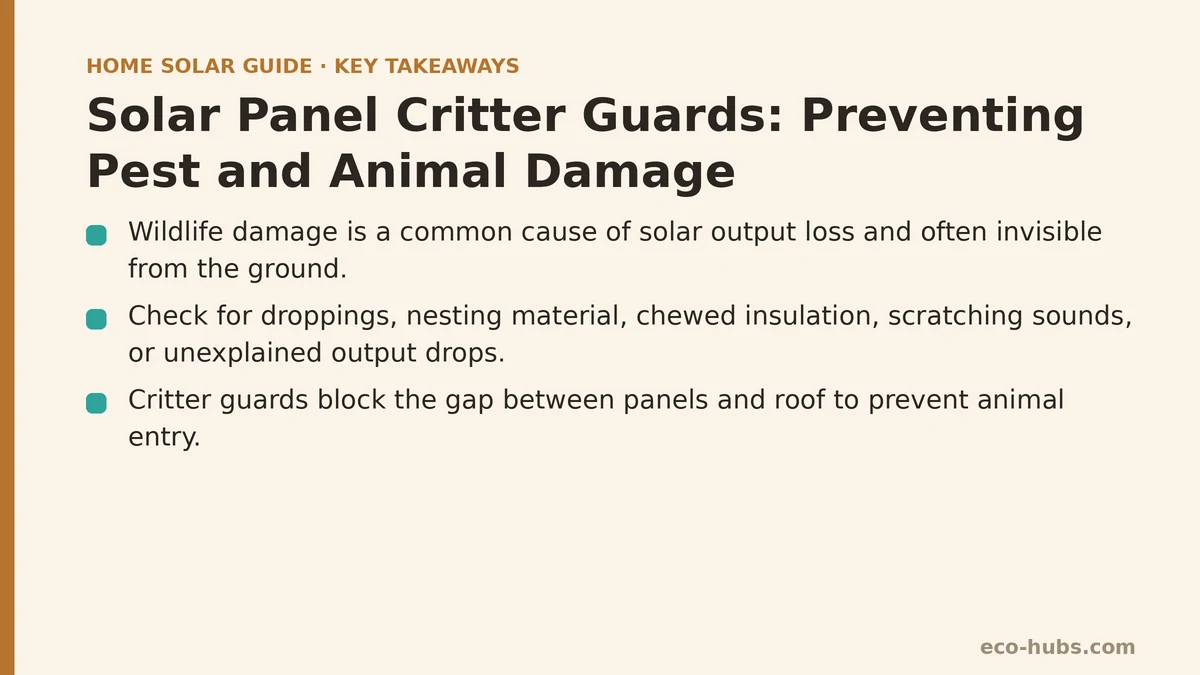
This is not a rare edge case. In many regions, wildlife damage is one of the more common causes of unexpected solar system performance loss. The problem is often invisible from the ground. Panels continue producing electricity while damage accumulates underneath, and by the time a drop in output becomes noticeable, the chewing has sometimes reached the wiring itself.
Q: How Do I Know if Animals Are Under My Panels?
Several signs point to animal activity even when you cannot see the underside of the array. Droppings on the ground near the roof edge, or visible on top of the panels themselves, are an obvious indicator. Nesting material — leaves, twigs, grass — pushed into the gap between the panel and the roof is another strong signal. Chewed wire insulation found near the inverter or in the attic is a direct red flag.
You may also hear scratching or scurrying sounds in the morning or evening, which is when many of these animals are most active. Finally, a sudden drop in system production that is not explained by weather, shading, or inverter error codes can point to damaged wiring affecting an entire string of panels.
If you suspect activity, a simple inspection from a safe vantage point with binoculars is a reasonable first step. For confirmation, an installer with an inspection camera can check the underside without lifting panels — a service that is often inexpensive or bundled with a maintenance visit.
Q: Which Animals Cause the Most Damage?
Squirrels are the most frequently reported culprit. They chew through wire insulation, build nests under panels, and can cause a single point of failure that disables a substantial portion of the array. Birds, particularly pigeons, nest under panels and create large accumulations of droppings that can corrode metal components and block airflow. Rats and mice are smaller but can fit through gaps that squirrels cannot, and their chewing behavior is similar.
Less common but still worth noting: raccoons can tear at wiring and lift panel edges, and in some regions smaller mammals like possums cause similar issues. The key takeaway is that most damage is not caused by one species alone — if one type of animal finds access, others often follow.
Q: What Exactly Is a Critter Guard and How Does It Work?
A critter guard is a physical barrier installed around the perimeter of the solar array. It is designed to block the gap between the bottom edge of the panels and the roof surface, which is the primary entry point for climbing animals. The guard is typically made from either a rigid plastic mesh or a corrosion-resistant metal mesh, cut to fit the specific dimensions of your array and attached with clips or screws.
The guard itself does not harm animals — it simply closes the access route. Because most animals enter from the edge rather than by jumping onto the middle of the panels, a perimeter barrier is effective for the vast majority of situations. For larger species or unusual roof geometries, additional measures like roof-edge flashing or vent covers may be recommended alongside the guard.
Q: Are There Different Types of Critter Guards?
Two main material categories dominate the market. The first is rigid PVC or plastic mesh — lightweight, easy to cut, and inexpensive. This option holds up well in mild climates but can become brittle in prolonged extreme cold or intense UV exposure. The second is metal mesh, usually galvanized steel or aluminum, which is more durable and offers better resistance to chewing, but it is heavier and requires more careful handling to avoid sharp edges.
The plastic versus metal tradeoff is worth weighing carefully. In testing, rodents have occasionally chewed through thinner plastic guards, though the rigid profile used by most reputable manufacturers is designed to be less appealing to chew than cable insulation. Metal options eliminate that risk entirely but come at a higher price point and can be harder to work with on steep roofs.
Beyond material, guards also vary in mounting style. Some clip onto the panel frame with no roof penetration; others screw into the racking system. The no-penetration clips are generally preferred because they avoid creating new holes in the roof surface, but on certain racking types a screw-mounted guard provides a more secure fit.
Q: How Much Do Critter Guards Cost?
Cost depends on array size, roof complexity, and whether the guard is installed at the same time as the panels or added later. As a general range, expect to pay between $15 and $30 per panel for materials plus installation labor. On a typical 6 kW system with roughly 15 panels, that translates to a total installed cost of roughly $300 to $700.
That price varies meaningfully by region and installer. In areas with high wildlife pressure, some installers price critter guards more competitively because they are a standard add-on. On difficult roofs — steep pitches, multiple levels, or complex racking configurations — labor can push the total higher.
Compared to the cost of repairing a single chewed wire, which often involves removing panels, replacing cable, and potentially replacing connectors, the guard is a low-cost insurance policy. A single repair visit can easily cost more than the entire guard installation.
Q: Should I Add a Critter Guard to My Existing System?
For most homeowners with trees nearby, known wildlife activity in the neighborhood, or a roof that is accessible to animals, the answer is yes. The guard is a passive component — once installed, it requires no maintenance and lasts the life of the system in most cases. If you are already having a repair crew on the roof for another reason, adding a guard at the same time reduces the additional labor cost.
One situation where a guard is less necessary: a roof with no nearby trees, no aerial access, and no history of animal problems in the immediate area. However, even in these cases, animals can arrive via power lines or neighboring structures. The gap under panels is an attractive shelter regardless of how animals reach the roof.
For new installations, the decision is easier. Adding a critter guard at the time of installation adds a small amount to the upfront cost but eliminates the labor penalty of a separate trip later. Many installers offer it as a standard add-on during the quote process.
Q: What Does the Installation Process Look Like?
For a retrofit on an existing system, installation typically takes a few hours. The installer works along the perimeter of the array, measuring each gap between panels and the roof, cutting the mesh to fit, and securing it with the appropriate clips or screws. No panels need to be removed unless existing wiring damage is discovered during the process.
For new installations, the guard is often installed after the panels are mounted but before the system is energized — a seamless timing that adds minimal labor. In both cases, the work does not affect the electrical production of the system while it is being done, since the guard is purely a mechanical addition.
One practical note: the guard will slightly reduce airflow under the panels. This is not a concern in most climates, but in very hot regions, confirm with the specific guard manufacturer that their product is designed to maintain adequate ventilation for your panel type.
Q: What Questions Should I Ask Before Hiring Someone to Install a Critter Guard?
First, ask what material is being proposed and why. A vague answer about “mesh” without specifying plastic versus metal, thickness, and UV resistance should raise a flag. Second, ask whether the guard attaches without roof penetration — if screws are involved, understand where exactly they go.
Third, ask about coverage. Does the guard fully enclose all edges of the array, or only the bottom edge? In practice, the bottom edge is the critical one, but a complete perimeter solution is more robust. Fourth, ask what happens if the guard is damaged — is there a warranty on the guard itself, and does the installer stand behind the workmanship?
Finally, ask whether the installer checks for existing damage before installing the guard. A guard installed over already-chewed wiring does not fix the underlying issue, and you do not want to pay for a barrier while a hidden wiring fault continues to degrade.
Q: Are There Any Alternatives to Critter Guards Worth Considering?
A few complementary measures exist, though none replace the guard as the primary defense. Ultrasonic deterrent devices claim to repel animals with high-frequency sound, but results are inconsistent and animals often habituate to them over time. Motion-activated sprinklers can work for ground-level access but do nothing for animals reaching the roof directly.
Trapping and relocation is a short-term solution at best, and in many regions it is regulated or prohibited. The honest answer from a solar maintenance perspective: the physical barrier is the only approach proven to provide comprehensive, long-term protection. Everything else addresses symptoms rather than access.
Decision Summary
| Factor | Recommendation |
|---|---|
| Existing animal signs (droppings, nesting, chewed wires) | Install a guard without delay, and inspect wiring first |
| Trees or power lines near the roof | Strongly consider a guard, even with no visible signs yet |
| New solar installation in any area with wildlife pressure | Add a guard at installation time to avoid higher retrofit labor |
| Metal versus plastic guard | Choose metal if chewing pressure is documented or climate is extreme |
| Repair visit scheduled for other reasons | Bundle the guard installation with that visit to save on labor |
| No trees, no animal history, very urban roof | Guard optional — but the cost is low relative to potential repair |
You now have a clear picture of what critter guards do, what they cost, and when they make sense. The deciding factor for most homeowners is whether wildlife has any reasonable path to your roof — if the answer is yes, the guard is a small price for protecting the largest single investment in your system.
Related guides: Solar Panel Repair After Storm or Hail Damage: What to Know, Common Solar Panel Problems: A Myth vs. Reality Troubleshooting Guide, and Solar Panel Cleaning: How Often Does It Actually Matter.
🔗 Recommended Reading
- Solar Incentive Paperwork: Common Filing Mistakes That Delay Your Rebate
- Home Battery Sizing Mistakes That Lead to Blackout Regret
- Common Solar Installer Mistakes Homeowners Should Catch Before Signing
- Common Home Battery Storage Wiring and Placement Mistakes to Avoid
- Solar Payback Period vs Cash-on-Cash Return: Which Metric Should Homeowners Use