Solar panel performance in cold climates is defined by two opposing forces: colder temperatures improve panel electrical efficiency, while snow cover temporarily blocks incoming sunlight. The net effect on annual production varies significantly by location, system tilt, and local snowfall patterns. Understanding these two forces separately — rather than lumping them into a vague “winter performance” concept — clarifies what to expect from a residential system in a snowy region.
The Temperature Coefficient Explained
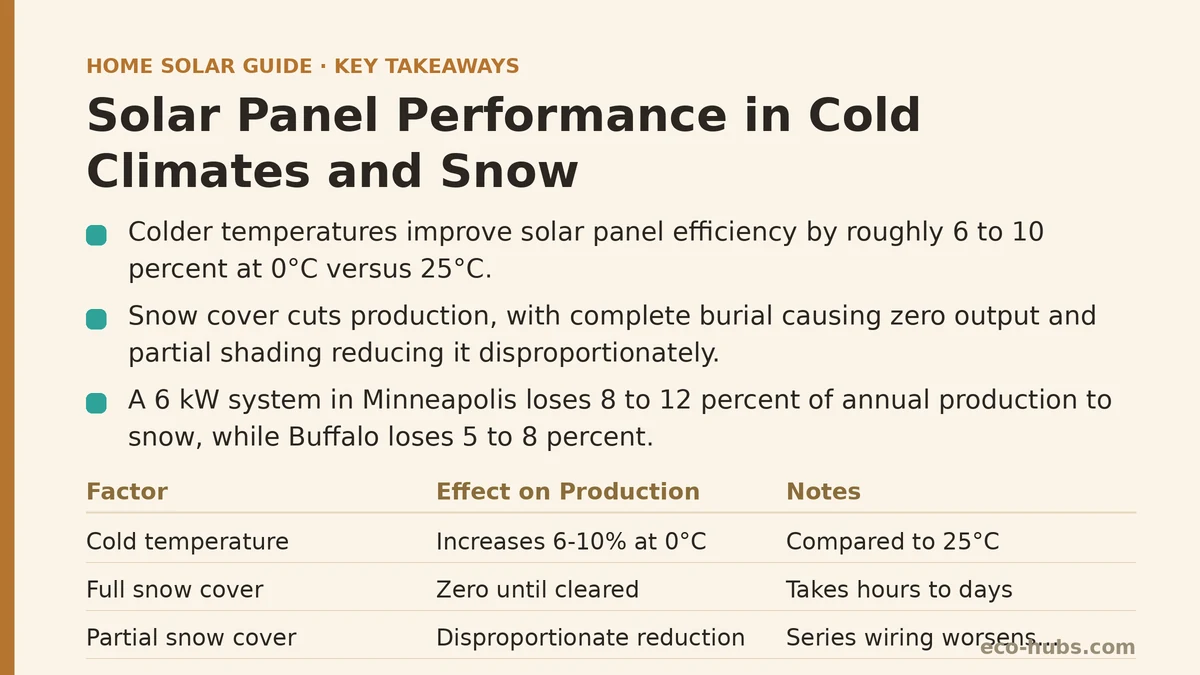
Every solar panel datasheet lists a temperature coefficient, typically between -0.25% and -0.40% per degree Celsius. This number describes how much power output drops when panel temperature rises above the standard test condition of 25°C (77°F). On a hot summer rooftop where panels routinely reach 60–70°C, that coefficient translates to production losses of 10–18%. In winter, the math reverses. A panel operating at 0°C produces roughly 6–10% more electricity than the same panel at 25°C, assuming identical sunlight.
This winter advantage is modest but consistent. It does not offset a full day of snow cover, but it does improve output during clear winter days. For a homeowner comparing performance across seasons, this means a cold, sunny day can deliver generation close to what the same system produces on a mild spring day with comparable irradiance.
How Snow Affects Production
Snow affects solar panels through two mechanisms: full blockage and partial shading. A heavy snowfall that completely buries panels can cut production to zero until the snow slides off, which typically takes several hours to several days depending on temperature, tilt angle, and panel surface type. More common in many regions is partial coverage — snow remaining on lower panel edges while upper sections clear — which creates shading patterns that disproportionately reduce output because panels wired in series behave like a string of holiday lights, with one shaded cell dragging down the entire string.
Framed panels with raised edges tend to hold snow longer than frameless or “all-black” panels that allow snow to slide more easily. Lower tilt angles accumulate more snow and shed it more slowly. A 30° tilt on a roof sheds snow faster than a 15° tilt on a ground mount, though both are common configurations in cold climates.
The Beginner Dimension: What to Understand Before Installing
A homeowner without prior solar experience in a snowy region faces three main questions: will the system produce enough in winter, will snow damage the panels, and is there anything to do about clearing snow manually.
Production in winter is addressable with real data. The National Renewable Energy Laboratory’s PVWatts tool allows anyone to simulate a system in their specific location using historical weather data, including snow cover losses. In Minneapolis, a south-facing 6 kW system with a 40° tilt loses roughly 8–12% of annual production to snow. In Buffalo, that figure runs closer to 5–8%. These losses are built into the production estimates that reputable installers provide, so winter shortfall should not be a surprise if the estimate was calculated honestly.
Snow damage is rare but not impossible. Static snow load ratings on modern racking systems typically handle 40–70 pounds per square foot, far exceeding most residential roof snow loads in North America. The greater risk is ice dam formation where snow melts, refreezes, and then slides as heavy chunks, occasionally damaging gutters or lower roof sections. Panel glass is tempered to withstand hail impact, but sliding snow can accumulate at roof edges and create conditions worth monitoring.
Manual snow removal is rarely recommended. Brisk wind frequently clears panels before homeowners can intervene. Where removal is necessary — after heavy wet snow rather than dry powder — using a roof rake with a soft rubber edge, never metal, and never spraying cold water over a warm panel (thermal shock can crack glass). Many owners in heavy-snow regions choose to leave panels alone and accept the temporary production loss, since clearing a roof in icy conditions carries more risk than the electricity gained.
The Advanced Dimension: Design Decisions That Reduce Snow Loss
For a homeowner with construction or electrical experience — or someone designing a ground mount rather than a roof system — there are deliberate engineering choices that measurably reduce winter losses.
Tilt angle is the single most influential design variable. Panels at steeper tilts shed snow faster because the angle approaches the natural repose angle of snow, reported in testing at roughly 45–55° depending on snow type and temperature. A ground mount tilted at 50–55° in a snowy region sacrifices some summer production compared to the optimal year-round tilt, but the winter recovery often compensates. Modeling in PVWatts for northern tier states shows that steep tilts recover 60–90% of the snow-induced losses they create through reduced winter sun angle collection.
Panel spacing matters for ground mounts. A single-row ground mount with adequate clearance beneath the panel bottom edge allows snow to slide off and fall freely to the ground. Multiple rows with tight spacing, however, allow snow to pile up behind the front row and bridge across rows, preventing full shedding. Designing for at least a foot of clearance behind the lower edge of each row reduces this bridging effect.
Microinverters or DC optimizers change the snow-loss calculation. A system with a string inverter can lose 30–50% of its output from a shaded section covering only 5% of the array, as described earlier. Microinverters confine that loss to the single affected panel. In regions with frequent partial snow events — where snow covers lower rows of a roof array while upper rows remain clear — this can recover 10–20% of winter production compared to the same array with a string inverter.
Bifacial modules add another dimension. Snow on the ground beneath a raised bifacial array reflects significant additional light onto the panel rear surface, producing measurable gains in winter and early spring when ground snow cover acts like a reflector. Testing in northern climates has shown 5–15% bifacial gain during snow-covered periods, though this depends on mounting height and ground reflectivity. This gain is strongest in the first few weeks after snowfalls, tapering as the ground cover melts.
What the Data Consistently Shows Across Cold Climate Studies
Several research groups have published head-to-head data on snow losses across different mounting strategies. The consistent findings are worth summarizing.
| Design Approach | Typical Annual Snow Loss | Notes |
|---|---|---|
| Roof-mounted, 20–30° tilt, string inverter | 10–15% | Most common residential configuration |
| Roof-mounted, 35–45° tilt, string inverter | 7–12% | Steeper roof pitch helps shedding |
| Ground-mounted, 45–55° tilt, microinverters/optimizers | 3–7% | Steep angle plus per-panel electronics |
| Ground-mounted, 45–55° tilt, bifacial + microinverters | 1–5% | Snow reflection adds to rear-side gain |
These figures represent annualized losses across a full year, not winter-only production. A system in a snowy region that loses 8% annually to snow typically loses 20–30% of its December–February production specifically, but that winter shortfall is spread across longer, sunnier days in spring and fall where the cold-temperature coefficient partially compensates.
A Note on Production Monitoring in Winter
Homeowners in snowy regions should expect daily production graphs that look nothing like summer patterns. A sunny winter day may show a sharper, earlier production curve because cold panels produce more efficiently at low sun angles. A snow day shows a flat line. When examining monthly production reports, comparing only to prior months rather than year-over-year for the same month will mislead. The better baseline is the same month in previous years, or the production estimate the installer provided specifically for winter months.
If you are designing a system for a snowy region, which of the variables above — tilt angle, module type, or inverter architecture — are you prioritizing in your current plan, and what is driving that priority for your specific site?
Related guides: Solar Panel Performance in Extreme Heat: What Homeowners Should Know, Common Solar Panel Problems: A Myth vs. Reality Troubleshooting Guide, and EV Charger and Solar Panel Integration: How It Actually Works.
🔗 Recommended Reading
- Solar Incentive Paperwork: Common Filing Mistakes That Delay Your Rebate
- Home Battery Sizing Mistakes That Lead to Blackout Regret
- Common Solar Installer Mistakes Homeowners Should Catch Before Signing
- Common Home Battery Storage Wiring and Placement Mistakes to Avoid
- Solar Payback Period vs Cash-on-Cash Return: Which Metric Should Homeowners Use