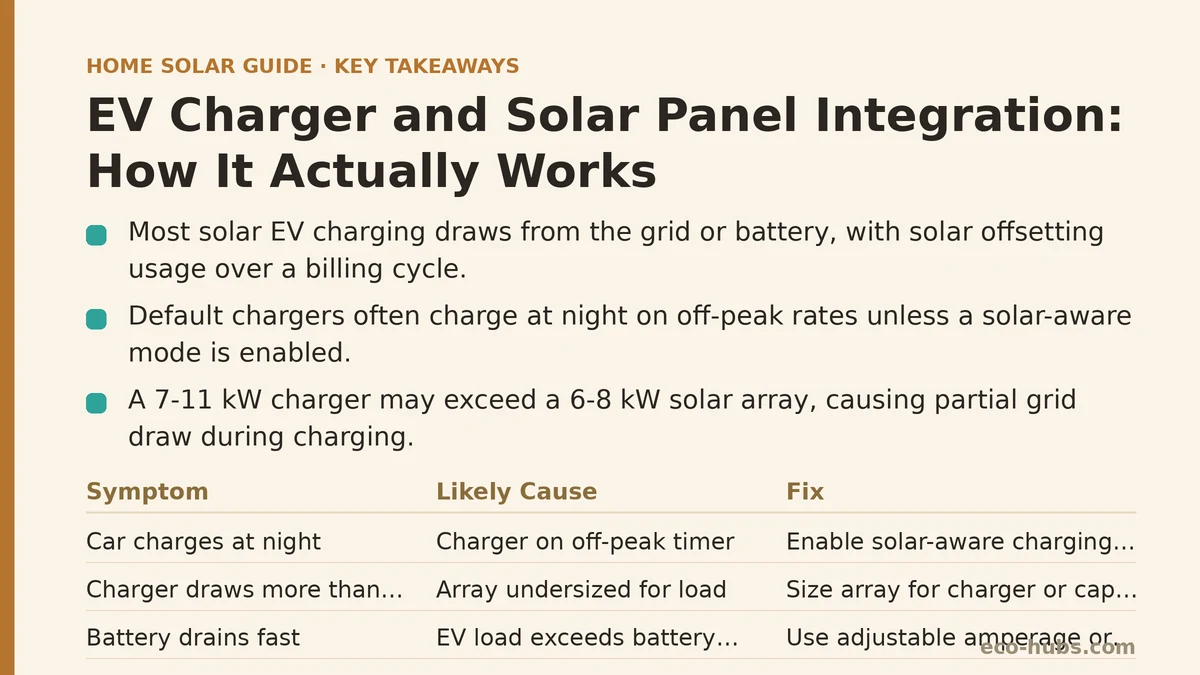
Most solar-powered EV charging does not run the car directly off the panels in real time. In the overwhelming majority of home setups, the car draws from the grid or from a battery, while solar production simply offsets that draw over the course of a billing cycle. The panels and the charger rarely talk to each other at all unless a homeowner has specifically installed equipment designed to make that happen.
That gap between how people assume the system works and how it is typically wired is where most complaints and support calls originate. Below is a troubleshooting-style rundown of the most common integration problems, organized by what a homeowner actually notices, what usually causes it, and what fixes it.
Symptom: The Car Charges at Night, Not During Sunny Afternoons
What homeowners notice: The charging session starts at 11 p.m. on a scheduled utility rate plan, even though the system produced excess solar all afternoon.
Likely cause: Most Level 2 chargers are configured on a timer tied to off-peak utility rates, not to real-time solar output. Unless a homeowner has specifically selected a “solar-aware” or “excess-power” charging mode — a feature only some chargers and inverters support — the default behavior is to charge whenever electricity is cheapest, which is frequently overnight.
Fix: Check whether the charger and inverter combination supports solar-matching or excess-export charging. Brands like Tesla, Wallbox, and a handful of others offer this as a software setting rather than a hardware feature, meaning it can sometimes be enabled after installation without new equipment. If the current charger lacks this capability, switching to a model with grid-tie communication support is usually more cost-effective than replacing the entire charging setup.
Symptom: The Charger Draws More Power Than the Solar Array Is Producing
What homeowners notice: Monitoring software shows the home pulling from the grid even while the sun is out and the panels are actively producing.
Likely cause: A typical Level 2 charger draws 30 to 48 amps, which translates to roughly 7 to 11 kilowatts. Many residential solar arrays, especially smaller systems sized around 6 to 8 kilowatts, simply cannot produce that much power on their own, particularly in the morning or late afternoon when the sun angle is lower. The charger isn’t malfunctioning — the array is undersized relative to the charging load.
Fix: This comes down to system sizing math done before installation, not something correctable after the fact without adding panels or accepting partial grid draw. Homeowners planning to add an EV charger should size their solar array with the charger’s full load in mind, not just household baseline consumption. If expanding the array isn’t practical, a charger with adjustable amperage settings lets you cap the draw closer to what the panels can realistically supply.
Symptom: The Home Battery Drains Fast Once EV Charging Starts
What homeowners notice: A battery that comfortably covers evening household use suddenly empties within an hour once car charging begins.
Likely cause: Home batteries are generally sized for household loads like lighting, refrigeration, and HVAC cycling — typically a few kilowatts at a time. An EV charger pulling 7 to 11 kilowatts can exceed what the battery is rated to discharge continuously, or it can simply drain the stored capacity far faster than anticipated since car charging represents a much larger, more sustained load than most other household appliances.
Fix: Some battery systems allow you to exclude EV charging circuits from battery backup entirely, routing that load straight to the grid or solar while reserving battery capacity for essential household circuits. Check the battery’s continuous discharge rating against the charger’s draw before assuming the two will coexist smoothly, and consider a dedicated charging schedule that avoids peak battery-reliance hours.
Symptom: Net Metering Credits Don’t Seem to Offset the Charging Cost as Expected
What homeowners notice: The monthly utility bill shows a smaller credit than expected, even though the solar production and EV charging both seem consistent with projections.
Likely cause: Net metering credits, as covered in our dedicated net metering guide, are typically based on excess production exported to the grid, not on total production. If the EV charges during the day and consumes solar output directly, that power never gets exported and therefore generates no credit — it simply avoids a grid purchase instead. Homeowners sometimes expect both benefits simultaneously, which isn’t how the credit mechanism works.
Fix: Understand which of the two outcomes matters more for your rate structure. Under some net metering arrangements, avoiding a grid purchase during peak pricing hours is worth more than the export credit would have been anyway. Reviewing your specific utility’s rate structure — and whether it uses net metering, net billing, or time-of-use pricing — clarifies whether daytime EV charging or nighttime off-peak charging is the better math for your household specifically.
Symptom: The Charger and Inverter Show Conflicting Information in Their Respective Apps
What homeowners notice: The solar monitoring app reports one production number while the charger’s app reports a different consumption figure, and the two numbers never quite reconcile.
Likely cause: Unless the charger and inverter are from the same manufacturer ecosystem or use a shared home energy management platform, they are usually reporting independently metered data with different sampling intervals, different rounding, and sometimes different definitions of what counts as a charging session. This is a reporting discrepancy, not evidence that power is being lost or miscounted.
Fix: For households that want a single, reconciled view of production versus consumption, a dedicated home energy management system that sits between the inverter, charger, and utility meter is usually the more reliable solution. Several major inverter brands now offer this as an add-on module. Absent that, treating each app’s numbers as an estimate rather than a precise ledger avoids a lot of unnecessary troubleshooting over discrepancies that are largely cosmetic.
Symptom: The Tax Credit for the Charger Was Smaller Than Expected
What homeowners notice: The federal credit applied to the EV charger installation came in lower than the credit received for the solar system itself.
Likely cause: The federal tax credit that applies to solar installation, detailed in our dedicated tax credit guide, is a separate credit from the one covering EV charging equipment, and the two have different caps and different qualifying rules. Charger-specific credits are often capped at a flat dollar amount or a lower percentage of installed cost, rather than following the same calculation used for solar equipment.
Fix: Confirm with a tax professional which credit applies to which invoice line item before assuming the same percentage applies across the board. Installers sometimes bundle solar and charger costs on a single invoice, which can make it harder to correctly separate the two credits during filing — requesting an itemized invoice upfront avoids this confusion later.
Quick Reference: Symptom, Cause, and Fix
| Symptom | Likely Cause | Fix |
|---|---|---|
| Charges at night, not midday | Timer-based scheduling, no solar-aware mode | Enable excess-power charging if supported, or upgrade charger |
| Pulls grid power despite sun | Charger load exceeds array output | Size array for charger load, or cap charger amperage |
| Battery drains fast when charging | Charger load exceeds battery discharge rating | Exclude EV circuit from battery backup |
| Net metering credit smaller than expected | Direct solar consumption isn’t exported | Understand your utility’s specific rate structure |
| Apps show conflicting numbers | Independent metering, no shared platform | Use a home energy management system |
| Tax credit lower than expected | Separate, capped charger-specific credit | Request itemized invoice, confirm with a tax professional |
The Underlying Pattern
Nearly every issue above traces back to the same root cause: solar panels, home batteries, and EV chargers are frequently sold and installed as three separate systems that happen to share a home, rather than as one coordinated system designed together from the start. Where integration works smoothly, it’s usually because someone specifically planned for the EV charging load during the solar sizing conversation, not because the equipment inherently knows how to cooperate on its own.
If you’re planning to add an EV charger to an existing solar system, or size both together from scratch, tell us your current setup — panel wattage, battery capacity if any, and expected charger amperage — and we can help flag which of these integration issues is most likely to affect your specific configuration. Related guides: How to Calculate How Many Solar Panels You Need for Your Home, Home Battery Storage: Common Mistakes and How to Troubleshoot Them, and How to Actually Calculate Your Solar Panel Payback Period.
🔗 Recommended Reading
- Solar Incentive Paperwork: Common Filing Mistakes That Delay Your Rebate
- Home Battery Sizing Mistakes That Lead to Blackout Regret
- Common Solar Installer Mistakes Homeowners Should Catch Before Signing
- Common Home Battery Storage Wiring and Placement Mistakes to Avoid
- Solar Payback Period vs Cash-on-Cash Return: Which Metric Should Homeowners Use