Say you are trying to decide between two bids for a 6 kW solar array. One installer wants to put all the panels on your south-facing roof plane. The other suggests splitting them between east and west, or even committing fully to the east side. Both quotes come in at nearly the same price per watt. The south-facing option promises more total annual production, yet the east-facing layout might match your household’s electricity usage pattern better. Which do you choose?
The short answer is that south-facing panels in the northern hemisphere produce the highest raw kilowatt-hours per installed watt over a full year. But that headline number does not account for time-of-use rates, battery charging behavior, or your roof’s actual geometry. In practice, the better orientation is the one that aligns production with the times you consume the most power, and that calculation often looks different than you might expect.
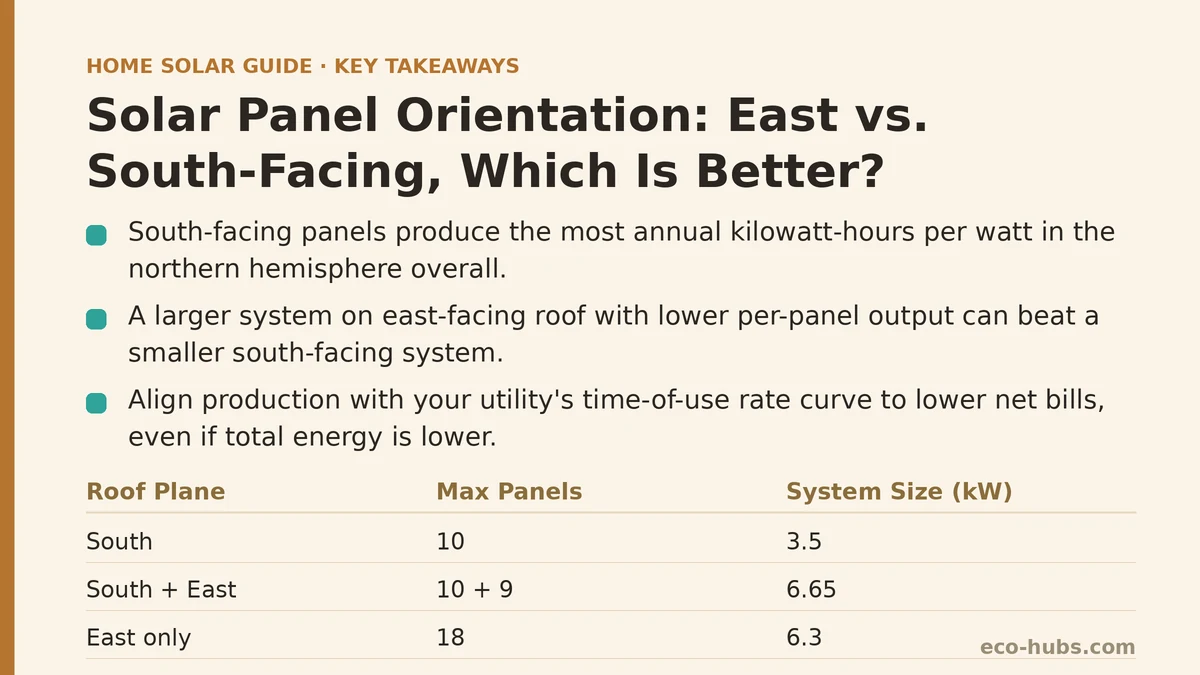
Symptom: Your Best Roof Plane Faces East, Not South
Cause: Many homes are built with the ridge line running north–south, which means the two main roof planes face east and west. Only the gable ends face south, and those often have limited usable area because of dormers, vents, or chimney obstructions. A south-facing-only design might force you to shrink the system size, use lower-efficiency panels, or accept a layout with poor aesthetics just to maximize per-panel output.
Fix: Measure the usable square footage on each roof plane before insisting on a south-only layout. An east-facing plane with enough room for 20 panels at full tilt will frequently beat a south-facing plane that can only fit 12 panels. Total system size matters more than per-panel efficiency. A 7 kW system on east-facing roof with 80% of optimal production will generate more total energy than a 5 kW system on south-facing roof at 95% of optimal production, assuming panel quality is comparable.
| Roof Plane | Usable Area (sq ft) | Max Panels (typical, 350W) | System Size (kW) | Relative Production per Panel |
|---|---|---|---|---|
| South | 180 | 10 | 3.5 | 100% baseline |
| South + East | 180 + 160 | 10 + 9 | 6.65 | ~85–90% blended |
| East only | 320 | 18 | 6.3 | ~80–85% |
Symptom: Your Utility Charges More for Afternoon and Evening Power
Cause: More utilities are moving toward time-of-use (TOU) rate plans where electricity costs more during peak demand hours, typically late afternoon to early evening. On a standard TOU schedule, solar production from south-facing panels peaks between 11 a.m. and 2 p.m., which can fall partially outside the highest-priced window in some regions. East-facing panels produce heavily in the morning, and that morning energy displaces grid power that would otherwise be purchased at a mid-tier or peak rate, depending on your specific TOU schedule.
Fix: Pull up your utility’s current TOU rate card and map each orientation’s hourly production curve against it. In a simplified example, a south-facing system produces 100 units over the day, with 60 of those units generated during peak-priced hours. An east-facing system produces 85 units total, with 75 of those generated during peak-priced hours. If the peak rate is triple the off-peak rate, the east-facing system can deliver lower net electricity bills despite producing less raw energy. This dynamic does not apply to every utility, so the calculations must be done with your specific rate plan, not generic assumptions.
Symptom: You Can Only Afford a Single Battery, Not a Large One
Cause: Battery storage changes the orientation calculus meaningfully. South-facing panels charge a battery later in the day, which is useful if you want the battery to cover evening load. But if your household’s biggest energy draw is morning — think running the dishwasher, laundry, and multiple showers before 9 a.m. — a south-facing system may leave the battery depleted by mid-morning, requiring grid draw until the south panels ramp up.
Fix: Model the combined production-and-battery profile across a full year. An east-facing array charges the battery earlier in the day, meaning the battery carries you through the afternoon even if cloud cover reduces afternoon production. For households that wake early and consume heavily before noon, an east-facing layout paired with a modest battery often provides better grid independence than a larger south-facing array with the same battery. The key metric is not annual production but the number of hours per day you can stay off-grid. A smaller system oriented to your morning loads may deliver more off-grid hours than a larger system that produces its energy in the middle of the day when you barely need it.
Symptom: The South Roof Plane Has Significant Shading, the East Plane Does Not
Cause: Shading is the single largest production killer for solar panels. A single shaded cell on a panel can reduce that panel’s output by 20–50%, depending on the panel’s design and whether it has half-cut cells or bypass diodes. South-facing roof planes often suffer from shading from a neighbor’s mature tree, a chimney, or a nearby two-story structure. East-facing planes, by contrast, often receive full morning sun with no obstacles.
Fix: Run a shade analysis with a tool like PVWatts, a Solar Pathfinder, or an on-site measurement by an installer using a Solmetric SunEye. A south-facing plane with 20% afternoon shading can easily perform worse than a clean east-facing plane. In such cases, the east-facing option wins on both total production and production consistency. Do not let the compass direction alone make the decision; the actual irradiance reaching the panels over the year is what governs output.
Symptom: You Plan to Use Net Metering at a 1:1 Ratio
Cause: Under traditional net metering, every kilowatt-hour you send to the grid earns a credit that offsets one kilowatt-hour you pull from the grid, regardless of when each occurred. This arrangement removes the time-of-day consideration almost entirely. Since credits are fungible, the orientation that produces the most total energy is the one that maximizes your bill credit, and that is nearly always south-facing if shading is equal.
Fix: If your utility offers true net metering with no peak/off-peak differentiation, then the south-facing layout is the clear winner. Maximize the total rated system size on the south plane first, then fill any remaining roof space with east or west panels to capture additional production. Do not sacrifice system size for orientation purity when net metering treats all production equally. But verify this assumption with your utility directly. Some utilities have shifted to reduced rates for exported energy or have introduced a tiered export structure, which changes this conclusion.
Symptom: Aesthetic or HOA Restrictions Favor One Plane
Cause: Homeowners associations, local zoning, or historic district rules sometimes restrict which roof planes can host solar panels, favoring those less visible from the street. If your south-facing plane faces the street and the east plane faces the backyard, the easterly option may be the only one permitted. This is a constraint that no production modeling can overcome.
Fix: Treat orientation as a constraint, not the target. Ask your installer to model the best possible system within the allowable roof planes, then compare the annual production and financial payback of that constrained system against the unconstrained option. A slightly lower-producing system that is allowed beats a higher-producing system that never gets built. Also check whether your jurisdiction grants solar access rights that override HOA restrictions, which varies by state and municipality.
Comparison at a Glance
| Consideration | South-Facing | East-Facing |
|---|---|---|
| Total annual production | Highest per installed watt | 15–25% lower per installed watt |
| Morning energy coverage | Weak until mid-morning | Strong starting early |
| Afternoon/evening coverage | Strong mid-day, tapering | Weak after noon |
| Time-of-use rate compatibility | Better if peak price is midday | Better if peak price is morning |
| Battery charging speed | Later in the day | Earlier in the day |
| Net metering (1:1) | Best choice | Second-best choice |
| Shading sensitivity | Often more exposed to afternoon shade | Often clean morning sun |
| Aesthetic/HOA constraints | Often street-facing | Often backyard-facing |
| Best-fit scenario | No shading, flat rate or 1:1 net metering, evening-heavy load | Morning-heavy load, TOU rates, backyard placement, shading on south plane |
The Practical Decision Framework
Start with shading — evaluate the actual irradiance on each roof plane rather than assuming cardinal direction dictates performance. Uniformly clear roof planes favor south if your utility’s rate structure does not penalize mid-day generation. East becomes the better choice when your load curve tilts toward morning, when your utility charges peak rates in the morning hours, or when the south plane carries shading that the east plane avoids.
Run both scenarios through a production modeling tool with your real roof geometry and your real utility rate schedule. The difference between the two options often amounts to 10–15% of annual output, which on a 6 kW system might represent 900–1,300 kWh per year. That gap is meaningful, but it is small enough that the behavioral factors above — when you use power, at what price, and whether a battery smooths the curve — routinely tip the decision the other way.
Have you already pulled your utility’s time-of-use rate schedule or run a shade analysis on your roof planes? Describe what you are seeing — particularly your roof angles, any shading sources, and whether your household peaks in the morning or evening — and I can help you compare the realistic production and bill impact of each orientation before you commit to a layout.
Related guides: Local vs. National Solar Installers: Which Is Actually the Better Choice, Common Solar Panel Problems: A Myth vs. Reality Troubleshooting Guide, and EV Charger and Solar Panel Integration: How It Actually Works.
🔗 Recommended Reading
- Solar Incentive Paperwork: Common Filing Mistakes That Delay Your Rebate
- Home Battery Sizing Mistakes That Lead to Blackout Regret
- Common Solar Installer Mistakes Homeowners Should Catch Before Signing
- Common Home Battery Storage Wiring and Placement Mistakes to Avoid
- Solar Payback Period vs Cash-on-Cash Return: Which Metric Should Homeowners Use