Many homeowners assume that a national solar company, backed by scale and brand recognition, will offer better pricing, faster installation, and more dependable service than a local outfit ever could. That assumption doesn’t hold up well once you look at what scale actually changes and what it doesn’t. National companies often have more marketing reach and standardized processes, but standardization is not the same thing as quality, and buying power at the corporate level doesn’t always translate into savings passed down to an individual homeowner’s quote. Local installers, meanwhile, carry their own tradeoffs that have little to do with being smaller and more everything is not automatically true either.
The more useful question isn’t “which type of company is better” in the abstract. It’s which type of company is better for a specific homeowner, and that answer shifts depending on how much research and comparison shopping that homeowner is prepared to do. A first-time buyer evaluating solar for the first time and a homeowner who has already gone through one or two quote cycles tend to reach different conclusions from the same set of facts, simply because they’re weighing different priorities.
Setting Up the Comparison
To make this useful rather than generic, it helps to separate two homeowner profiles: the beginner, who is getting their first few quotes and has limited prior exposure to how solar contracts and warranties work, and the more advanced homeowner, who has already done some comparison shopping, understands financing terms reasonably well, and is weighing installer choice as one variable among several rather than the entire decision. The categories below — pricing, equipment access, accountability, and support after installation — matter to both groups, but the weight each group should give them differs.
Beginner Profile: Pricing and Quotes
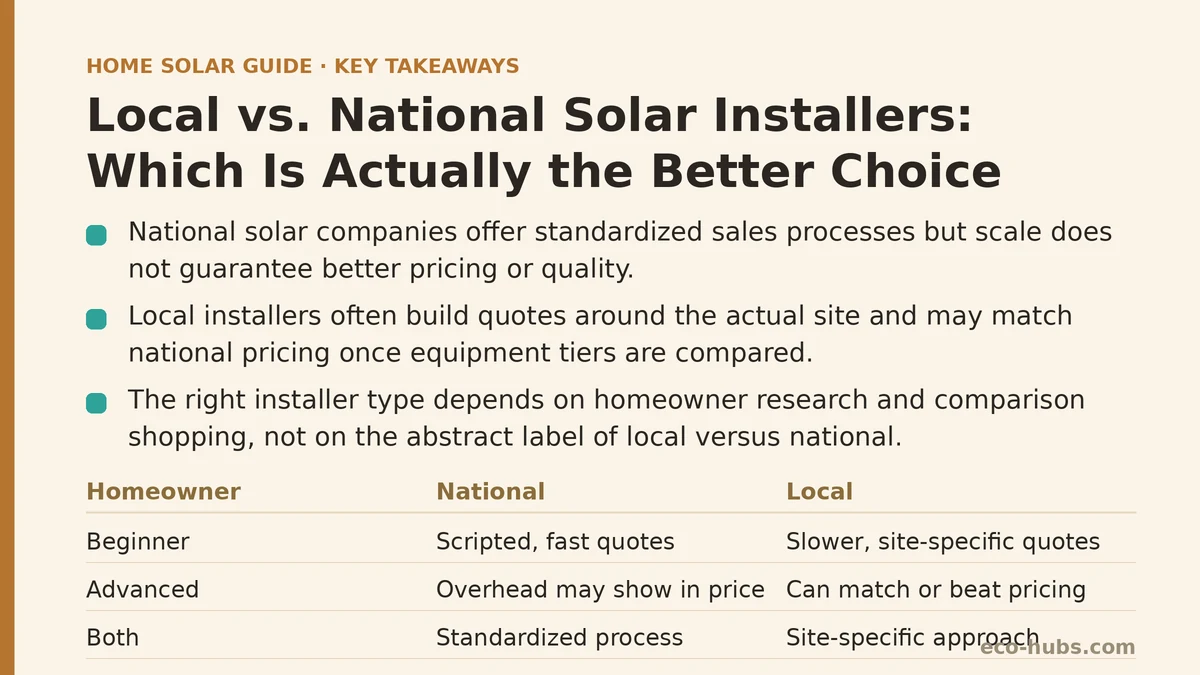
For someone getting their first quote, national installers can feel reassuring simply because the process is more scripted. Sales representatives walk through a standardized presentation, financing options are pre-packaged, and the quote often arrives quickly. That speed can be mistaken for a better deal, when in practice it reflects a sales process built around volume rather than a price built around this specific roof and this specific usage pattern.
Local installers, by contrast, tend to produce quotes that take longer to generate but are often built more directly around the actual site — roof angle, shading, panel layout — rather than a generalized regional average. For a beginner without a frame of reference, the tradeoff is patience versus polish: a local quote may look less refined on paper but reflect the property more accurately.
Advanced Profile: Pricing and Quotes
A homeowner who has already collected multiple quotes is in a stronger position to see past the presentation and compare the numbers directly — price per watt, equipment tier, and financing terms side by side. At this stage, national companies sometimes lose their apparent advantage, since their overhead (national advertising, call centers, layered sales commissions) can show up in the final price even when their equipment costs are comparable to what a local installer sources.
Experienced comparison shoppers frequently find that local installers, without that overhead, can match or beat national pricing once the same equipment tier is being compared. The catch is that this only becomes visible once you’re comparing specific line items rather than headline monthly payment figures, which is exactly the kind of comparison a beginner isn’t yet equipped to make on the first pass.
Beginner Profile: Equipment and System Design Options
A first-time buyer often doesn’t know to ask which specific panel and inverter models are being proposed, and national installers, in our observation, tend to standardize around a narrower set of equipment options to keep installation training and procurement simple across many markets. That’s not inherently a problem, but it does mean less flexibility if a homeowner’s roof or aesthetic preferences call for something outside that standard package.
Advanced Profile: Equipment and System Design Options
A more experienced homeowner, especially one who has read our guide on questions to ask an installer, knows to request specification sheets directly and compare them across quotes. This is where local installers frequently have an edge: many work with a wider range of manufacturers and can tailor a system design — panel placement, inverter type, battery pairing — more specifically to unusual roof geometry or specific efficiency goals than a national company’s standardized packages allow.
Beginner Profile: Accountability and Installation Quality
For someone without a background in construction or electrical work, evaluating installation quality directly is difficult regardless of which type of company they hire. What a beginner can reasonably evaluate is accountability: who do you call if something goes wrong, and how quickly do they respond? National companies sometimes route service requests through a centralized call center that isn’t the same team that performed the installation, which can add delay when a beginner has no other frame of reference for what a normal response time should look like.
Advanced Profile: Accountability and Installation Quality
Homeowners who have already dealt with contractors on other home projects tend to weigh accountability differently — they know to ask directly whether the crew doing the physical installation is a direct employee or a subcontractor, a distinction that matters more with some national installers than with most local companies, where the person answering the phone and the person on the roof are often the same small team. This traceability can matter considerably if a warranty claim ever needs to be resolved quickly.
Beginner Profile: Longevity and Company Stability
A first-time buyer might reasonably assume that a national company, simply by being larger, is less likely to go out of business than a local installer. That assumption isn’t automatically true — the solar installation industry has seen both large national installers and small local ones close their doors, and company size alone isn’t a reliable predictor of stability. What matters more, as covered in our guide on questions to ask before signing, is whether the workmanship warranty is backed by anything beyond the installer’s own continued existence.
Advanced Profile: Longevity and Company Stability
An experienced homeowner tends to dig further here, checking how long a specific local installer has operated in that market, how many completed installations they can point to, and whether references are available from customers whose systems have been in place long enough to reveal real long-term performance. National scale doesn’t substitute for this kind of specific, verifiable track record, and a well-established local installer with ten or fifteen years in one region can, in practice, offer more confidence than a national brand’s general reputation.
Where the Two Profiles Actually Diverge
The clearest difference between these two homeowner profiles isn’t pricing or equipment — both groups can, with enough research, land on a fair quote from either type of company. The real divergence is in how much verification work each homeowner is willing and able to do before signing. A beginner, without the time or background to compare specification sheets and dig into subcontractor arrangements, may reasonably lean toward the more standardized, easier-to-evaluate national process. An advanced homeowner, willing to ask more direct questions and cross-reference answers, often finds that a well-vetted local installer delivers more value for the same or lower price.
Comparison at a Glance
| Factor | Beginner Homeowner | Advanced Homeowner |
|---|---|---|
| Pricing | National quotes feel simpler, harder to evaluate | Local pricing often competitive once compared line by line |
| Equipment options | Limited to standardized national packages | Wider range available through local installers |
| Accountability | Centralized service can add delay | Direct crew traceability often clearer with local companies |
| Company stability | Size alone isn’t a reliable signal | Verifiable local track record often more telling than brand size |
| Best fit | Standardized national process may reduce decision fatigue | Vetted local installer often delivers stronger value |
A Middle Path: Using National Quotes as a Baseline
Neither profile has to pick one type of installer outright before comparing anything. A workable approach for either group is to get a quote from a national installer first, since the process is fast and gives a rough baseline for pricing and system size, then request a matching quote from one or two local installers using the same equipment tier and system size as a direct comparison point. Beginners get a faster education in what questions to ask, and more experienced homeowners get a clean side-by-side comparison without having to build the baseline from scratch.
Have you already gotten a quote from either a local or national installer, and if so, what stood out — or felt unclear — about it? Share where you are in the process, and we can help you figure out what a comparable quote from the other type of company should look like.
Related guides: Common Solar Installer Mistakes Homeowners Should Catch Before Signing, Questions to Ask a Solar Installer Before Signing Anything, and Solar Panel Installation Red Flags: What Sales Reps Avoid Telling You.
🔗 Recommended Reading
- Solar Incentive Paperwork: Common Filing Mistakes That Delay Your Rebate
- Home Battery Sizing Mistakes That Lead to Blackout Regret
- Common Solar Installer Mistakes Homeowners Should Catch Before Signing
- Common Home Battery Storage Wiring and Placement Mistakes to Avoid
- Solar Payback Period vs Cash-on-Cash Return: Which Metric Should Homeowners Use