A solar sales red flag is any claim, omission, or pressure tactic that prevents you from evaluating a system on the same numbers a lender, inspector, or competing installer would use. Most red flags are not outright falsehoods. They are selective omissions — a production estimate shown without its assumptions, a monthly payment quoted without the escalator clause attached to it, an efficiency figure cited without the panel model it belongs to. The checklist below is organized by symptom: what you notice in the pitch, what typically causes it, and what to do next.
Symptom 1: The Savings Number Appears Before the Usage Data
Cause. A savings estimate that arrives in the first five minutes of a conversation was probably generated from a generic regional average, not from your actual utility bills. Solar production is heavily dependent on roof orientation, tilt, shading, and local weather, and consumption varies enormously between households of similar size. A number produced without your twelve months of kilowatt-hour usage and your roof’s specific orientation is a rough guess dressed up as a projection.
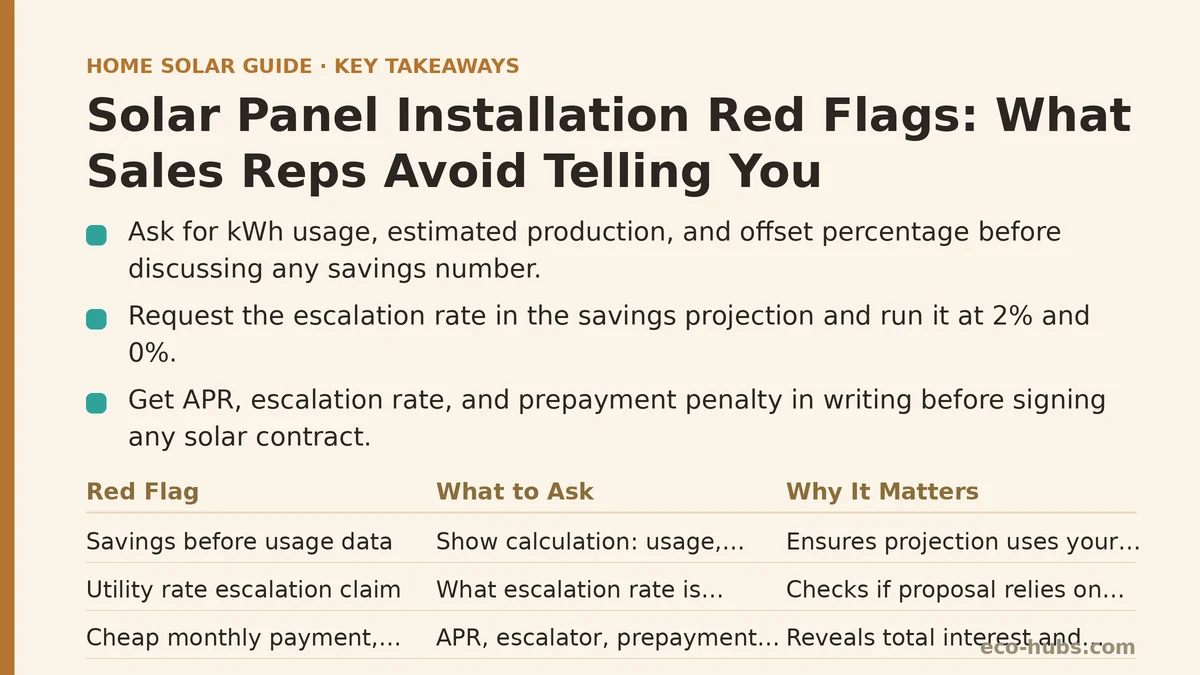
Fix. Before discussing any dollar figure, ask the rep to show the calculation: your annual usage in kWh, the proposed system’s estimated annual production in kWh, and the assumed offset percentage. If the rep cannot produce those three inputs on the spot, treat every downstream number as provisional. In practice, a well-built proposal takes a day or two to assemble precisely because it requires pulling your interval usage data from the utility.
Symptom 2: “Your Utility Rate Is Going Up Forever”
Cause. This is technically true in direction and commonly misleading in magnitude. Utility rates have generally risen over long periods, but the rate of increase varies widely by region and by year, and some years see flat or declining rates depending on fuel costs and regulatory decisions. Sales models sometimes apply a fixed 5-8% annual escalation for thirty years, which compounds into a number far above what most utilities have delivered historically.
Fix. Ask what escalation rate is baked into the savings projection, then ask what the projection looks like at 2% and at 0%. A proposal that only works at 6% escalation is a bet on one specific assumption, not a conservative estimate. If the rep resists running the lower cases, that resistance is the information you need.
Symptom 3: The Monthly Payment Looks Cheap, But the Term Is Long
Cause. Solar financing is frequently structured as a 20- or 25-year loan or lease with a payment designed to sit just below your current electric bill. That makes the payment feel like a wash. What gets de-emphasized is the total interest paid over that term, whether the payment includes an annual escalator, and whether there is a prepayment penalty. A payment that starts at $95 and escalates 2.9% per year reaches roughly $180 by year 25 — a fact that is often buried in a disclosure page rather than the headline slide.
Fix. Ask three things in writing: the annual percentage rate, whether the payment escalates and at what rate, and whether there is any prepayment penalty. As covered in our tax credit guide, the federal credit is generally claimed by the system owner, so confirm who owns the system under your specific contract — a lease or power purchase agreement usually means the third-party owner claims it, not you.
Symptom 4: No Mention of the Interconnection or Permission to Operate Timeline
Cause. The physical panel installation might take one to three days, but the system cannot legally produce and export power until the utility grants permission to operate. That approval process commonly takes anywhere from a few weeks to several months depending on the utility and jurisdiction, and it is entirely outside the installer’s control. Reps focused on closing a sale tend to talk about the install date, not the activation date.
Fix. Ask directly: “What is the typical time from signed contract to permission to operate in my specific utility territory, and who handles the interconnection paperwork?” Get the answer in the contract as a stated timeline with defined consequences if it slips. If the contract is silent on interconnection delays, that silence favors the installer, not you.
Symptom 5: The Quote Lists “Tier 1 Panels” Without Model Numbers
Cause. “Tier 1” is a bankability rating that describes a manufacturer’s financial stability, not a panel’s efficiency or quality. Two panels from Tier 1 manufacturers can differ by several percentage points in efficiency and by a decade in warranty length. Generic language lets a quote be filled with whichever module is cheapest at the moment of ordering.
Fix. Require the specific manufacturer and model number for every panel and inverter, plus the specification sheets. Then verify three things: the panel’s efficiency percentage, its product warranty length, and its performance warranty (typically expressed as a guaranteed output percentage at year 25). A proposal without model numbers is not yet a proposal.
Symptom 6: The Roof Condition Conversation Never Happens
Cause. Solar panels have a service life of 25 to 30 years. If your roof has 8 years of useful life remaining, installing panels now typically means paying to remove and reinstall the array when the roof is replaced — a cost that can run into the thousands and is rarely covered by any warranty. Sales reps who are not roofing contractors may simply not raise the topic.
Fix. Before signing, get an independent assessment of your roof’s remaining life from a roofer who is not affiliated with the solar company. If the roof needs replacing within the next 5-10 years, the standard recommendation is to replace it first, then install solar. Bundling the two can sometimes save on labor, but only if the same contractor is doing both and the sequencing is written into the contract.
Symptom 7: The Warranty Answer Is Vague About Who Backs What
Cause. A solar system carries at least three separate warranties: the panel manufacturer’s product and performance warranty, the inverter manufacturer’s warranty, and the installer’s workmanship warranty covering the physical installation and wiring. These have different lengths and, importantly, gaps where an issue could fall between two of them. Our guide on questions to ask an installer covers this in detail, but the short version is that “25-year warranty” on a sales sheet almost never means one entity covers everything for 25 years.
Fix. Ask for each warranty in writing: the entity backing it, the coverage length, what is excluded, and what happens if the installer goes out of business. Manufacturer warranties generally survive the installer’s closure; workmanship warranties usually do not. That asymmetry is worth knowing before you weigh the value of a long workmanship term.
Symptom 8: You Are Being Pushed to Sign During the Visit
Cause. Same-day-signing discounts are a real sales tactic, and they function by removing your ability to compare quotes. A legitimate price reduction for prompt signing can exist, but it should survive a 24-48 hour review window.
Fix. A simple test: ask for the same price with a three-day review period. If the answer is no, the discount was never about your speed — it was about preventing comparison. Walk through our installer questions checklist and get at least three quotes on comparable equipment before committing.
Quick Triage Table
| Symptom | Likely Cause | Immediate Action |
|---|---|---|
| Savings figure before usage review | Generic regional estimate | Request the kWh calculation |
| High fixed rate escalation | Aggressive savings model | Ask for 0% and 2% scenarios |
| Low monthly payment, long term | Escalating loan or lease | Get APR, escalator, prepay terms |
| No activation timeline | Interconnection delay hidden | Require a stated PTO timeline |
| “Tier 1” without model numbers | Equipment not yet locked | Demand spec sheets for each model |
| Roof condition unmentioned | Outside rep’s expertise | Get independent roof assessment |
| Vague warranty language | Multiple overlapping warranties | Get each warranty in writing |
| Pressure to sign today | Comparison being blocked | Ask for a 3-day review window |
Common Mistakes and How to Recover
The most frequent mistake is signing before requesting the underlying calculations — the usage data, production estimate, and escalation assumption. If you have already signed, most contracts include a rescission period, commonly three days but sometimes longer depending on your state. Read the cancellation clause immediately and exercise it in writing if you need to.
The second common mistake is accepting an oral answer to a warranty or timeline question. Verbal assurances are difficult to enforce. If the answer matters to your decision, get it into the contract as a written term or an addendum.
A third mistake is treating the lowest quote as the best value. Quotes that come in substantially below the others sometimes omit items like permitting fees, main panel upgrades, or monitoring hardware — line items that reappear later as change orders.
What to Do Next
Start today by pulling twelve months of your utility bills and locating your annual kWh usage. That single number lets you sanity-check any savings claim you receive. Then request written quotes from at least three installers, with model numbers, warranty terms, and interconnection timelines spelled out. Before you sign anything, share the proposal with someone who is not selling you the system — a licensed electrician, a roofing contractor, or your state consumer protection office, many of which publish solar-specific complaint histories for local installers. That thirty-minute review is the cheapest insurance available on a 25-year purchase.
Related guides: The Top 5 Solar Sales Red Flags: How to Spot and Avoid High-Pressure Tactics, Solar Contract Red Flags: What to Read Before You Sign, and Common Solar Installer Mistakes Homeowners Should Catch Before Signing.
🔗 Recommended Reading
- Home Battery Sizing Mistakes That Lead to Blackout Regret
- Common Solar Installer Mistakes Homeowners Should Catch Before Signing
- Common Home Battery Storage Wiring and Placement Mistakes to Avoid
- Solar Payback Period vs Cash-on-Cash Return: Which Metric Should Homeowners Use
- Net Metering Credit Rollover Rules: What Happens at Year End