After reading this, you will be able to identify the contract clauses most likely to cause problems later, compare them across installer quotes, and know what to negotiate before signing. Solar contracts are legally binding documents that specify everything from equipment model numbers to what happens if your roof leaks in five years. Most homeowners read the total price and the monthly payment, then sign. The clauses that create the most conflict later are spread across the remaining pages, written in language that is technically precise but rarely memorable.
The sections below organize common red flags into the questions homeowners most frequently ask. Each answer explains what to look for, why it matters, and how to respond.
Q: Does the contract specify exact equipment, or just categories of equipment?
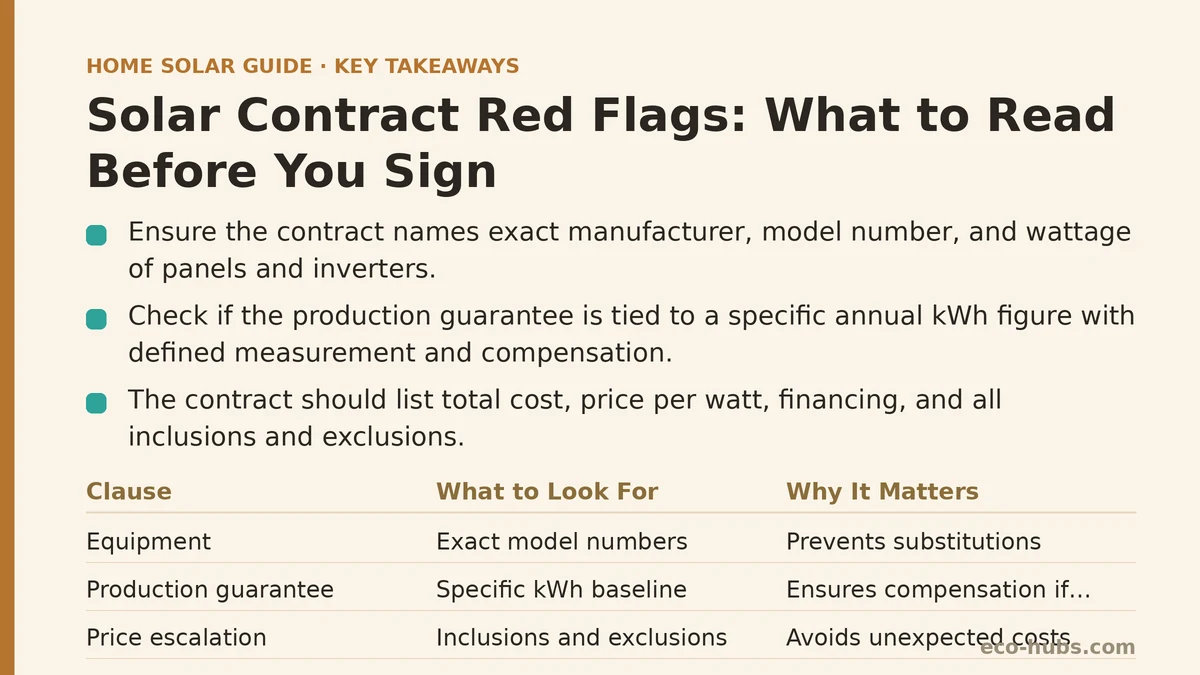
The contract should name the precise manufacturer, model number, and wattage of every panel and inverter being installed. Language like “premium Tier 1 panels” or “a leading inverter brand” leaves room for substitution after you sign. Contract clauses that allow “equivalent or better equipment” without defining the comparison baseline are equally problematic.
In practice, substitutions happen when supply chains shift, and “equivalent” is interpreted by whoever is doing the installing. Some installers insert a substitution clause that requires written approval before swapping equipment, which is acceptable. Others leave it open-ended. The difference matters because your production estimate, warranty coverage, and system aesthetics all depend on the specific models installed.
What to check: Verify the model numbers are written into the contract itself, not just in an attached quote or a separate email that might not be incorporated by reference.
Q: What does the production guarantee guarantee?
Many contracts include a “production guarantee” or “performance warranty” that sounds absolute. The language that follows the headline number tells the real story. Look for the basis — is the guarantee tied to a specific annual kWh figure under standard test conditions, or does it reference a simulation model that the installer controls?
Red flags include production guarantees that exclude “weather events,” “grid outages,” or “unforeseen shading” without defining those terms with precision. A contract that guarantees production at 90% of the estimated annual output, with a clear measurement method and a defined compensation formula, is reasonable. A contract that guarantees production as a percentage of the installer’s own software simulation, with no independent verification method spelled out, is significantly weaker.
What to check: How is the baseline determined, who measures actual production, and what compensation do you receive if the guarantee is missed?
Q: What is the price escalation language, and does it match what the salesperson said?
Verbal price promises do not survive contact with a lawyer’s reading of the contract. The document should show the total system cost, the price per watt, any financing components, and a complete list of inclusions and exclusions. That last category matters more than most homeowners expect.
Common exclusion clauses remove from the quoted price things like main panel upgrades, trenching, tree trimming, roof flashing for certain roof types, and permit fees. These items easily add thousands of dollars. The sales presentation might have mentioned them as “likely needed,” but the contract quotes only the base system price.
What to check: Look for the words “included,” “excluded,” and “additional.” Count how many exclusions exist and estimate their combined cost. Existing electrical service capacity, the age of your roof, and the distance from your panel to your meter all influence these costs.
Q: How is the cancellation window structured?
Federal law allows a three-day rescission period for door-to-door sales, but many solar sales occur at kiosks, home shows, or through online quotes. Those channels do not always carry the same cancellation rights. The contract should state your cancellation rights explicitly, including the deadline, the method for canceling (written notice vs. phone call), and any associated costs.
Less obvious is the cancellation language that appears after the three-day window. Some contracts include substantial “restocking fees” or “engineering fees” if you cancel between signing and installation. Others require paying for the full system price minus a percentage if cancellation happens after permits are filed. These numbers can be aggressive, and they are the first place disputes arise when people change their minds.
What to check: Count the total cost of cancellation at day 3, day 30, and day 60 after signing. The increases should be transparent and proportional to the work completed.
Q: What happens to your roof warranty?
Solar panel installation involves penetrating the roof surface. If the roof later develops a leak, the manufacturer’s shingle warranty and the installer’s workmanship warranty can create a gap where neither party accepts responsibility. The contract should address roof penetrations explicitly.
Acceptable language specifies that the installer provides a roof penetration warranty for a defined period, often 10 years, covering leaks that result from installation work. Problematic language states that roof issues are covered by the roofer’s workmanship warranty, without specifying who that roofer is, how they are engaged, or what happens if the roofer is no longer available. A third category — contracts that say nothing at all about roof penetrations — is the worst of all.
What to check: Find the paragraph mentioning “roof,” “penetration,” “shingle,” or “leak.” If none exist, ask for an addendum before signing.
Q: Are there performance-based financing contingencies you are missing?
Loans with a “% of tax credit” structure, solar lease agreements with annual escalators, and power purchase agreements with per-kilowatt-hour rates all have specific clauses that affect what you pay over time. The contract should separate the equipment loan from any performance promises. If the system produces less than expected, that is a warranty issue, not a loan forgiveness issue, and the contract should keep those two worlds distinct.
Red flags here include leases with escalator clauses that outpace your local utility rate inflation, or loan documents that require annual income verification during the term of the loan. Another increasingly common structure is the “% of tax credit” loan, where your monthly payment assumes you will claim the federal credit and apply it to principal within 18 months. Missing that timeline changes your payment schedule.
What to check: Look at whether the payment schedule changes at any point, what triggers that change, and whether you have any documented obligation beyond the signed contract.
Q: What does the dispute resolution clause say about your rights?
This is the section most homeowners bypass completely. Arbitration clauses that waive your right to join class actions, binding arbitration requirements that name a specific arbitration association, and clauses limiting damages to the amount you paid for the system are all common. Each carries implications far beyond the installation itself.
A contract that requires arbitration in a specific location, perhaps the installer’s home city, effectively raises your cost of pursuing a dispute. A contract that limits damages to “refund of the purchase price” protects the installer from consequential damages but leaves you with no compensation for roof repair costs, permit rework, or additional financing expenses if the installation fails.
What to check: If the dispute resolution clause is longer than two paragraphs, the installer’s legal team likely designed it to manage a specific prior dispute. Read it carefully or have someone else read it.
Q: What happens if the installer goes out of business mid-project?
The contract should address what happens to your deposits, your equipment, and your warranty if the installer ceases operations. Some contracts include a “financially responsible party” clause that names the parent company or a specific individual as guarantor of the agreement. Others explicitly disclaim liability for installer insolvency.
Warranty coverage after installer closure depends on whether the manufacturer backs the installation warranty directly. While most panel manufacturers offer product warranties that survive installer bankruptcy, workmanship warranties do not. The contract may describe the workmanship warranty as “provided by the installer,” which carries no protection if the installer dissolves.
What to check: Identify which specific warranties are backed by the manufacturer directly versus which depend on the installer’s continued operation. The difference matters across a 25-year system lifetime.
Your Clause Checklist in Summary
| Contract Section | Red Flags to Look For |
|---|---|
| Equipment schedule | Model numbers missing, “equivalent or better” without definition |
| Production guarantee | Guarantee tied to installer’s own simulation with no independent verification |
| Price and inclusions | Exclusions listed without cost estimates, verbal promises not in writing |
| Cancellation rights | Three-day window expires with no stated alternative, escalating fees beyond day three |
| Roof penetration | No mention of roof work, or warranty depends on an unnamed third-party roofer |
| Payment schedule | Nonpayment triggers that change payment amounts without formal notice |
| Dispute resolution | Mandatory arbitration outside your jurisdiction, damages capped at purchase price |
| Installer solvency | No guarantor clause, workmanship warranty depends on installer’s existence |
What To Do Before You Sign Anything
Take the contract to a third-party solar consultant or an attorney who reviews solar agreements. The cost of that review, usually a few hundred dollars, is a fraction of the cost of a contract you regret for the next 25 years. Cross out any clause you do not understand and extract a written explanation from the installer. Installers who resist clarifying language often do so for a reason.
Compare two contracts side by side, not on total price alone, but on the red flags above. An installer offering a lower price with a weak guarantees clause is not cheaper in the long run if the production shortfall compensation language is vague or missing. The contract defines your recourse, and recourse is what turns a disappointment into a recoverable loss.
Which contract section feels least clear to you right now — the production guarantee, the cancellation terms, or the roof work clause? Describe the language that raised the question, and I can help you understand what it likely means in practice.
Related guides: Solar Panel Installation Red Flags: What Sales Reps Avoid Telling You, The Top 5 Solar Sales Red Flags: How to Spot and Avoid High-Pressure Tactics, and Solar Panel Permits and HOA Restrictions: What to Know Before You Apply.
🔗 Recommended Reading
- Solar Incentive Paperwork: Common Filing Mistakes That Delay Your Rebate
- Home Battery Sizing Mistakes That Lead to Blackout Regret
- Common Solar Installer Mistakes Homeowners Should Catch Before Signing
- Common Home Battery Storage Wiring and Placement Mistakes to Avoid
- Solar Payback Period vs Cash-on-Cash Return: Which Metric Should Homeowners Use