Confidence and pressure look similar on the surface, but they are not the same thing. A confident salesperson answers your questions directly and leaves you room to think; a high-pressure one fills every silence with urgency and steers you away from comparison. The distinction matters because solar is a five-figure decision most homeowners make once, and the sales tactics used to close that decision quickly can cost far more than the panels themselves.
What Actually Counts as a “Red Flag” in Solar Sales?
Not every assertive sales pitch is a scam, and not every polite installer is trustworthy. A red flag, in this context, is a specific behavior or claim pattern that has been documented repeatedly in consumer complaints and state attorney general warnings about solar sales. These are not vague vibes — they’re identifiable moves that benefit the salesperson’s close rate more than they benefit your decision-making. The five below are the ones that show up most consistently across homeowner complaints.
Red Flag #1: “This Price Is Only Good Today”
Why does urgency get used this heavily in solar sales? Because it works. A homeowner who feels the deal will disappear tomorrow is far less likely to get a second quote tonight, and skipping that comparison is exactly what benefits the salesperson, not the homeowner. Legitimate solar pricing is based on equipment costs, labor, and permitting fees that don’t meaningfully change overnight. A price that supposedly evaporates within 24 hours is a pressure device, not a real market condition.
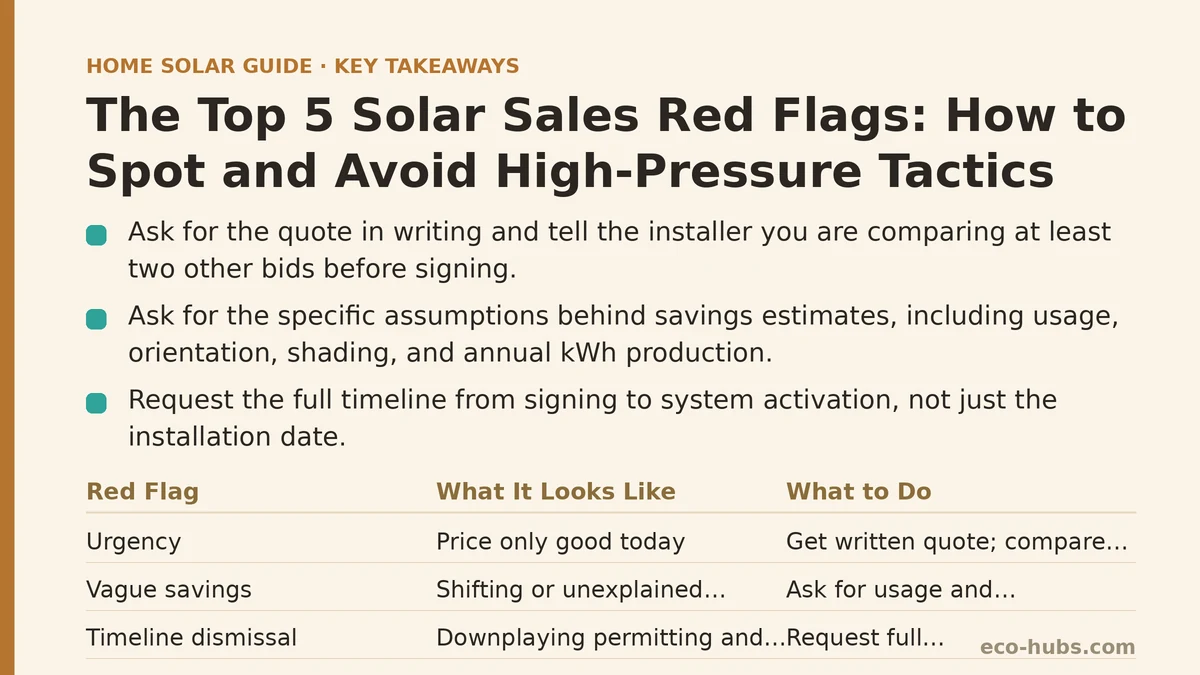
What should you do instead? Ask for the quote in writing and tell the installer you’re comparing at least two other bids before signing anything. A company confident in its pricing will still be competitive next week. One that pushes back hard on this request is telling you something about how that price was built in the first place.
Red Flag #2: Vague or Shifting Savings Numbers
How can I tell if a savings estimate is inflated? Ask for the specific assumptions behind it — your actual electricity usage, the panel orientation and shading factored in, and the exact production estimate in kilowatt-hours per year, not just a dollar figure. As covered in our payback period guide, an inflated production estimate produces an inflated savings projection automatically, since one number feeds directly into the other. If the salesperson can’t walk you through where the number came from, or the estimate changes when you ask a follow-up question, that instability is itself the warning sign.
Is it normal for savings estimates to vary slightly between installers? Some variation is expected, since different companies may use different assumptions about future utility rate increases. What’s not normal is a number that can’t be explained or that moves dramatically once you press for detail.
Red Flag #3: Dismissing Permitting or Interconnection Timelines
Why would an installer downplay how long the process takes? Because a realistic timeline — often including weeks or months for permitting and utility interconnection approval — sounds less appealing than “installed in a day.” Some salespeople gloss over this to keep the pitch feeling fast and simple, even though the physical installation is frequently the shortest part of the entire process.
What’s a reasonable question to ask here? Request the full timeline from signing to system activation, not just the installation date, and ask what happens if permitting or interconnection runs long. A company that gives you a vague “it varies” without offering a realistic range for your specific jurisdiction hasn’t done this often enough locally, or isn’t being straightforward about what to expect.
Red Flag #4: Pressure to Sign Before You’ve Reviewed Financing Terms
What’s the actual risk of signing financing paperwork quickly? Solar loans can include origination fees, dealer fees baked into the interest rate, or prepayment penalties that aren’t obvious from a monthly payment figure alone. A salesperson pushing you to sign financing documents in the same visit as the sales pitch, before you’ve had time to read the terms independently, is prioritizing the close over your understanding of what you’re agreeing to.
How much time should I take before signing financing paperwork? At minimum, take the documents home and read the full terms, including the annual percentage rate and any fees beyond the headline number. A legitimate lender’s terms won’t change because you took a night to review them. If a salesperson claims the financing offer is only valid if signed on the spot, treat that the same way you’d treat Red Flag #1.
Red Flag #5: Refusing to Provide References From Older Installations
Why does the age of a reference matter? A homeowner installed six months ago hasn’t had time to experience a warranty claim, a roof leak, or a production shortfall relative to what was promised. References from installations that are two, three, or more years old tell you far more about how the company handles problems after the sale, not just how smoothly the initial pitch and installation went.
What if the installer says references aren’t available? That’s worth treating with real skepticism. A company with a track record of satisfied long-term customers generally has no reason to withhold that information. Reluctance here often correlates with the same reluctance you’d encounter later if you needed a workmanship warranty claim honored.
Red Flag Quick Reference
| Red Flag | What It Sounds Like | What to Ask Instead |
|---|---|---|
| Artificial urgency | “This price expires tonight” | Get it in writing, compare other quotes |
| Vague savings figures | A dollar number with no breakdown | Ask for usage, shading, and production assumptions |
| Downplayed timeline | “Installed in a day” | Ask for the full permitting-to-activation timeline |
| Rushed financing signature | “Sign today to lock the rate” | Take the paperwork home, review the APR and fees |
| No older references | “We don’t share customer info” | Ask specifically for references two-plus years in |
Does One Red Flag Mean I Should Walk Away Entirely?
Not necessarily, and treating every individual flag as an automatic disqualifier would rule out installers who are simply inexperienced at communication rather than dishonest. What matters more is the pattern. One vague answer might be a communication gap; three or four of these behaviors clustered in the same pitch is a much stronger signal that the sales process is built around closing quickly rather than informing you thoroughly.
Have you run into one of these situations already, or are you currently sitting across from a pitch that feels a little too urgent? Describe what happened and which specific claim felt off, and we can help you figure out whether it’s worth pushing back on or walking away from entirely. Related guides: Solar Panel Installation Red Flags: What Sales Reps Avoid Telling You, Solar Contract Red Flags: What to Read Before You Sign, and Common Solar Installation Mistakes and How to Avoid Them.
🔗 Recommended Reading
- Home Battery Sizing Mistakes That Lead to Blackout Regret
- Common Solar Installer Mistakes Homeowners Should Catch Before Signing
- Common Home Battery Storage Wiring and Placement Mistakes to Avoid
- Solar Payback Period vs Cash-on-Cash Return: Which Metric Should Homeowners Use
- Net Metering Credit Rollover Rules: What Happens at Year End