Only about one percent of U.S. rental properties have solar panels installed, even though renters consistently report a willingness to pay more for homes with solar. That gap between what tenants say they want and what landlords are building is not a sign that solar is a bad fit for rentals. It is a sign that most landlords have never had the math laid out clearly, including the specific places where the math fails for them.
Myth: Solar Only Pays Off for Long-Term Owner-Occupants
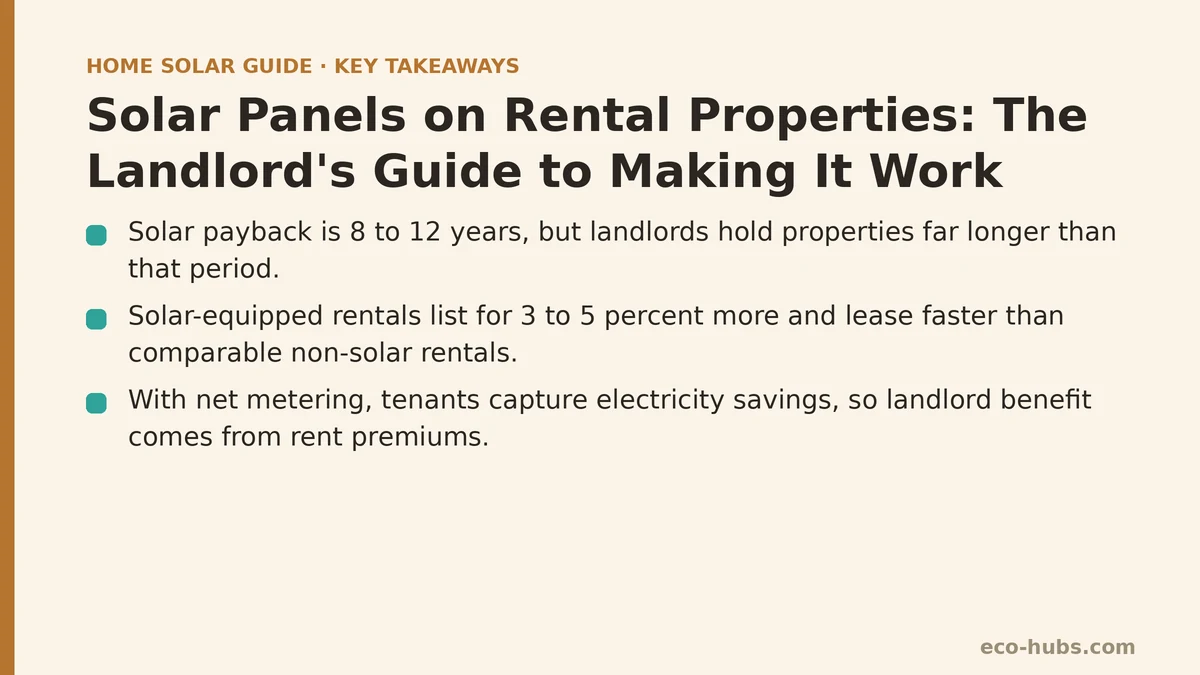
The logic here seems straightforward — solar pays back over 8 to 12 years, so you need to stay put for a decade to capture the benefit. For an owner-occupant, that logic holds. For a landlord, the timeline math works differently because you are not selling the home when you stop living there. You are keeping it as a rental, and the solar system remains attached to the property, generating value for you in the form of rent premiums and property appreciation regardless of who is living there at any given time.
Reality: The relevant holding period for a landlord is not how long you personally live in the house. It is how long you own the property. Most landlords hold properties far longer than the solar payback period, making the investment horizon more favorable than the owner-occupant comparison suggests.
Myth: You Cannot Pass Solar Costs Through to Tenants
A common objection is that you cannot simply raise rent by a fixed amount to cover a solar installation, because tenants may not accept the increase. That objection misunderstands how rental markets price solar.
Reality: The rent premium for solar is not something you negotiate line-by-line with each tenant. It is a market-level effect. When comparable rental homes in your area have solar and yours does not, yours sits on the market longer and commands less. When yours has solar and comparable homes do not, you can price accordingly. Data from rental listings in several U.S. markets consistently shows solar-equipped rentals listing for 3 to 5 percent more than comparable non-solar rentals, and they lease faster. That premium is not a direct pass-through of your system cost — it is a market outcome driven by tenant preference.
Myth: Net Metering Rules Make Rental Solar Pointless
Some landlords assume that because tenants pay the utility bills, any solar generation benefits the tenant rather than the landlord. Under net metering, that is broadly correct — the tenant receives the bill credit for surplus generation, not you.
Reality: This is where the myth veers closest to being true, and where the distinction between ownership models matters most. If you install solar on a rental property where the tenant pays the utility bill, the tenant captures the electricity savings directly. Your benefit comes from the rent premium, not from the energy savings. But if you instead structure the arrangement as a sub-metered solar lease or a rent-inclusive utility arrangement, the calculus changes. More commonly, landlords use a simpler approach: install solar, raise rent slightly, and let the tenant keep the utility savings as part of the value proposition. The tenant pays less for electricity than they would without solar, you earn a rent premium, and both parties end up ahead compared to the non-solar baseline.
Myth: Tax Incentives Do Not Apply to Rental Solar
The federal solar investment tax credit (ITC) covers residential installations, but there is a common misreading that it only applies to primary residences. That reading is incorrect.
Reality: The ITC applies to solar on residential rental properties, but the specific rate and treatment differ depending on whether the property is classified as residential or commercial under IRS rules. A single-family rental that is used for residential purposes generally qualifies for the same 30 percent credit as an owner-occupied home, so long as the landlord is paying for the installation. Short-term rentals like Airbnb properties historically have different treatment — they can qualify, but under the commercial credit rules rather than the residential ones. The full details are in our dedicated tax credit guide, but the key point for landlords is this: the credit is available, and treating it as unavailable is leaving a 30 percent reduction in your installed cost on the table.
Myth: Tenants Will Not Care or Notice
The assumption that renters do not pay attention to energy features is contradicted by listing data and renter surveys alike.
Reality: In markets where utility costs are high, tenants actively search for solar-equipped rentals. The reasons vary — some want lower monthly bills, some value the environmental angle, and some simply treat solar as a marker of a newer or better-maintained property. Across all of those motivations, the practical outcome for landlords is the same: a solar-equipped rental generates more qualified interest, shorter vacancy periods, and a defensible rent premium. In a competitive rental market, those three factors often matter more than the raw electricity savings math.
Where Rental Solar Does Not Make Sense
Honesty requires naming the conditions under which rental solar is a poor investment, because those conditions do exist.
Condition one: You hold properties short-term. If your strategy is to buy, renovate, and sell within three to five years, solar is unlikely to pay off. The system adds value at sale, but typically not dollar-for-dollar with its installed cost, and the remaining tax credit recapture rules can complicate a fast resale.
Condition two: Your tenants pay their own utilities and you cannot adjust rent. In a soft rental market where you lack the leverage to raise rent even slightly, the tenant captures the entire electricity savings and you capture nothing. The solar system becomes an outright gift to your tenant, which is fine as a goodwill gesture but not as an investment.
Condition three: Orientation and shading are poor. The roof faces north, or a neighbor’s tree covers the array for half the day. No ownership structure or tenant arrangement can fix a fundamentally poor solar site. Run the production estimate before you get excited about the tax credit.
Myth vs. Reality at a Glance
| Myth | Reality |
|---|---|
| Solar only pays off for long-term owner-occupants | Landlords hold properties long enough that the payback period is shorter than their holding period |
| You cannot pass costs through to tenants | Rental markets price solar as a premium; tenants pay it willingly in the form of higher lease rates |
| Net metering makes rental solar pointless | The tenant captures bill savings, but the landlord captures the rent premium — both benefit under the right structure |
| Tax incentives do not apply to rentals | The ITC applies to residential rental properties, typically at the full 30 percent rate |
| Tenants do not care about solar | Rental listings data shows solar-equipped homes lease faster and at a premium |
| Solar is always a good investment for landlords | Poor orientation or soft rental markets can flip the math negative |
A Structure That Aligns Interests Cleanly
The most defensible rental solar structure for a landlord with utility-bill-paying tenants is straightforward: install an appropriately sized system, raise rent by a modest amount, and let the tenant keep the electricity savings. Your rent premium should be sized below the tenant’s expected electricity savings, so the tenant is measurably ahead compared to a non-solar comparable, and you are ahead compared to your non-solar baseline rent. This alignment means both parties have an incentive to keep the system operational, and neither side feels like the arrangement is lopsided.
The one structural detail to get right in writing: specify in the lease that the solar system remains the landlord’s property, that the tenant is expected to keep the panels accessible for maintenance, and that the tenant does not have the right to alter or remove any part of the system. This provision costs nothing to include and prevents the most common dispute that arises in rental solar arrangements.
The Decision Framework for Landlords
If you are considering solar on a rental property, run through this sequence before committing. First, confirm your actual holding period — if you plan to sell within five years, skip solar. Second, run a basic production estimate for the specific roof, not a generic average. Third, check your local rental market — can you reasonably price a solar-equipped home 3 to 5 percent above comparable non-solar listings? Fourth, review the ITC rules for your specific rental classification. Finally, check whether your utility’s net metering policy is favorable — some markets have moved to net billing structures that reduce the value of exported electricity, which changes the tenant-facing savings math.
Are you a landlord weighing solar for a specific property, or have you already installed solar on a rental and want to compare notes? Describe your property type, typical utility costs, and target market, and the conversation can go deeper on whether the numbers work for your situation.
Related guides: Do Solar Panels Work During a Power Outage? It Depends on Your System Type, What Happens to Solar Panels at the End of Their Life: A Recycling Guide, and A Beginner’s Step-by-Step Guide to Getting Your First Solar Quote.
🔗 Recommended Reading
- Solar Incentive Paperwork: Common Filing Mistakes That Delay Your Rebate
- Home Battery Sizing Mistakes That Lead to Blackout Regret
- Common Solar Installer Mistakes Homeowners Should Catch Before Signing
- Common Home Battery Storage Wiring and Placement Mistakes to Avoid
- Solar Payback Period vs Cash-on-Cash Return: Which Metric Should Homeowners Use