A common misconception is that an off-grid solar system starts with choosing solar panels. In practice, the panels are nearly the last meaningful decision you will make. Choose them too early and you will either overspend on generation you cannot store or undersize a battery bank that then dictates everything else. The correct sequence runs from energy demand backward to generation, and each step constrains the next.
5. Battery Bank Capacity: The Load Anchor
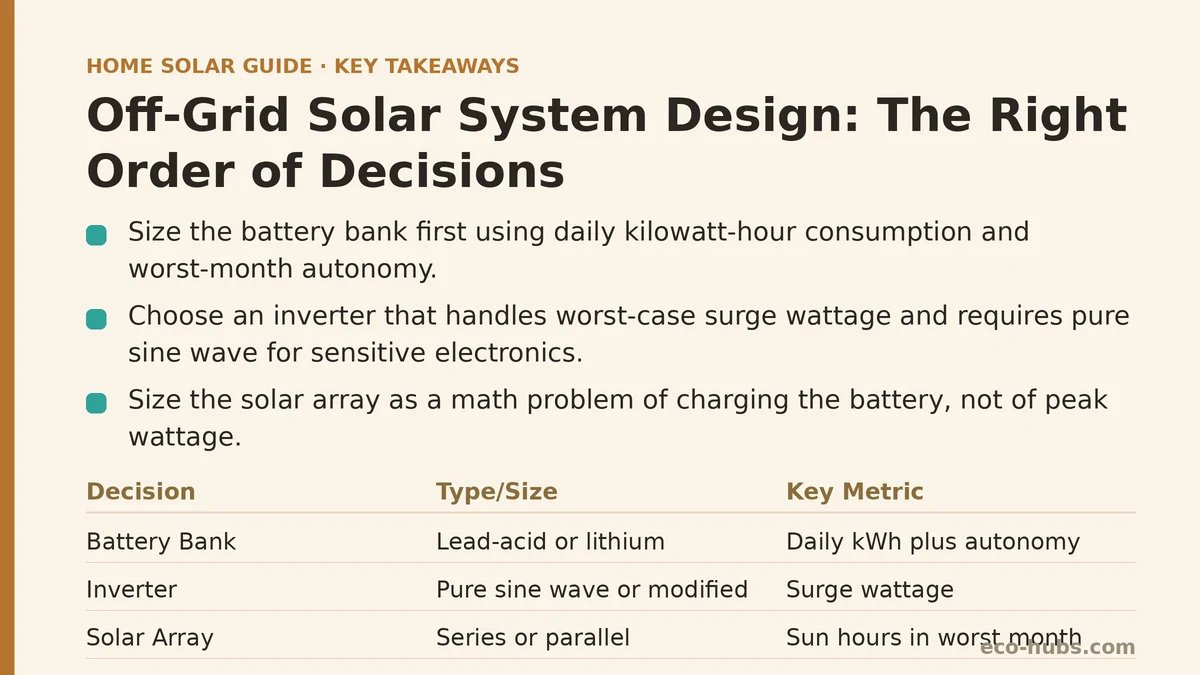
Before any panel count or inverter wattage, you need a precise number: your daily kilowatt-hour consumption. Off-grid systems fail far more often from under-sized batteries than from under-sized solar arrays. A battery bank sized for three days of autonomy with 50% depth of discharge (for lead-acid) or 80% (for lithium) is a starting benchmark, but the real calculation depends on your seasonal worst month, not an annual average. A cabin used only in summer has a very different bank requirement than a year-round home at a northern latitude.
Calculate your critical loads — lighting, refrigeration, water pumping, communication devices — and separate them from discretionary loads like entertainment systems or power tools. Your battery bank must carry the critical loads through consecutive cloudy days. That number, in kilowatt-hours, sets the floor for everything else in the design.
4. Inverter Size and Type: The Power and Waveform Gate
The inverter converts battery DC into the AC your appliances use, and its size follows from two distinct measurements: continuous wattage and surge wattage. Motors, compressors, and pumps can draw three to seven times their running wattage for a few seconds on startup. A refrigerator rated at 600 watts running can spike to 1,800 watts on compressor start. Your inverter must handle the worst-case simultaneous surge, not the sum of running loads.
Waveform matters equally. Pure sine wave inverters are required for electronics with microprocessor controls, variable-speed motors, and some induction cooktops. Modified sine wave units are cheaper but cause measurable inefficiency in certain appliances and can damage others over time. Check every appliance label before choosing, especially if you plan to run modern refrigerators, heat pumps, or any device with a touchscreen or digital display.
3. Solar Array Sizing: Production Matching Storage
With the battery bank and inverter locked in, the array size becomes a math problem of charging, not of peak wattage. In winter or heavy-cloud months, a flat daily production estimate called “sun hours” drops significantly. A system designed for 4.5 sun hours in July might see only 1.5 in December at the same location. The array must produce enough to recharge your battery bank from its depth-of-discharge limit to full within one typical sunny day, plus cover daily loads simultaneously.
Array voltage also matters for efficiency. Higher array voltage (e.g., 72-cell or bifacial panels wired in series) reduces wire losses over longer runs between the array and battery shed. Keep the array at a voltage compatible with your charge controller — MPPT controllers handle a wide input range but have upper and lower limits that must be respected.
2. Charge Controller Selection: MPPT vs. PWM
MPPT (Maximum Power Point Tracking) controllers are the default choice for any system over a few hundred watts. They convert excess array voltage into additional charging current, which measurably improves harvest in cold weather and low-light conditions. PWM (Pulse Width Modulation) controllers are cheaper but effectively waste any array voltage above the battery bank voltage. For a year-round off-grid home, the efficiency difference between the two often pays for the MPPT controller’s higher upfront cost within one season.
Controller sizing requires both a voltage rating and a current rating. The current rating must match or exceed your array’s short-circuit current multiplied by a safety factor of 1.25. Over-sizing the controller by one model size costs little and provides headroom for future array expansion without a controller replacement.
1. Load Assessment and Seasonal Profile: The Decision That Precedes All Others
Ranked first because it is the most commonly skipped: a detailed seasonal load assessment. Off-grid design fails when assumptions replace measurements. Use a plug-in watt meter on each major appliance for one week to record real consumption rather than nameplate ratings. Note which loads run simultaneously — morning coffee, refrigerator, and water pump together draw differently than the same loads spaced apart.
Seasonality changes this profile. A workshop heated for weekends only, a summer cabin, or a full-time residence each create different battery and array requirements even with identical peak loads. The off-grid system that fits a weekend retreat is embarrassingly oversized for a summer-only cabin and dangerously undersized for winter residence. Document your monthly energy budget across all twelve months before you price a single component.
Comparison at a Glance: Where Mistakes Happen
| Design Step | Typical Mistake | Consequence | Correct Approach |
|---|---|---|---|
| Load assessment | Using appliance nameplate watts instead of measured usage | 20–40% oversizing or undersizing | Week-long watt meter measurement per appliance |
| Battery bank | Sizing for average days, not worst consecutive cloudy days | Premature battery failure or load shedding | Size for 3-day autonomy at seasonal worst month |
| Inverter | Ignoring surge wattage of motor loads | Inverter trips on startup, appliances don’t run | Sum worst-case simultaneous surge, not running load |
| Array sizing | Matching panel wattage to daily load without seasonal sun-hour data | Battery never fully recharges in winter | Calculate daily recharge requirement at lowest sun-hour month |
| Charge controller | Choosing PWM to save money on a large array | 15–25% harvest loss, longer recharge times | Use MPPT for any array above 400W |
The Order Revisited: Why This Sequence Prevents Rework
Working backward from load to battery to inverter to array to controller means each component’s specification is justified by the one before it. A common failure pattern emerges when people reverse this — they buy panels first, then discover their battery bank cannot accept the charge current, or their inverter cannot handle the surge from their well pump, and rework costs erase any initial savings.
One additional consideration that reinforces the order: wire and breaker sizing. Proper gauge wire between array and controller, controller and battery, and battery and inverter follows directly from the current ratings of each component. Designing in the correct sequence allows you to calculate every cable run once, rather than redoing voltage-drop calculations each time you swap a component.
A Practical Note on Phased Expansion
The ranked order above does not mean you must build the entire system at once. A common off-grid strategy is to start with a smaller battery bank and array sized for critical loads — lighting, refrigerator, communication — and expand in subsequent seasons. The design order still applies: your initial load assessment defines the phasing plan. The charge controller and inverter you choose now should be sized for the final system, not the first phase, because those two components are the most expensive to replace. The battery bank and array can grow incrementally without rework if the foundation components are sized for the end state. Skipping the ranked assessment and buying a smaller controller or inverter to save money in phase one typically forces a full replacement in phase two.
What is your worst-month load — the set of appliances that must run even on consecutive cloudy days? Write down that list and measure each item’s real consumption for a week. That single dataset determines more about your off-grid system design than any other piece of information, and it is the one most people never collect.
Related guides: How to Calculate How Many Solar Panels You Need for Your Home, Solar Panel Brands Compared: Tesla, SunPower, Panasonic, and More, and Solar Panel Maintenance: What to Actually Expect Over Time.
🔗 Recommended Reading
- Solar Incentive Paperwork: Common Filing Mistakes That Delay Your Rebate
- Home Battery Sizing Mistakes That Lead to Blackout Regret
- Common Solar Installer Mistakes Homeowners Should Catch Before Signing
- Common Home Battery Storage Wiring and Placement Mistakes to Avoid
- Solar Payback Period vs Cash-on-Cash Return: Which Metric Should Homeowners Use