After working through this guide, you’ll be able to take your own electricity bill, a rough sense of your roof’s sun exposure, and a calculator, and arrive at a defensible estimate of how many panels your home actually needs — one you can compare against any installer’s proposal instead of accepting it at face value. The math itself isn’t complicated. What matters is doing the steps in the right order and understanding which factors have the biggest effect on the final number, since a mistake early in the process compounds through everything that follows.
Below are the five factors that determine panel count, ranked from most influential to least, with the calculation method for each.
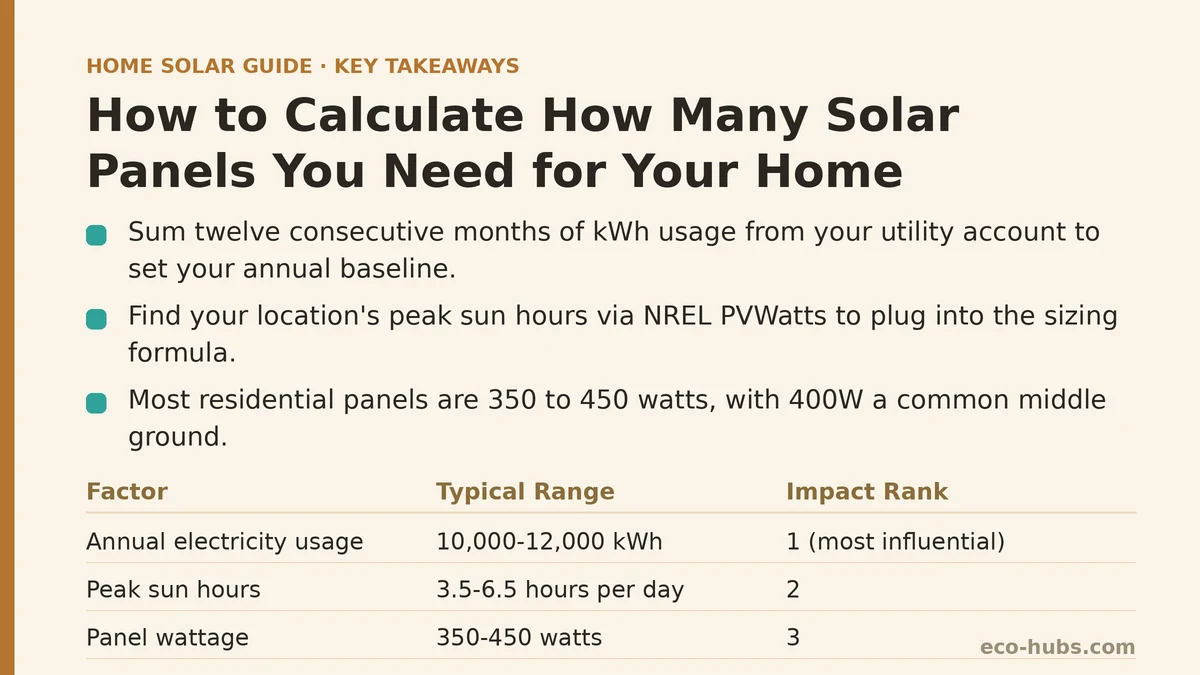
1. Your Annual Electricity Usage (The Foundation Everything Else Builds On)
This is the single most important number in the entire calculation, and it’s also the easiest one to get wrong by relying on a single recent bill rather than a full year of data. Usage swings seasonally — air conditioning in summer, heating-related electrical load in winter — so a system sized off a mild spring month will undersize your actual annual need.
Pull twelve consecutive months of kilowatt-hour (kWh) usage from your utility account, sum them, and you have your baseline. A typical U.S. household lands somewhere between 10,000 and 12,000 kWh annually, but yours could be meaningfully higher or lower depending on home size, climate, and whether you’re planning to add an EV or heat pump in the near future — a detail worth building in now rather than resizing the system later.
Why it ranks first: every subsequent calculation in this guide multiplies against this number. A 10% error here produces roughly a 10% error in your final panel count, which no amount of precision in the later steps can correct.
2. Peak Sun Hours for Your Specific Location
Peak sun hours measure how many hours per day your location receives solar irradiance strong enough to count as “full sun” equivalent — not the same as total daylight hours. Phoenix might average 6.5 peak sun hours daily; Seattle might average closer to 3.5. This single variable explains why two homes with identical usage can need noticeably different system sizes.
You can find a reasonable estimate for your specific zip code through NREL’s PVWatts calculator, which is free and doesn’t require signing up for anything. Enter your location, and it will return a location-specific average you can plug directly into the formula in step four.
Why it ranks second: location affects your number almost as much as usage does, but unlike usage, it’s fixed — you can’t reduce it through conservation. It sets a hard ceiling on how much energy a given panel can realistically produce where you live.
3. Panel Wattage You’re Planning to Use
Most residential panels sold today fall between 350 and 450 watts, with 400W becoming something of a common middle ground. Higher-wattage panels produce more energy per panel, which means fewer panels are needed to hit your target — useful if your roof space is limited, though higher-wattage panels also tend to cost more per unit.
This is the one factor in this list you have some direct control over independent of your house itself. Choosing 400W panels instead of 350W panels can shrink your total panel count by roughly 12% for the same energy target, which matters if roof space or aesthetics are a constraint.
Why it ranks third: it’s a real lever, but a smaller one than usage or location. Swapping panel wattage adjusts the final count by a modest percentage; getting your usage number wrong can throw off the estimate by a much larger margin.
4. The Actual Calculation (Where the Previous Three Numbers Combine)
With annual usage, peak sun hours, and panel wattage in hand, the formula looks like this:
System size (kW) = Annual usage (kWh) ÷ 365 ÷ Peak sun hours
Number of panels = System size (kW) × 1,000 ÷ Panel wattage
Worked example: a household using 11,000 kWh annually, located somewhere averaging 5 peak sun hours per day, planning to use 400W panels.
- System size: 11,000 ÷ 365 ÷ 5 = roughly 6.03 kW
- Panel count: 6.03 × 1,000 ÷ 400 = roughly 15 panels
Installers typically add a modest buffer — often 10 to 20% — to account for system losses from inverter efficiency, wiring, temperature effects, and gradual panel degradation over time, discussed in more detail in our guide on panel efficiency and degradation. Applying a 15% buffer to the example above brings the estimate to roughly 17 panels.
Why it ranks fourth: this is the step where the previous three factors get combined, but it introduces no new information on its own — it’s arithmetic, not a separate variable, which is why it sits below the inputs that actually determine the result.
5. Roof Space, Orientation, and Shading Constraints
The math might tell you 17 panels, but your roof has the final say. A standard 400W panel occupies roughly 20 square feet, so 17 panels need approximately 340 square feet of usable, south-facing (or close to it) roof area free of significant shading from trees, chimneys, or neighboring structures.
If your roof can’t accommodate the full calculated count, you have a few realistic paths: higher-wattage panels to reduce the number needed, a smaller system paired with continued grid reliance for the remaining usage, or splitting panels across multiple roof faces with different orientations, which typically reduces total production somewhat but can still close most of the gap.
Why it ranks fifth: it doesn’t change how many panels your usage and location mathematically call for, but it determines whether that number is achievable as calculated or needs to be adjusted downward to fit physical reality.
Ranked Summary
| Rank | Factor | Effect on Final Panel Count |
|---|---|---|
| 1 | Annual usage (kWh) | Largest — errors here scale directly into the final number |
| 2 | Peak sun hours (location) | Large and fixed — can’t be improved through conservation |
| 3 | Panel wattage | Moderate — a real lever you can adjust |
| 4 | The calculation itself | Combines the above — no independent influence |
| 5 | Roof space/orientation | Caps or adjusts the theoretical number to what’s physically buildable |
Running Your Own Numbers Before Talking to an Installer
Working through these five factors yourself, even roughly, gives you a number to compare against whatever an installer proposes. If their estimate comes in noticeably higher than your own calculation, it’s worth asking which assumption — usage, peak sun hours, or system losses — accounts for the difference, a conversation covered in more depth in our guide on questions worth asking before signing with an installer. If it comes in lower, it’s worth checking whether they’ve fully accounted for future usage increases like an EV or added HVAC load.
Have you pulled your annual kWh usage yet, or are you still estimating from a single bill? Share your location and rough usage, and we can help you sanity-check where your own number might land. Related guides: EV Charger and Solar Panel Integration: How It Actually Works, Home Battery Storage: Common Mistakes and How to Troubleshoot Them, and Off-Grid Solar System Design: The Right Order of Decisions.
🔗 Recommended Reading
- How to Prepare Your Home for a Solar Site Assessment: A Beginner's Checklist
- How to Size a Solar System for Your Home: A Beginner's Step-by-Step Walkthrough
- Solar Panel Monitoring Apps: A Setup Guide for Beginners
- How to Read Your Electricity Bill After Solar: A Line-by-Line Walkthrough
- Solar Incentive Paperwork: Common Filing Mistakes That Delay Your Rebate