The most common assumption about solar installation is that the biggest regret homeowners face is choosing the wrong equipment—an underperforming panel brand or an inverter that fails early. In practice, that assumption is backward. Across installation reviews, permit failures, and service call records, the regrets that cost homeowners the most money and time are installation mistakes, not equipment choices. A panel defect triggers a warranty claim. An installation error triggers a roof leak, a failed inspection, or a system that produces a fraction of its rated output for years without anyone noticing.
Myth: “If It Produces Power, It Was Installed Correctly”
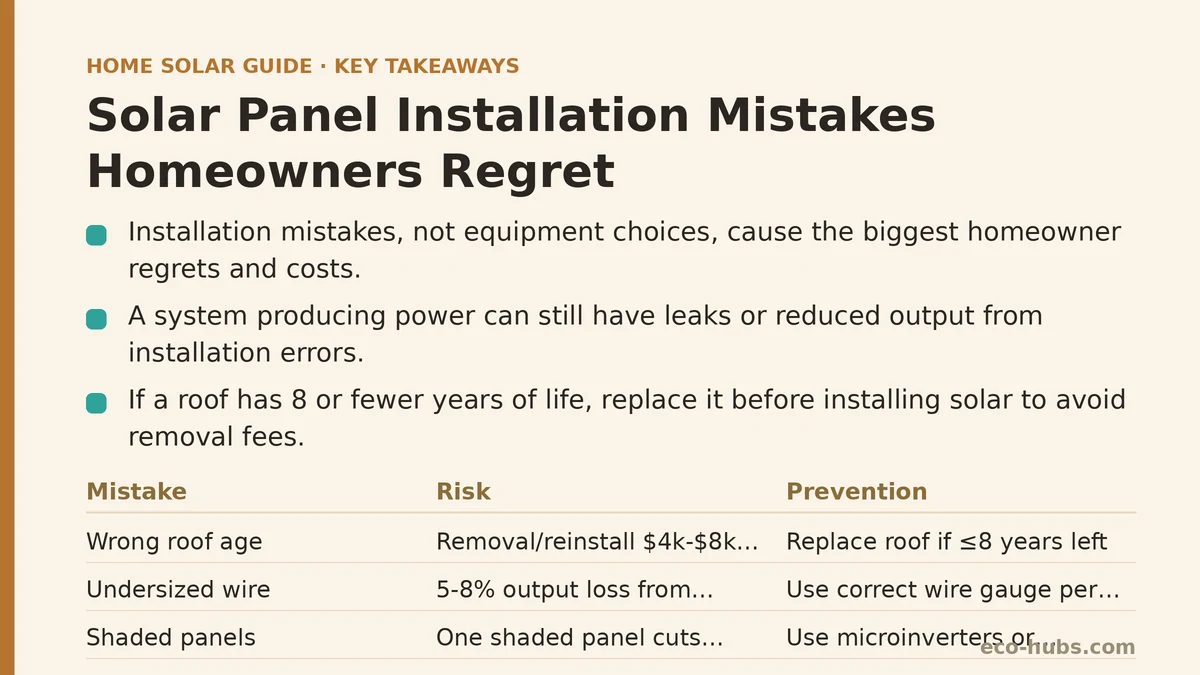
A system that generates electricity is not the same as a system that generates electricity safely, durably, and at full rated capacity. A panel array can be producing power while a mounting foot is improperly flashed—letting water seep into the roof deck—and that leak may not appear inside the home for 18 to 24 months, long after the installer has moved on. Similarly, a string of panels connected with undersized wire will run, but voltage drop can reduce total output by 5 to 8 percent of what the system should deliver. That sort of loss never appears on any single screen in the monitoring app; it only shows up when the same array is compared against a properly wired twin on the same roof.
The reality: Power production is necessary but not sufficient proof of a correct installation. The proof is in the details—flashing, torque specs, wire gauge, grounding paths, and code compliance.
Myth: “Roof Age Doesn’t Matter Until the Roof Leaks”
Most solar installers will mount panels on a roof that has 10 to 12 years of life left in it. Many homeowners read that as permission to proceed without asking why. The why is simple: a solar array costs $4,000 to $8,000 to remove and reinstall. If your asphalt shingle roof has 5 years of life remaining, you will pay for that removal and reinstallation once, possibly twice, during the 25-year expected life of the array. That adds $8,000 to $16,000 of unplanned cost to a system that may have been quoted at $22,000 to $35,000.
The reality: A roof with 8 or fewer years of remaining life is a resurfacing project first, a solar project second. The roof replacement costs $9,000 to $15,000 before a single panel goes up, but it saves $8,000 to $16,000 in later removal fees and protects the array’s continuous uptime. Homeowners who skip this step report the most expensive single regret in follow-up surveys.
Myth: “More Panels Always Means More Savings”
Covering every available roof surface with panels feels like maximizing the investment. In practice, it frequently produces diminishing returns. The end of a roof plane that gets afternoon shade from a chimney, a neighbor’s tree, or a dormer can pull down the output of the entire string. In a typical series-wired system, a shaded panel drops the current for every panel in that string—meaning one shaded module can reduce output by 15 to 25 percent for six to ten other panels that would otherwise be producing at full capacity.
The reality: A system sized to fit only the unshaded portion of the roof, paired with microinverters or power optimizers, will often cost 5 to 10 percent less and produce the same annual kWh as a larger system hobbled by shade. Before adding a panel that sits in shade for more than two hours a day, run the shade analysis in the system design tool and compare the marginal cost of that panel against its marginal production. More often than not, the math says stop at the shade line.
Myth: “The Installer’s Quote Is the Final Plan”
That quote you signed describes the system’s total capacity, equipment brand, and price. It rarely spells out every mounting point, every conduit run, or every gap in the roof’s flashing. A homeowner who approves a quote without reviewing the actual roof layout map—the one showing where each panel sits and where every standoff is placed—discovers later that the installer routed conduit across the most visible slope of a front-facing roof, or that a panel overhangs a roof edge by three inches, or that mounting holes penetrated the ridge cap rather than the flat plane of the shingles.
The reality: Reputable installers will provide a roof layout diagram before work begins. Ask for it explicitly. Walk through it with a copy of your own roof measurements. Check every panel position for shade, roof edge clearance, and aesthetics. Check every conduit path for visual impact. This review takes 20 minutes and prevents the most commonly photographed and complained-about mistakes on solar review sites.
Myth: “Permits Are the Installer’s Problem, Not Mine”
Many homeowners treat the building permit and utility interconnection process as bureaucratic noise they never need to look at. The paperwork, they assume, is handled. That assumption fails at resale time. When the home is sold, the buyer’s home inspector will often request documentation of the solar array’s permits and inspections. If the paperwork is incomplete—or if the system was installed without a permit—the sale can stall for weeks while the seller scrambles to obtain retroactive approvals.
The reality: Ask your installer to provide the final signed permit and inspection certificate when the work is complete, and keep that document with your deed. Also confirm that the utility interconnection agreement has been finalized and that your metering change is reflected on your first post-installation utility bill. A system can operate for weeks under a temporary interconnection arrangement before anyone flags it—and a homeowner who never checks may only learn of the problem when they receive a letter from the utility demanding the system be disconnected.
Myth: “A 25-Year Panel Warranty Covers Everything”
The panel warranty covers the physical module against manufacturing defects. It does not cover the wiring, the inverter (often warrantied separately for 12 years, extendable to 20 or 25 at extra cost), the mounting hardware, or the labor required to remove and replace a failing component. A panel that fails in year 14 will be replaced under warranty—but you will pay $300 to $600 for the service call, the crane, and the reinstallation labor. More importantly, if the installer’s workmanship warranty was only 5 years, a racking failure or a wiring short in year 8 is entirely your cost.
The reality: When comparing quotes, look at the installer’s workmanship warranty term, not just the panel warranty. Ten-year workmanship coverage is increasingly standard. Five-year coverage is a red flag at any price. And for the inverter, pay the $200 to $400 premium for an extended 25-year warranty—it is the single best-value warranty extension in the entire solar purchase, because inverter failure is the most common electrical failure point in residential systems.
Myth: “The Monitoring App Tells Me Everything I Need to Know”
Your monitoring dashboard shows production. It does not show a loose ground lug, a corroded connection, a cracked panel glass that hasn’t yet affected output, or a mounting foot that has shifted a quarter-inch. Homeowners who rely solely on the app discover these problems only when output drops—often months after the physical defect appeared.
The reality: Schedule a visual inspection twice a year, in spring and fall. Walk the roof or use binoculars from the ground. Look for lifted shingles near mounting feet, gaps in the flashing boots, panels that sit unevenly against the roof plane, and any visible wire abrasion. Check the junction box covers and the inverter’s indicator lights. A 10-minute inspection twice a year costs nothing and catches 80 percent of the physical problems that cause eventual output loss or roof damage.
Myth vs. Reality: A Quick Reference
| Myth | Reality |
|---|---|
| If it produces power, it’s correct | Production hides wiring, flashing, and grounding issues for years |
| Roof age doesn’t matter until it leaks | An older roof adds $8,000–$16,000 in removal/reinstall fees |
| More panels = more savings | A shaded panel drags down an entire string’s output by 15–25% |
| The quote is the final plan | The roof layout map determines visual impact and future shade problems |
| Permits are the installer’s problem | Missing permit documentation stalls home sales and triggers utility disconnection |
| Panel warranty covers everything | Labor, racking, and inverter failures sit outside standard panel coverage |
| The monitoring app is sufficient | Annual visual inspections catch physical defects the app cannot see |
What to Check Before You Sign
- Confirm the roof has at least 8 to 10 years of remaining life, or plan a replacement in the same project timeline.
- Request the roof layout map, and review panel positions and conduit paths yourself.
- Ask for the installer’s workmanship warranty term; accept nothing shorter than 10 years.
- Confirm the inverter warranty is extendable to 25 years at a known price.
- Ask what happens if the utility interconnection is delayed—specifically whether storage charges apply.
- Keep the final permit, inspection certificate, and interconnection agreement with your deed.
What to Do Tomorrow
Gather the documentation for any solar system you already own—the permit, inspection certificate, utility interconnection agreement, and warranty terms for every component. Compare the workmanship warranty expiry against today’s date. If it lapsed more than two years ago, plan a paid inspection from a licensed electrician who works on solar, focusing on connections, ground lugs, and flashing integrity. A $150 to $250 inspection is substantially less expensive than the roof repair or output loss it will prevent.
Which of these seven myths matches a decision you are facing right now—roof age, panel count, or warranty coverage? Describe your specific situation and we can help you prioritize the next step before you sign or before you approve the final layout.
Related guides: Common Solar Installation Mistakes and How to Avoid Them, Common Solar Installer Mistakes Homeowners Should Catch Before Signing, and Solar Panel Installation Process Step by Step: What Actually Happens.
🔗 Recommended Reading
- How to Prepare Your Home for a Solar Site Assessment: A Beginner's Checklist
- How to Size a Solar System for Your Home: A Beginner's Step-by-Step Walkthrough
- Solar Panel Monitoring Apps: A Setup Guide for Beginners
- How to Read Your Electricity Bill After Solar: A Line-by-Line Walkthrough
- Solar Incentive Paperwork: Common Filing Mistakes That Delay Your Rebate